


It may seem that the American Museum of Natural History is
cruising for controversy in presenting Darwin, the most comprehensive exhibition any museum has offered on the naturalist's life and theories. It is a time, after all, when the theory of evolution by natural selection seems as newsworthy as it was back in the days of the Scopes trial 80 years ago.
According to a CBS News poll last month, 51 percent of Americans reject the theory of evolution, saying that God created humans in their present form. And reflecting a long-standing sentiment, 38 percent of Americans believe that
PHOTOS: NY TIMES NEWS SERVICE
creationism should be taught instead of evolution, according to an August poll by the Pew Research Center in Washington.
A continuing federal trial in Harrisburg, Pennsylvania, may determine whether a local school board can compel teachers to inform students about the theory of intelligent design -- the idea that life on earth is too complex to have arisen through evolution alone. And though there is no credible scientific
support for this position,
President George W. Bush, when asked in August about evolution and intelligent design, said that "both sides ought to be properly taught." However, said Ellen Futter, president of the museum, the US$3 million exhibition, which opens to the public on Nov. 19, was conceived three years ago, and "is not a riposte, but a celebration of Darwin's life and his ideas, which are the cornerstone of modern biology."
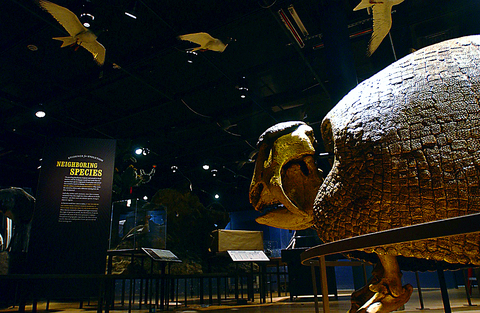
The exhibition will consist of more than 400 artifacts, specimens and documents, including at least 100 manuscripts on loan and other objects, 159 models fabricated by the museum's workshops, 74 specimens from the museum's
collections and nine live animals.
Referring to the museum's curatorial, research and academic faculty of 200 scientists, "the work of most of them is essentially based on Darwin's work," Novacek said. None of the staff members believe in intelligent design "or at least they haven't declared it," he said. "Nothing in biology makes sense except in the light of evolution." He added, "Some of the current reactions to Darwin's work are the same as they were when Origin was first published."
The exhibition mentions intelligent design not as science, or as a theory to be debated, but as a form of creationism, which offers the biblical view that God created the earth and its creatures fully formed within the last 10,000 years. In 1987 the Supreme Court ruled that creationism is a religious belief that cannot be taught in public schools. Novacek said that "we are welcoming everyone to the show," adding that "we will be prepared to respond to questions."
The show is the next in the museum's series on thinkers, explorers and scientists, following its exhibitions on Leonardo da Vinci and Albert Einstein. The Darwin exhibition has been assembled not only from the museum's collections but also from those of Cambridge University, the Darwin family and Down House, where the naturalist spent the last 40 years of his life.

The exhibition "has the crown jewels," Novacek said, referring to Darwin's original specimens, manuscripts and notes. "Many of these haven't been together since they were on the HMS Beagle," he said, referring to the 27m ship that carried Darwin on a voyage from 1831 to 1836 to South America and the Galapagos.
The show will offer an overview of human evolution through the rich fossil record. It will also demonstrate how Darwin's work gave rise to modern biology with displays on genomic research, DNA research and evidence of the latest scientific update of the taxonomic tree of life.
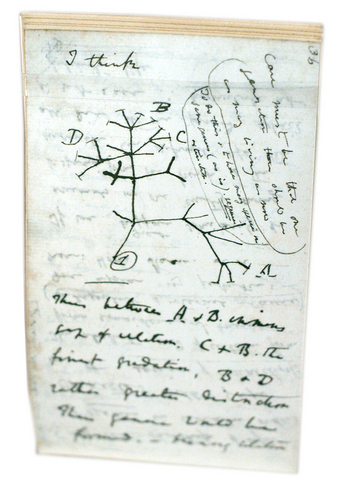
Also on view will be some of Darwin's most famous notebooks, written from 1837 to 1839, especially Page 36 in "Notebook B," where he famously sketched the world's first evolutionary tree of life. "That's the equivalent of seeing E = mc2 in Einstein's papers," Eldredge said.
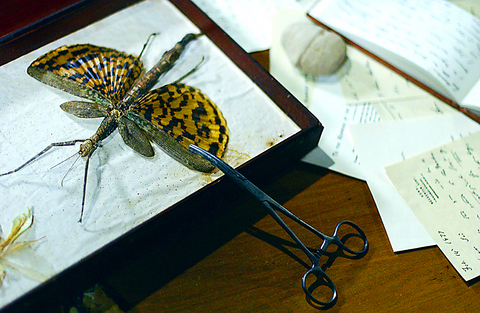
Also on display is the original text from "Notebook D" that shows the eureka moment when Darwin first described natural selection. From the Beagle voyage, the exhibition offers Darwin's original pistol, his telescope and his Bible. There are also 33 of the beetles, butterflies, moths and flies Darwin collected, and his rock hammer, used on geological excursions. The museum also offers a meticulous recreation of the room at Down House where he wrote Origin, presenting Darwin's original cane, work table and specimen boxes.
The significance of Darwin's ideas "has grown," Bloomfield said. "For example, at this moment we're looking at Asian bird flu and where it's going. If not for Darwinism, we would be ignorant of the mechanism of that flu, and how it changes over time."

Last week Joseph Nye, the well-known China scholar, wrote on the Australian Strategic Policy Institute’s website about how war over Taiwan might be averted. He noted that years ago he was on a team that met with then-president Chen Shui-bian (陳水扁), “whose previous ‘unofficial’ visit to the US had caused a crisis in which China fired missiles into the sea and the US deployed carriers off the coast of Taiwan.” Yes, that’s right, mighty Chen caused that crisis all by himself. Neither the US nor the People’s Republic of China (PRC) exercised any agency. Nye then nostalgically invoked the comical specter
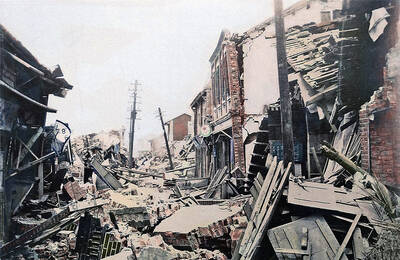
April 15 to April 21 Yang Kui (楊逵) was horrified as he drove past trucks, oxcarts and trolleys loaded with coffins on his way to Tuntzechiao (屯子腳), which he heard had been completely destroyed. The friend he came to check on was safe, but most residents were suffering in the town hit the hardest by the 7.1-magnitude Hsinchu-Taichung Earthquake on April 21, 1935. It remains the deadliest in Taiwan’s recorded history, claiming around 3,300 lives and injuring nearly 12,000. The disaster completely flattened roughly 18,000 houses and damaged countless more. The social activist and

Over the course of former President Ma Ying-jeou’s (馬英九) 11-day trip to China that included a meeting with Chinese Communist Party (CCP) leader Xi Jinping (習近平) a surprising number of people commented that the former president was now “irrelevant.” Upon reflection, it became apparent that these comments were coming from pro-Taiwan, pan-green supporters and they were expressing what they hoped was the case, rather than the reality. Ma’s ideology is so pro-China (read: deep blue) and controversial that many in his own Chinese Nationalist Party (KMT) hope he retires quickly, or at least refrains from speaking on some subjects. Regardless

Approaching her mid-30s, Xiong Yidan reckons that most of her friends are on to their second or even third babies. But Xiong has more than a dozen. There is Lucky, the street dog from Bangkok who jumped into a taxi with her and never left. There is Sophie and Ben, sibling geese, who honk from morning to night. Boop and Pan, both goats, are romantically involved. Dumpling the hedgehog enjoys a belly rub from time to time. The list goes on. Xiong nurtures her brood from her 8,000 square meter farm in Chiang Dao, a mountainous district in northern Thailand’s


 RSS
RSS