


A young Purepechan Indian woman stands on the sidewalk, watching the procession of cars pass by. A woven shawl draped around her shoulders, she holds a large bundle of long-stemmed, orange marigolds and waits to cross the street. The narrow cobblestone streets of Patzcuaro are clogged with traffic, carloads of Mexican nationals and tourists pouring into town for the Dia de los Muertos -- Day of the Dead -- observance. Finally, there is a break, and the woman winds her way through stalled vehicles honking their horns.
I follow in her path toward the town square. I have traveled to this colonial city, high in the Sierra Madre range, 178 miles southeast of Guadalajara, to witness the Day of the Dead festivities. While this holiday is observed all over Mexico, the city of Patzcuaro and the nearby island of Janitzio draw thousands of visitors each year from around the country and around the world.
This region of Mexico is a tourist destination throughout the year, because of the temperate climate, the preserved colonial-style towns, excavated pre-Hispanic ruins and its native handicrafts (textile arts, pottery, copper work and hewn wooden furniture).
Another attraction between November and February is the nesting grounds of the monarch butterfly, which migrate south from the US and Canada to spend each winter in the mountains of Michoacan, a few hours drive from Patzcuaro.
Dia de los Muertos, an ancient Aztec tradition to honor the dead, originally was held in midsummer. After the Spanish Conquest, Roman Catholic priests moved the date to Nov. 1 and Nov. 2 to coincide with All Hallow's Eve and the Feast of All Souls Day.
The holiday expresses the Aztec belief that death is not the end of life but a passage to another realm where the souls of the dead exist. To welcome the souls who will journey from their world to this one, people visit cemeteries and decorate graves with flowers, candles and candy in the shape of skulls and skeletons.
In Patzcuaro, vendors' booths border the perimeter of the Plaza Grande, and are teeming with orange marigolds, the traditional flower of the dead, which symbolize the cycle of life and death that embodies universal harmony. Buckets of yellow mums and gladioluses in lavender, peach and cream fill the sidewalk.
More flowers arrive by the truckload and are sold as quickly as the trucks are emptied. Tables overflow with miniature sugar skeletons and basketfuls of small, round loaves of bread imprinted with crosses and skull designs, to be offered to the dead or enjoyed by the living.
Outside the nearby village of Tzintzuntzan whose name in Purepecha means "the place of hummingbirds," cars line the shoulder of the narrow highway that divides the town cemetery into two sections. I enter into the main cemetery through an archway filled with thousands of marigolds.
Children play tag among the headstones while their families clean weeds from around the graves, which they then decorate with flowers and votive candles.
One little boy holds a miniature toy coffin with a string attached and shrieks with delight when he pulls on the string, and a skeleton pops up. The Purepechan woman from the town square, her shawl folded on the earth beside her, sits with three other women next to a grave, talking and laughing as they divide bundles of flowers into small bouquets. They seem oblivious to the tourists around them snapping photos and shooting videos.
By nightfall, the souls will have all the sustenance they need to replenish themselves after their long journey to the land of the living. The cemetery is littered with offerings for them: plates of rice, beans, enchiladas, tamales, tacos and loaves of pan de muertos. Bottles of Coca-Cola, beer and tequila balance on mounds of earth, while sugar skulls poise on headstones.
Plastic tarps the deep blue color of the Virgin of Guadalupe's mantel cover the ground for those who will spend the night singing, reminiscing and communicating with the dead through prayer. Families will be on the lookout for signs that the souls of the dead are with them: a strange shadow, a bottle tipping over for no reason, a whisper, or the feeling of being touched when there is no one near.
Back in Patzcuaro, explosions of fireworks splinter the shrouded sky. Nov. 1 is the Night of the Children, "Angelitos," and the fireworks open the skies, guiding the souls of the little angels back down to Earth.
Boys in costume dart through the crowd, carrying carved pumpkins with a candle lit inside. I assume they are trick-or-treating, and buy a bag of candy from a nearby store, but they look puzzled when I offer them a treat. Finally, I understand what they are saying. They don't want candy; they want coins to help their families defray some of the expense of preparing for this holiday. "Gracias," they murmur, as I give each child a few pesos.
On my way to the bus stop, I run into an artist I met on my last trip to Patzcuaro (I'd been there three times during a five-year stint living in Mexico). He invites me to join his friends in a ceremony in their neighboring village. I had planned on spending the night in the cemetery on the island of Janitzio along with hundreds of others, but I gratefully accept his invitation, and go to buy flowers to take as an offering.
The town square, which has been a sea of flowers and candy for days, is now barren except for a lone vendor standing over two bedraggled bunches of mums. "Dos pesos," about 30 cents, the vendor says. I snatch up the flowers, and hurry to catch a ride to the village.
Around midnight, a dozen people gather in a cozy adobe house to prepare for the ceremony, a blending of Aztec and Catholic traditions. They work in silence as they build an altar, light copal incense and sprinkle orange flower petals into the shape of a cross on the smooth stone floor. The mums I have brought are placed in an earthenware vase alongside the altar.
A thick black notebook is passed around for each person to write down the names of their loved ones who have died, names that will be spoken out loud during the ritual tonight, and in the years to come. Writing down the names of the people whom I've loved that have passed away, I realize that I've only given them an occasional thought over the years, usually on their birthday or on the anniversary of their death.
Listening to the ceremony, partly spoken, partly sung in Spanish and in some ancient tongue, I understand few of the words, but when the long list of names is read just before dawn, I recognize the names of my family and friends honored in prayer.
At that moment, I am no longer a casual observer of a sacred tradition; I have become a part of Dia de los Muertos. And the words I overheard spoken earlier that day by the Purepechan woman in the cemetery come back to me:
"When you love truly, the dead are never far from your heart."

Last week Joseph Nye, the well-known China scholar, wrote on the Australian Strategic Policy Institute’s website about how war over Taiwan might be averted. He noted that years ago he was on a team that met with then-president Chen Shui-bian (陳水扁), “whose previous ‘unofficial’ visit to the US had caused a crisis in which China fired missiles into the sea and the US deployed carriers off the coast of Taiwan.” Yes, that’s right, mighty Chen caused that crisis all by himself. Neither the US nor the People’s Republic of China (PRC) exercised any agency. Nye then nostalgically invoked the comical specter
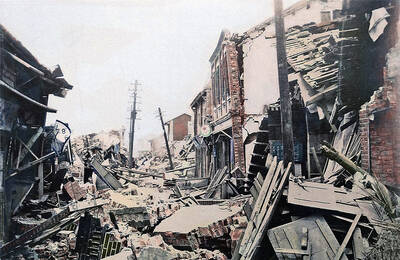
April 15 to April 21 Yang Kui (楊逵) was horrified as he drove past trucks, oxcarts and trolleys loaded with coffins on his way to Tuntzechiao (屯子腳), which he heard had been completely destroyed. The friend he came to check on was safe, but most residents were suffering in the town hit the hardest by the 7.1-magnitude Hsinchu-Taichung Earthquake on April 21, 1935. It remains the deadliest in Taiwan’s recorded history, claiming around 3,300 lives and injuring nearly 12,000. The disaster completely flattened roughly 18,000 houses and damaged countless more. The social activist and

Over the course of former President Ma Ying-jeou’s (馬英九) 11-day trip to China that included a meeting with Chinese Communist Party (CCP) leader Xi Jinping (習近平) a surprising number of people commented that the former president was now “irrelevant.” Upon reflection, it became apparent that these comments were coming from pro-Taiwan, pan-green supporters and they were expressing what they hoped was the case, rather than the reality. Ma’s ideology is so pro-China (read: deep blue) and controversial that many in his own Chinese Nationalist Party (KMT) hope he retires quickly, or at least refrains from speaking on some subjects. Regardless

Approaching her mid-30s, Xiong Yidan reckons that most of her friends are on to their second or even third babies. But Xiong has more than a dozen. There is Lucky, the street dog from Bangkok who jumped into a taxi with her and never left. There is Sophie and Ben, sibling geese, who honk from morning to night. Boop and Pan, both goats, are romantically involved. Dumpling the hedgehog enjoys a belly rub from time to time. The list goes on. Xiong nurtures her brood from her 8,000 square meter farm in Chiang Dao, a mountainous district in northern Thailand’s


 RSS
RSS