


Kang Kang (康康)
Don't Care Who You End Up With (管妳媽媽嫁給誰)
Sony
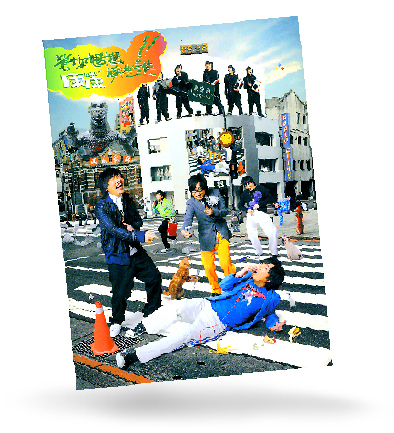
Love him or loath him, you have to hand it to foul-mouthed entertainer Kan Jin-rong (
Although better known for his crude humor rather than his musical prowess, Kang Kang has released a couple of albums over the past few years. Packed with cover versions of other people's tunes the records failed to capture the hearts and minds of the general public.
His latest album, however, is a far cry from his previous ventures and is, sad to say, pretty entertaining, albeit in a slightly unoriginal way. Sure it's not award-winning stuff, but there's something about the way Kang Kang mixes it up with everything from comedic and rudimentary hip-hop tunes to orchestrated piano driven ballads that work quite well.
Packed with an eclectic selection of sounds, Don't Care Who You End Up With (
The album opens with the Joy Topper-like Drain Your Glass (
Don't Care Who You End Up With is not without its highlights, however, and the album's title track on which Kang Kang mixes it up with a brass section and grinding nu-metal guitar makes for reasonably good listening.
Jay Chou (周杰倫)
November's Chopin (十一月的蕭邦)
Sony
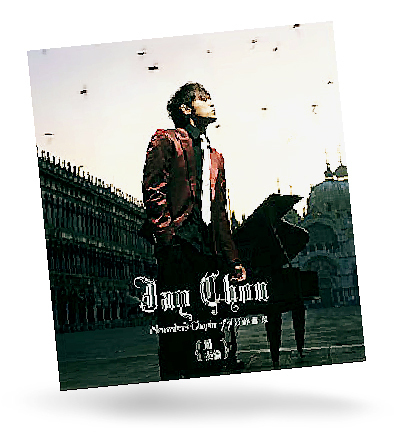
Released to great fanfare on Tuesday, Jay Chou's (周杰倫) sixth and latest album November's Chopin (十一月的蕭邦) looked destined to become number one throughout Asia even before its release. On-line music retail outlets and music stores alike were inundated with pre-order requests a month ago when news was first leaked of the album's pending release.
Named after the renowned composer for the simple reason that, according to Chou, his songs "tend to lean towards the works of Chopin [rather] than Liszt," the album features 10 new tunes, a handful of previously released bonus tracks and, as is now the norm, a couple of music videos.
For the most part the album sees Taiwan's favorite musical son veering away from his tried-and-tested Mando-hip-hop format and is instead wooing fans with moody piano- and guitar-based ballads.
And it is these ballads that prove the highlights of the album. Here listeners get to hear Chou at his previously seldom heard best. One such tune is Nocturne (夜曲) on which Chou's vocalizes over a backdrop of easy-going guitar on a soulful number about the death of a girlfriend.
In addition to the moving ballads Chou still takes his time to croon his way through a couple of up-tempo classic Mando-pop melodies. These are, needless to say, pretty much on a par with the material that propelled Chou to superstardom four years ago and if you like Chou you'll like these.
While the crux of November Chopin may not be quite what the hordes of teenage girls who swoon whenever Chou appears on TV like, for the rest of us, who are either a little to old or too cynical to enjoy Mando-pop, Chou's latest album could be considered a breakthrough and one that should earn the already popular star even more fans.
La Petite Nurse (小護士樂團)
Pubescent Legumes (青春豆)
Rock
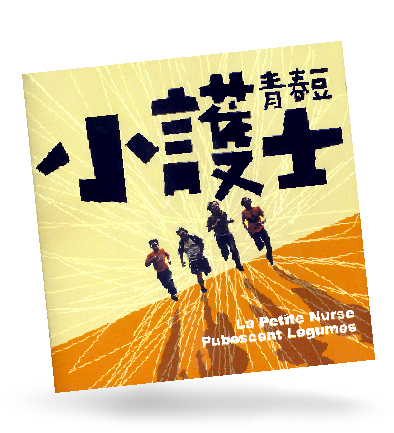
La Petite Nurse (
Unlike many of its peers, La Petite Nurse doesn't follow the over-played format of power pop and rock. Its music is hard to categorize. The band is able to switch and swap from Coldplay-like downbeat numbers to up-beat and typical Taiwan indie scene noise without either missing a beat or sounding stupid.
This ability is markedly noticeable on the band's recently released debut, Pubescent Legumes (青春豆) on which the four-piece perform a mixed bag of tunes.
While there's nothing wrong with the band's more rock/pop oriented tunes oriented such as the Oasis-like opener Into The Sun, the power pop tune Smash the TV (摔電視), the jerky rock anthem Spice Girl (辣妹) and the great alt-pop/blues inspired number Mad Mask (
Downbeat and Coldplay-like tunes such as Die For You, White Lie (
Bobby Chen (陳昇)
Fish Says (魚說)
Rock
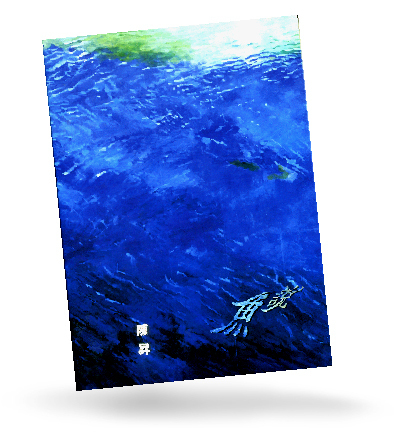
The bad boy of Taiwanese pop/rock returns with a new album this month entitled Fish Says (
Instead of sing-a-long anthems and heavy rock riffs Chen's Fish Says is a melancholy affair that sees the popular singer tackling material of an easy listening nature.
Slow ballads, folksy guitar, orchestrated moments and traces of world music all combine to give Fish Says an appeal that is so often lacking from Chen's less personal and more commercial releases.
After a couple of iffy openers the album's title track cuts in like a breath of fresh air. Fish Says sees Chen doing his utmost to sound like any one of a dozen indie-folk crooners, but instead of coming off the worse for the experience Chen is on top form. He can't quite hit all the high notes, but the tune's uplifting beats compensates for his rather off key vocals.
Other tunes of note include the offbeat, yet interesting tango-influenced 1989, the mild rock/blues-like London's Disabled Spaces (倫敦廢人區) and the wistful, piano driven Dream River (夢河).
The bottom line is that Fish Says might not be what one would expect from the hard drinking, hard playing and aging womanizing pop star, but Chen's pensive musical mood pays dividends on what is, in the end, a pleasing album.

Last week Joseph Nye, the well-known China scholar, wrote on the Australian Strategic Policy Institute’s website about how war over Taiwan might be averted. He noted that years ago he was on a team that met with then-president Chen Shui-bian (陳水扁), “whose previous ‘unofficial’ visit to the US had caused a crisis in which China fired missiles into the sea and the US deployed carriers off the coast of Taiwan.” Yes, that’s right, mighty Chen caused that crisis all by himself. Neither the US nor the People’s Republic of China (PRC) exercised any agency. Nye then nostalgically invoked the comical specter

April 15 to April 21 Yang Kui (楊逵) was horrified as he drove past trucks, oxcarts and trolleys loaded with coffins on his way to Tuntzechiao (屯子腳), which he heard had been completely destroyed. The friend he came to check on was safe, but most residents were suffering in the town hit the hardest by the 7.1-magnitude Hsinchu-Taichung Earthquake on April 21, 1935. It remains the deadliest in Taiwan’s recorded history, claiming around 3,300 lives and injuring nearly 12,000. The disaster completely flattened roughly 18,000 houses and damaged countless more. The social activist and

Over the course of former President Ma Ying-jeou’s (馬英九) 11-day trip to China that included a meeting with Chinese Communist Party (CCP) leader Xi Jinping (習近平) a surprising number of people commented that the former president was now “irrelevant.” Upon reflection, it became apparent that these comments were coming from pro-Taiwan, pan-green supporters and they were expressing what they hoped was the case, rather than the reality. Ma’s ideology is so pro-China (read: deep blue) and controversial that many in his own Chinese Nationalist Party (KMT) hope he retires quickly, or at least refrains from speaking on some subjects. Regardless

Approaching her mid-30s, Xiong Yidan reckons that most of her friends are on to their second or even third babies. But Xiong has more than a dozen. There is Lucky, the street dog from Bangkok who jumped into a taxi with her and never left. There is Sophie and Ben, sibling geese, who honk from morning to night. Boop and Pan, both goats, are romantically involved. Dumpling the hedgehog enjoys a belly rub from time to time. The list goes on. Xiong nurtures her brood from her 8,000 square meter farm in Chiang Dao, a mountainous district in northern Thailand’s


 RSS
RSS