


The only ones left are the information desk workers and a few contractors renovating the aging buildings, stately domiciles with a story to tell, even as they sit silent and empty. Kinmen's Shuitou village (
Shuitou is one of several towns from which Chinese emigrated to other parts of Asia and the US in the first half of the 19th century. They went as migrant workers and merchants and left from Guangdong and Fujian provinces, as well as from this small island off China's east coast, to become one of history's most successful diasporas.
"Chinese began traveling a long long time ago," said Lee Hsi-rong (
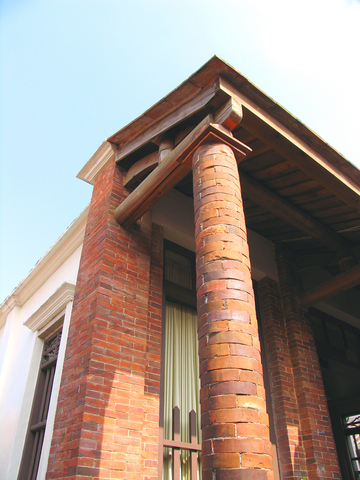
PHOTO: DAVID MOMPHARD, TAIPEI TIMES
At first, the government of the Qing dynasty -- which administered Kinmen as a part of Fujian province -- forbade its citizens to venture abroad. But overpopulation, a limited amount of farmland and frequent natural disasters and wars allowed residents of Guangdong and Fujian provinces to leave their homelands unchecked by the law.
Even as young men left in the thousands, others stayed behind and lobbied the Qing government to lift its restrictions on emigration. In 1860, with the signing of the Beijing Treaty, emigration was legalized and workers set off in even greater numbers in search of better job opportunities.
At the time, Western governments were actively seeking laborers from Southeast Asia. Chinese laborers volunteered their services abroad, but were often encouraged to do so by tales of places paved with gold.
Initially, they were indentured laborers who worked in appalling conditions and there was a greater chance among immigrant workers of dying than of returning home rich. But as they toiled, their conditions improved and overseas communities developed.
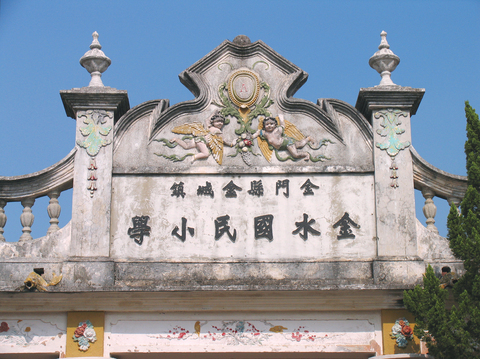
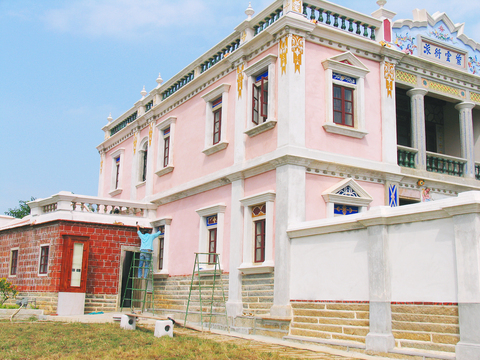
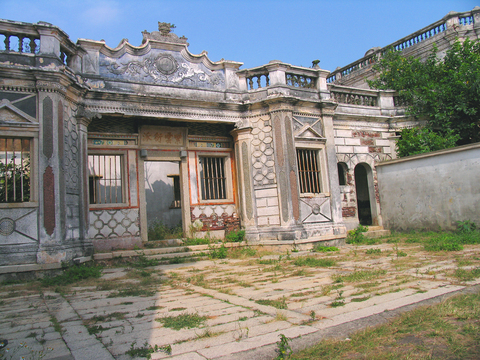
The effects of this desire to become rich is nowhere more apparent than in Shuitou, with its rows of grand villas that reflect the architectural styles of the places to which its residents aspired: bungalow-styled homes reminiscent of those found in Great Britain's Southeast Asian colonies and an elementary school that echoes traditional Indian architecture
For the residents of Shuitou, emigration occurred in three waves. The first was around 1860, when people fled the many natural disasters that left them impoverished. The second was from 1912 to 1929, when Southeast Asian colonies were becoming prosperous and Kinmen merchants expanded their businesses to the region. The last came in 1937 to 1945, when locals tried to escape the ravages of the Sino-Japanese War.
Traveling first to Xiamen, emigrants would board ships that sailed for five to seven days to Singapore, before departing for the Malay peninsula, Vietnam, Indonesia and further afield.
Many Kinmen residents went to places in Southeast Asia where they already had friends or relatives. As a result, these places developed into Chinese enclaves, many of which remain today.
In Singapore, for example, the Kinmen Guild (
Most immigrants would remit their savings back to their hometowns.
The amount remitted grew substantially after the Qing government legalized emigration and reached a peak during the Sino-Japanese War.
During World War II, however, Japan occupied much of Southeast Asia and remittances ceased. Stability did not come for Kinmen with the ending of the war and emigrants ceased to send their savings back their hometowns.
The whole point of the remittances, of course, was to allow the immigrants the chance to eventually return home to a comfortable retirement. Overseas Chinese sent letters with money drafts through a private postal agency called minhsinchu (
The minhsinchu not only delivered remittances, it helped spread the success stories of thousands of overseas Chinese and develop the dream of getting rich by going abroad. Nothing did more to inspire the emigration dream than the houses former immigrants built in their hometowns.
But the influence of emigration was felt in other ways when the merchants and laborers returned home. Besides a change in architectural styles, habits changed as well. This is when the first outhouses were built and other improvements in sanitation were made.
Clothing, much changed from the days of the Qing dynasty, became the Western suits merchants had worn abroad. Even the language changed. To this day, residents of Kinmen use the Malay word reun to mean "money."
The influence of emigration was felt in
education, too. Chinese who returned from overseas helped establish schools where their children would prepare to go abroad themselves by studying business and languages. In 1929, there were 25 elementary schools in Kinmen. By 1947, there were 53, built mostly with money remitted by communities of overseas workers and businessmen.
"The people of Kinmen are still emigrating," Lee said. "The sad difference is that they're not as concerned as their ancestors were about coming home."
How to get there:
Kinmen's Shuitou village is located on the southwest corner of Kinmen Island.
Accommodation:
If traveling to Shuitou Village, an interesting and comfortable choice of accommodations are the traditional Chinese courtyard-style houses that have been converted to bed and breakfast inns. Visit www.familyinn.idv.tw for more information, or call (082) 322 389.
Airlines:
Far Eastern Airline (082) 327 339, Transasia (082) 321 1501, Uni Airline (082) 324 481.
Tour buses:
Da Fu (082) 324 491, Nan Xing (082) 322 459. Kinmen Tourist Department: (082) 324 174 or http://tour.kinmen.gov.tw

Last week Joseph Nye, the well-known China scholar, wrote on the Australian Strategic Policy Institute’s website about how war over Taiwan might be averted. He noted that years ago he was on a team that met with then-president Chen Shui-bian (陳水扁), “whose previous ‘unofficial’ visit to the US had caused a crisis in which China fired missiles into the sea and the US deployed carriers off the coast of Taiwan.” Yes, that’s right, mighty Chen caused that crisis all by himself. Neither the US nor the People’s Republic of China (PRC) exercised any agency. Nye then nostalgically invoked the comical specter
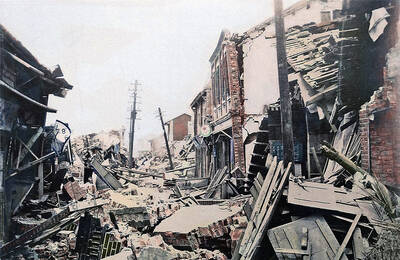
April 15 to April 21 Yang Kui (楊逵) was horrified as he drove past trucks, oxcarts and trolleys loaded with coffins on his way to Tuntzechiao (屯子腳), which he heard had been completely destroyed. The friend he came to check on was safe, but most residents were suffering in the town hit the hardest by the 7.1-magnitude Hsinchu-Taichung Earthquake on April 21, 1935. It remains the deadliest in Taiwan’s recorded history, claiming around 3,300 lives and injuring nearly 12,000. The disaster completely flattened roughly 18,000 houses and damaged countless more. The social activist and

Over the course of former President Ma Ying-jeou’s (馬英九) 11-day trip to China that included a meeting with Chinese Communist Party (CCP) leader Xi Jinping (習近平) a surprising number of people commented that the former president was now “irrelevant.” Upon reflection, it became apparent that these comments were coming from pro-Taiwan, pan-green supporters and they were expressing what they hoped was the case, rather than the reality. Ma’s ideology is so pro-China (read: deep blue) and controversial that many in his own Chinese Nationalist Party (KMT) hope he retires quickly, or at least refrains from speaking on some subjects. Regardless

Approaching her mid-30s, Xiong Yidan reckons that most of her friends are on to their second or even third babies. But Xiong has more than a dozen. There is Lucky, the street dog from Bangkok who jumped into a taxi with her and never left. There is Sophie and Ben, sibling geese, who honk from morning to night. Boop and Pan, both goats, are romantically involved. Dumpling the hedgehog enjoys a belly rub from time to time. The list goes on. Xiong nurtures her brood from her 8,000 square meter farm in Chiang Dao, a mountainous district in northern Thailand’s


 RSS
RSS