


History hands out its titles and Omara Portuondo was given the sobriquet "Cuba's Edith Piaf" after becoming the voice of her country and a generation. An innovative and stylish interpreter of a variety of musical styles, her career peaked artistically in the 1950s and 1960s but the album and 1999 documentary Buena Vista Social Club brought belated worldwide fame.
Like Wim Wenders' postcard-perfect film, Portuondo encapsulates a faded but romantic image of Cuba that is spirited, independent, passionate, impossibly romantic yet tinged with sadness. A performer for 60 years, she said in an e-mail interview translated from Spanish that her earliest musical influences in Havana, where she was born, were parental.
"They used to sing a lot at home and those songs were the first I ever listened to, for instance: La Bayamesa from Ernesto Grenet y Sindo Garay, or Veinte Anos from Maria Teresa Vera." Jazz kings like Nat King Cole and the Glenn Miller Orchestra also inspired her to start singing, she said, first at friends' homes and small clubs, then as part of a succession of groups, notably the female vocal quartet, Cuartet D'Aida, with her sister. She entered the world of show business in the chorus line at El Tropicana.
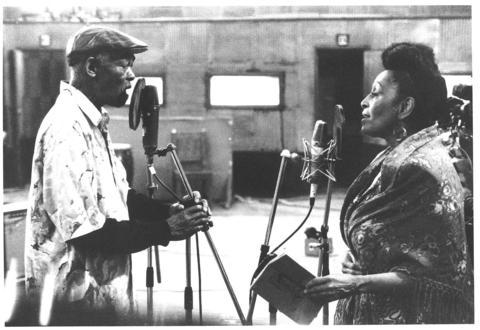
"They were looking for a dancer because one of them could not participate at the premiere. And because I went to all the rehearsals, I was the only one who could help them out. At first, I refused the offer as I was very shy and the idea of showing my legs dancing was not very pleasing to me. Imagine, I was only 15 years old. But my mother told me that I should do it, because that way I could help other people. So that is how I started in this world."
She made a name for herself singing in the "vieja trova" style of the 1920s and 1930s, covered the dance standards of the 1940s and was known for being the definitive interpreter of "filin" [feeling], a Cuban-jazz sound and bolero, "a ballad with a little black beans on the side."
Today, she is as active ever despite her advanced years and her country's political isolation since the Cuban missile crisis in 1961 (she used to perform in the US with her sister, who stayed). She is still touring the world and producing albums, such as last year's Flor de Amor.
"I think that it is my most personal album with songs that go straight to the heart. Probably a reason for this has been the inclusion of other influences. Different cultures always enrich one's own and Flor de Amor has the fine mix of our culture and Brazil ... Finishing the project and now touring with a symphony orchestra is like a dream come true. This is something I have always wanted to do and next year we will start a world tour."
As for the comparison with the talented and totemic Edith Piaf, Portuondo accepts the compliment with grace but points out she did duet with the French icon and has had other nicknames over the years.
"For me Edith Piaf was a great star, a very complete artist and being compared with her makes me feel very proud. It was a long time ago when my sister, Haydee, and I used to meet some friends every weekend: Cesar Portillo de la Luz, Jose Antonio Mendez and the pianist Frank Emilio Flynn. We were called the Loquibamba Swing and we played at that time what we started to call `Feeling.' We made American jazz standards but with a Cuban touch and influenced by bossa nova too. Once in a radio program, the journalist started calling me the `Feeling girlfriend' and from that moment I have kept the nickname. Also `Omara Brown.'"
Like many musicians, however, Portuondo has had her trials and after the first flush of Communist revolution she was farmed out cultural revolution-style to sing in the fields and inspire the workers. She toured as an international musical ambassador during the 1970s, but in the late 1980s she practically "retired" and only became known to the world once more a decade later through the work of Ry Cooder. Her solo album, The Buena Vista Social Club Presents Omara Portuondo, released in 2000,confirmed her status as a jazz legend.
"It was very interesting to work with Ry Cooder. [He] knows Cuban music very well, he is a studious man and he works with great respect. It's for this reason that the music for Buena Vista Social Club keeps the original roots and passion of the original composers."
"Our music in this recording was original, nothing was changed. With this work Ry spread out our music internationally, so everybody could enjoy it. Wenders' film picked up what that moment was, the reunion and the recording, and we all know that cinema is a very important diffusion source."
As for her life in Cuba today, Portuondo said, "I am a very calm person but I like having an active life. In Havana I drive my own car and I always have things to do. I like sharing things with my friends and spend a lot of time with family, with my son, his wife and my beautiful grand-daughter. I love swimming and of course I do all of these things once I come back from my tours.
"Touring makes me feel very active and fills me with a great desire for life. I cannot wait to be in Taiwan and feel the audiences' warmth. We have a very complete show and great musicians, and we will all give our best."
Portuondo will be playing two nights at the Sun Yat-sen Memorial Hall, beginning tonight, and has brought over long-time band members and the Buena Vista Club artists' musical director. When Portuondo sings she lifts a song above the level of genres and makes it personal, a beautifully crafted piece of musical poetry. Technically gifted, with great timing, presence and personality, she is at her best live according to critics, among them the reporter from the San Francisco Chronicle who dubbed her Cuba's Edith Piaf.
Finally, this could be a last chance to see the musical legend and it should be remembered that Ibraham Ferrer -- who can forget his tear-jerking duet Silencio with Portuondo in Buena Vista Social Club? -- died aged 78 in August. Da Da Arts, has been negotiating for five years to bring Portuondo over and her concerts should be special occasions, especially on Saturday when her 75th birthday will be celebrated.

Last week Joseph Nye, the well-known China scholar, wrote on the Australian Strategic Policy Institute’s website about how war over Taiwan might be averted. He noted that years ago he was on a team that met with then-president Chen Shui-bian (陳水扁), “whose previous ‘unofficial’ visit to the US had caused a crisis in which China fired missiles into the sea and the US deployed carriers off the coast of Taiwan.” Yes, that’s right, mighty Chen caused that crisis all by himself. Neither the US nor the People’s Republic of China (PRC) exercised any agency. Nye then nostalgically invoked the comical specter
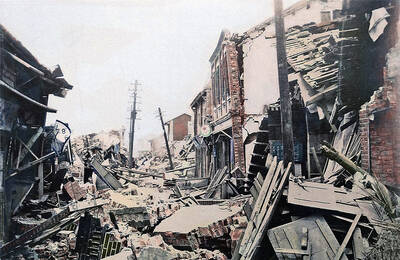
April 15 to April 21 Yang Kui (楊逵) was horrified as he drove past trucks, oxcarts and trolleys loaded with coffins on his way to Tuntzechiao (屯子腳), which he heard had been completely destroyed. The friend he came to check on was safe, but most residents were suffering in the town hit the hardest by the 7.1-magnitude Hsinchu-Taichung Earthquake on April 21, 1935. It remains the deadliest in Taiwan’s recorded history, claiming around 3,300 lives and injuring nearly 12,000. The disaster completely flattened roughly 18,000 houses and damaged countless more. The social activist and

Over the course of former President Ma Ying-jeou’s (馬英九) 11-day trip to China that included a meeting with Chinese Communist Party (CCP) leader Xi Jinping (習近平) a surprising number of people commented that the former president was now “irrelevant.” Upon reflection, it became apparent that these comments were coming from pro-Taiwan, pan-green supporters and they were expressing what they hoped was the case, rather than the reality. Ma’s ideology is so pro-China (read: deep blue) and controversial that many in his own Chinese Nationalist Party (KMT) hope he retires quickly, or at least refrains from speaking on some subjects. Regardless

Approaching her mid-30s, Xiong Yidan reckons that most of her friends are on to their second or even third babies. But Xiong has more than a dozen. There is Lucky, the street dog from Bangkok who jumped into a taxi with her and never left. There is Sophie and Ben, sibling geese, who honk from morning to night. Boop and Pan, both goats, are romantically involved. Dumpling the hedgehog enjoys a belly rub from time to time. The list goes on. Xiong nurtures her brood from her 8,000 square meter farm in Chiang Dao, a mountainous district in northern Thailand’s


 RSS
RSS