


A small, pothole-laden city in the central valley of the Dominican Republic, anchored by a concrete-pillared, irregularly shaped cathedral whose decidedly ugly look takes some time to grow on you, La Vega isn't high on the to-do list of most travelers. There are no beaches, a few tolerable hotels, some unremarkable restaurants and, for 11 months of the year, no real reason to go there. But that changes in February, when Carnaval comes to town.
Then, the quiet streets of La Vega are crowded with visitors who seem to double the population of 200,000, the clubs fill with deafening music that keeps their customers dancing until almost dawn, and -- most notably -- grotesquely beautiful, intricately decorated, jingle-bell-draped demons race through the streets of the jam-packed town every Sunday, whipping anyone who dares to get in their way with reinforced cow bladders that carry a surprisingly nasty sting.
It is a month peppered with street concerts that attract the country's big music stars; of weeks spent with family members who have returned home to relive the traditions of their childhood; of days and nights filled with music -- the blaring brass of merengue, the tinny guitar of bachata, both played at absurdly high volumes on huge portable speakers -- that acts as a kind of nonstop soundtrack to the surreal events that unfold as Carnaval gathers steam.
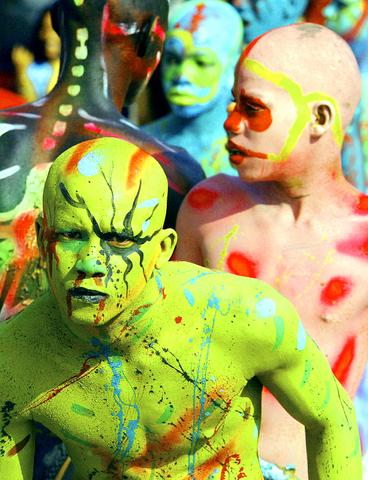
Carnaval takes place on each weekend of February, with parades on Sundays, culminating with the largest one, on Feb. 27, Dominican Independence Day. Many Dominican cities and towns have their own Carnaval traditions, usually with some demonic or outrageous character as its symbol and centerpiece. But none rivals that of La Vega, and, in fact, many other cities send representatives there on the 27th to march alongside that town's famed diablos cojuelos -- horned, fanged, winged creatures whose outfits are created in ramshackle workshops by people who have been honing this skill for years.
The legendary Dominican singer Fernandito Villalona summed up the experience in a Spanish-language merengue that you'll hear repeatedly if you go to La Vega: "When February comes, everything is happiness, Dance in the street by night, dance in the street by day."
The word carnival is said to come from the Latin "carne vale," a farewell to meat, which explains why it was traditionally celebrated in the three days before Lent, ending with Fat Tuesday, or Mardi Gras, festivities preceding Ash Wednesday. But in the Dominican Republic it has become more closely associated with Independence Day. In La Vega, Carnaval is a decidedly multigenerational event.
While local partygoers in their teens and 20s rule the streets and the clubs -- witness the beer-swilling, high-decibel gathering Friday night at the Parque de los Estudiantes, a pocket park at a busy intersection -- their parents and grandparents are equally enthusiastic participants in the celebrations. During my visit last February, on the final weekend of the celebrations, one of the best dancers around was Lisa Fernanda Tapia, shaking her hips as she stood on the outskirts of a huge street party late into a Saturday night. The next day, she turned four.
At over US$1,000 a costume for the Carnival, several months' salary for most, the designs of the elite teams are highly guarded, and in recent years have grown increasingly complex and creative and, alas, often sponsored by corporations. Living in a largely Dominican neighborhood in New York, I had heard a lot about the workmanship that went into these costumes and seen many examples of them at various festivals and at community centers. But to see their humble origins was a shock.
Many of the Carnaval costume-making teams -- groups with names like the Broncos, the Buddies, the Ants and the Scorpions -- set up cuevas, or caves, which serve as gathering places for their friends, staging grounds for the parade on Sunday and ground zero for the after-party.
Outside their cueva, available to the public, the Rebels had created what may be the first machine in history to measure how hard you can swing a dried bladder. The test-of-strength gadget, called a vejigometro, or bladder-meter, looks like a cannon. Wind up and bash the back end with your handy cow-bladder whip, and out flies a ball. The farther it goes, the stronger you are. Or, put another way, the more pain you would have inflicted on somebody's rear end.
I stuck around the Rebels' cave as the parade route began to fill the streets for the Saturday evening festivities. And, in the Dominican Republic, festivity means loud music. By 10pm, a nearly full moon had risen behind a stage that would later feature live bands, and conversation was possible only by direct mouth-to-eardrum shouting.
All around me, people were dancing to reggaeton hits like Daddy Yankee's Gasolina, which in February was reaching its apogee. Sunday morning broke and I took off to wander the streets and scout out the best spot to watch the afternoon parade. Signs of preparation were everywhere. Off Parque las Palmas, a square park blocked off by "Do Not Enter" signs that everyone was ignoring, a teenage boy set up blocks of ice and bottles of syrup for frio-frios, the local snow cone.
By early afternoon, the streets were packed: sellers of Munchkin Land-like lollipops lugged their wares through the crowd, people sucked ice-cold passion-fruit juice through straws, and among those carving out dance spaces in this mass of humanity was a little girl in a frilly pink dress dancing with a costumed penguin. The best viewing spots were anywhere with barriers separating the street from the crowd, because as the day went on, the crowd elsewhere surged out little by little, occasionally nearly blocking the procession until a few demonic whips got cracking.
It was not a place for the claustrophobic. I could hear the somewhat disorderly parade before I could see it, as cheers rose from the crowd down the street as groups of dancing diablos appeared. Those residents who had taken to rooftops or perched in trees were the first to see the marchers, swinging their vejigas as they swept down the street in somewhat disorderly fashion, eliciting shouts of delight from the crowd. Some teams had stunning costumes, ranging from royal blue and gold to neon green to a rather startling orange.
Other traditional (and nutty) Carnaval characters also made an appearance, like Robalagallina, which means "steal the hen" and generally is a man dressed as an ample woman, usually, for some reason, with rollers in her hair and holding an umbrella. La Vega's elaborately costumed diablos are, deservedly, the central attraction.
With their deeply grooved faces, jutting demonic eyes (usually red), outsize fangs and brilliant colors, they are irresistible -- and for many local children, irresistibly scary. The vejigazos, or bladder attacks, don't help, and many children in the Dominican Republic grow up with a kind of love-fear relationship to Carnaval.
In recent years, the Carnaval authorities have tried to restrict the whipping: only on the street, and only on the behind. Many of the visitors dispersed after the parade ended, but for those who stayed, the party had just begun. Freed from their marching orders, devils roamed the streets, doling out freelance vejigazos, and kids whose parents bought them vejigas from vendors joined in.
Hearing that I had remained largely unscathed from the vejigazos, one diablo reared back and took a massive swing. The next day, as I settled into my seat on the airplane I realized I was leaving La Vega with a black-and-blue souvenir of the place.
ON YOUR WAY TO SANTO DOMINGO:
Taipei to Tokyo to New York (with overnight stays at your own expense) is the way to the Dominican Republic's capital of Santo Domingo. This costs NT$49,800, for five days to three months, through T-Link Travel Service. Call (02) 2562 9335 or ctlink@ms43.hinet.net. Renting a car is advisable. You can use one of the many ATM's in La Vega to get pesos.

Last week Joseph Nye, the well-known China scholar, wrote on the Australian Strategic Policy Institute’s website about how war over Taiwan might be averted. He noted that years ago he was on a team that met with then-president Chen Shui-bian (陳水扁), “whose previous ‘unofficial’ visit to the US had caused a crisis in which China fired missiles into the sea and the US deployed carriers off the coast of Taiwan.” Yes, that’s right, mighty Chen caused that crisis all by himself. Neither the US nor the People’s Republic of China (PRC) exercised any agency. Nye then nostalgically invoked the comical specter
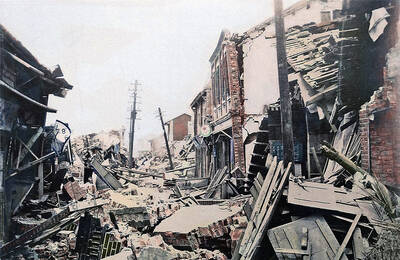
April 15 to April 21 Yang Kui (楊逵) was horrified as he drove past trucks, oxcarts and trolleys loaded with coffins on his way to Tuntzechiao (屯子腳), which he heard had been completely destroyed. The friend he came to check on was safe, but most residents were suffering in the town hit the hardest by the 7.1-magnitude Hsinchu-Taichung Earthquake on April 21, 1935. It remains the deadliest in Taiwan’s recorded history, claiming around 3,300 lives and injuring nearly 12,000. The disaster completely flattened roughly 18,000 houses and damaged countless more. The social activist and

Over the course of former President Ma Ying-jeou’s (馬英九) 11-day trip to China that included a meeting with Chinese Communist Party (CCP) leader Xi Jinping (習近平) a surprising number of people commented that the former president was now “irrelevant.” Upon reflection, it became apparent that these comments were coming from pro-Taiwan, pan-green supporters and they were expressing what they hoped was the case, rather than the reality. Ma’s ideology is so pro-China (read: deep blue) and controversial that many in his own Chinese Nationalist Party (KMT) hope he retires quickly, or at least refrains from speaking on some subjects. Regardless

Approaching her mid-30s, Xiong Yidan reckons that most of her friends are on to their second or even third babies. But Xiong has more than a dozen. There is Lucky, the street dog from Bangkok who jumped into a taxi with her and never left. There is Sophie and Ben, sibling geese, who honk from morning to night. Boop and Pan, both goats, are romantically involved. Dumpling the hedgehog enjoys a belly rub from time to time. The list goes on. Xiong nurtures her brood from her 8,000 square meter farm in Chiang Dao, a mountainous district in northern Thailand’s


 RSS
RSS