


Call it the diaper-free revolution or too much too soon but a growing number of parents in the United States are trying to wean their infants off diapers even before they can walk.
The parents say it is common in other cultures and cite a number of advantages. No more diaper rash, no more money spent on expensive diapers and no more overflowing, foul-smelling trash bins.
Melinda Rothstein, mother of seven-month-old Hannah and three-year-old Samuel, said her concerns about adding yet more man-made rubbish to the world's landfills helped persuade her to adopt "elimination communication" with her daughter.

PHOTO: AP
"I was concerned about the environment," Rothstein said in a telephone interview.
"The savings are a big plus, but mostly it's about having a close relationship with the kid," she said.
Rothstein, who has founded the non-profit association DiaperFreeBaby.org to spread the word, said the technique encourages her daughter to convey her needs.
Soon after giving birth to Hannah, Rothstein showed her how to use the potty seat. For the first three months, Rothstein put cloth diapers on her daughter while looking for the right moments to place Hannah on the potty.
Making a small "pssss" sound, parents encourage the child to urinate. And with a little grunt, they try to stimulate a bowel movement.
According to diaper-free advocates, the best opportunity presents itself after a baby wakes in the morning or after a nap and a few minutes after nursing or feeding.
After a while, the parents begin to recognize and mimic the telltale signs of an imminent event. At about six or seven months, the baby learns to take a seat and to signal her requirements to Mom or Dad.
"Now she lets me know when she needs to go, occasionally she uses sign language or when she's in a sling she pushes me away," Rothstein said.
The fledgling diaper-free movement still has only a small following and runs counter to prevailing attitudes in a country where it is not unusual to see four-year-old children in diapers playing in the park.
The conventional wisdom on toilet training has advised caution, letting things take their course.
According to the writings of the late Benjamin Spock, whose baby books have served as a kind of Bible for many US parents since the 1940s, early toilet training can eventually backfire.
"During the first year there is a small amount of readiness for partial training in some babies in the sense that they always have their first movement of the day within five or ten minutes after breakfast," the pediatrician wrote in his best-selling book, Dr. Spock's Baby and Child Care.
Although parents can place the baby on the potty seat to "catch" the bowel movement, it does not add up to genuine toilet training because the infant has merely been conditioned to respond to the toilet underneath, he said.
"This is a small degree of training, but it's not learning because the baby is not really conscious of the bowel movement or of what she herself is doing," Spock wrote.
"She's not cooperating knowingly. And some babies who have been `caught' early in this way are more apt to rebel later through prolonged soiling or bed-wetting."
Jean-Claude Liaudet, a French psychoanalyst, agrees.
"Toilet training must be carried out when an infant has acquired sufficient muscular control, and not at a pre-established age and under constraints," Liaudet wrote.
Yet Rothstein and other proponents say that early toilet training, far from representing a return to the rigid ways of an earlier age, is a way of adapting to an infant's rhythms.
"Elimination communication should always be gentle, non-coercive, and based on babies' interests and needs," according to the DiaperFreeBaby website.
Some skeptics question if it's realistic to promote the idea when so many working parents lack the time required to monitor every toilet opportunity. And others, such as Emmy Kelly of Des Moines, Iowa, wonder whether it has much to do with the child in the end.
"What your article describes isn't toilet training ... ," Kelly wrote in a letter to the New York Times. "It's parent training!"

Last week Joseph Nye, the well-known China scholar, wrote on the Australian Strategic Policy Institute’s website about how war over Taiwan might be averted. He noted that years ago he was on a team that met with then-president Chen Shui-bian (陳水扁), “whose previous ‘unofficial’ visit to the US had caused a crisis in which China fired missiles into the sea and the US deployed carriers off the coast of Taiwan.” Yes, that’s right, mighty Chen caused that crisis all by himself. Neither the US nor the People’s Republic of China (PRC) exercised any agency. Nye then nostalgically invoked the comical specter
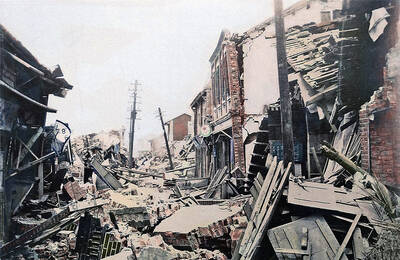
April 15 to April 21 Yang Kui (楊逵) was horrified as he drove past trucks, oxcarts and trolleys loaded with coffins on his way to Tuntzechiao (屯子腳), which he heard had been completely destroyed. The friend he came to check on was safe, but most residents were suffering in the town hit the hardest by the 7.1-magnitude Hsinchu-Taichung Earthquake on April 21, 1935. It remains the deadliest in Taiwan’s recorded history, claiming around 3,300 lives and injuring nearly 12,000. The disaster completely flattened roughly 18,000 houses and damaged countless more. The social activist and

Over the course of former President Ma Ying-jeou’s (馬英九) 11-day trip to China that included a meeting with Chinese Communist Party (CCP) leader Xi Jinping (習近平) a surprising number of people commented that the former president was now “irrelevant.” Upon reflection, it became apparent that these comments were coming from pro-Taiwan, pan-green supporters and they were expressing what they hoped was the case, rather than the reality. Ma’s ideology is so pro-China (read: deep blue) and controversial that many in his own Chinese Nationalist Party (KMT) hope he retires quickly, or at least refrains from speaking on some subjects. Regardless

Approaching her mid-30s, Xiong Yidan reckons that most of her friends are on to their second or even third babies. But Xiong has more than a dozen. There is Lucky, the street dog from Bangkok who jumped into a taxi with her and never left. There is Sophie and Ben, sibling geese, who honk from morning to night. Boop and Pan, both goats, are romantically involved. Dumpling the hedgehog enjoys a belly rub from time to time. The list goes on. Xiong nurtures her brood from her 8,000 square meter farm in Chiang Dao, a mountainous district in northern Thailand’s


 RSS
RSS