


A lexander Lervik, a Swede, knows about the gloom of long dark winters. So, as a designer striving to bring light to dim spaces, he has come up with illuminated versions of products that never glowed before: a door handle fitted with a light-emitting diode, or LED, that shines bright red when the door is locked, and an illuminated children's swing.
For Lervik, light "changes the identity of a product and gives you more to work with, more expression."
He is not alone in his fascination with light. Designers and manufacturers in many countries are now using miniaturized LED technology to wire everything from kitchen and bathroom fixtures to furniture and floor tile. Light is emerging as the medium of the moment.
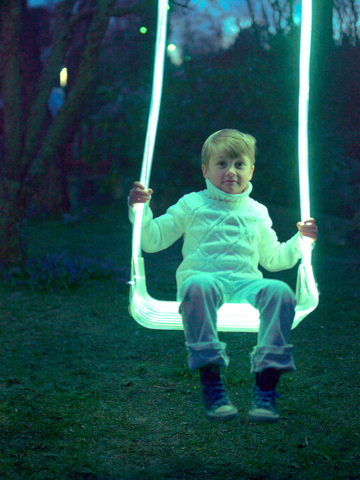
PHOTO: NY TIMES
This fall, the German home products company Villeroy & Boch will begin selling Light Tiles -- ordinary-looking glazed clay tiles equipped with an LED device -- in the US. Hit a wall switch and the tiles, which will cost US$75 to US$100 each and come with a 60-page installation manual, glow blue, white or amber.
At a time when high-tech gadgets fill every corner of the house, "people are receptive to light applications that go beyond ceiling lamps and sconces," said Rick Crane, tile sales manager for Villeroy and Boch.
Mixing the elements of light and water is popular with many companies exploring this new field, but the combination comes at a price. Neve Rubinetterie, a small Italian faucet maker based outside Milan, will soon start selling a product in the US called the Brick Glas. It is a faucet embedded in a rectangular block of transparent or frosted Plexiglas, which is lighted from below by a low-voltage LED.
The faucet costs about US$1,500, which may be a bit steep for the opportunity to brush your teeth in the dark. But it is not as expensive as showering with light.
Ondine, a luxury shower systems company in City of Industry, California, sells the Electric Light shower head, with 270 spray channels wired with fiber optic cables and a halogen light, for between US$2,500 (for the chrome version) and US$15,000 (24-carat gold). The color of the light is
adjustable.
"If you like blue because it's more soothing, you can set the head to that," said Patty Gatto, marketing director at Ondine. The shower head was designed as a form of chromatherapy, which assigns healing
properties to each color of the light spectrum and which has become a popular marketing tool for light product makers.
Designers are jumping on the
chromatherapy bandwagon, whether or not they are true believers. Jan Puylaert, a Dutch designer who runs an Italian design
company called Wet, says he's not really a New Age type, but he believes that light gives you "a nice energy and some invisible comfort, like plants."
Puylaert's contributions to such comforts are a bathtub and a wash basin, made of lightweight polyethylene, which come with either a halogen light or an LED, and sell for between US$1,400 and US$2,500 for the tub, and US$250 and US$500 for the basin.
Torsten Neeland, a German designer based in London, says light is about
"stimulating the senses," even when its source is something as mundane as a coffee table. During London design week events last week, he showed such a table, the Oranienburg (US$2,350) with three elliptical Corian tops that can swivel out from a
pedestal base. A fluorescent light on the base casts a pink glow between the layers. The effect, Neeland said, "reflects the
power of color."
These new forms of illumination are popular with consumers, manufacturers say, but some design-world purists are less impressed. Brooke Hodge, the curator of architecture and design at the Museum of Contemporary Art in Los Angeles, says in many of these cases, adding an element like light is "an odd embellishment" because it doesn't have a function.
"Light is a pleasant thing and you can use it to change the mood and atmosphere, like those watches with different colored faces," she said. "But you have to ask, `what does it do? Why is it there?'"
The push to illuminate everything isn't all frivolous, according to Lervik. He got the idea for the Brighthandle door handle, which sells in the US for about US$150, while gazing at a "do not disturb" sign in a hotel. "I thought, it might be possible to design the function of that sign into the door, to use light to communicate the same thing," Lervik explained.
It may be simply the beauty of light that is attracting so many designers to it. After all, said Leni Schwendinger, a lighting artist in New York City who is working on a project to illuminate the Coney Island
parachute jump, people love light because "it fills the eye with brightness and delights."
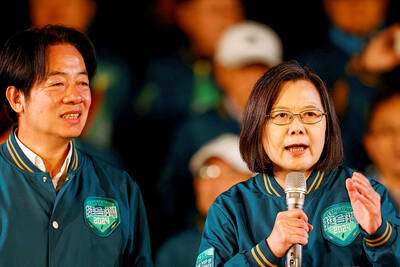
Last week Joseph Nye, the well-known China scholar, wrote on the Australian Strategic Policy Institute’s website about how war over Taiwan might be averted. He noted that years ago he was on a team that met with then-president Chen Shui-bian (陳水扁), “whose previous ‘unofficial’ visit to the US had caused a crisis in which China fired missiles into the sea and the US deployed carriers off the coast of Taiwan.” Yes, that’s right, mighty Chen caused that crisis all by himself. Neither the US nor the People’s Republic of China (PRC) exercised any agency. Nye then nostalgically invoked the comical specter
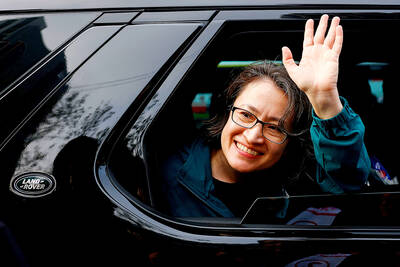
Relations between Taiwan and the Czech Republic have flourished in recent years. However, not everyone is pleased about the growing friendship between the two countries. Last month, an incident involving a Chinese diplomat tailing the car of vice president-elect Hsiao Bi-khim (蕭美琴) in Prague, drew public attention to the People’s Republic of China’s (PRC) operations to undermine Taiwan overseas. The trip was not Hsiao’s first visit to the Central European country. It was meant to be low-key, a chance to meet with local academics and politicians, until her police escort noticed a car was tailing her through the Czech capital. The
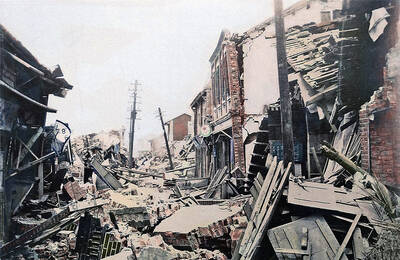
April 15 to April 21 Yang Kui (楊逵) was horrified as he drove past trucks, oxcarts and trolleys loaded with coffins on his way to Tuntzechiao (屯子腳), which he heard had been completely destroyed. The friend he came to check on was safe, but most residents were suffering in the town hit the hardest by the 7.1-magnitude Hsinchu-Taichung Earthquake on April 21, 1935. It remains the deadliest in Taiwan’s recorded history, claiming around 3,300 lives and injuring nearly 12,000. The disaster completely flattened roughly 18,000 houses and damaged countless more. The social activist and

Over the course of former President Ma Ying-jeou’s (馬英九) 11-day trip to China that included a meeting with Chinese Communist Party (CCP) leader Xi Jinping (習近平) a surprising number of people commented that the former president was now “irrelevant.” Upon reflection, it became apparent that these comments were coming from pro-Taiwan, pan-green supporters and they were expressing what they hoped was the case, rather than the reality. Ma’s ideology is so pro-China (read: deep blue) and controversial that many in his own Chinese Nationalist Party (KMT) hope he retires quickly, or at least refrains from speaking on some subjects. Regardless


 RSS
RSS