


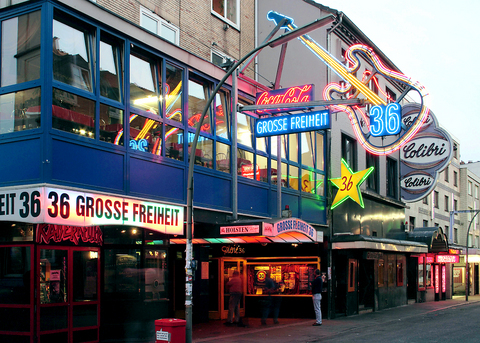
It's a typical early evening scene in Hamburg. Several well-dressed diners are discussing their most recent vacations while sampling the "new German" cuisine at Schauermann, a chic new harborside restaurant on Hafenstrasse in the St. Pauli area, all but oblivious to the scene outside the restaurant's large windowed facade: A large banner draped from the roof of a nearby apartment building reads: "Eat the Rich" -- evidence that the spirit of healthy anarchy lives on in St. Pauli, a district that is balancing precariously between prostitutes and squatters and gentrification.
The most famous and heavily
touristed street in St. Pauli is the Reeperbahn, an avenue that defines the heart of the city's red-light district.
PHOTOS: NY TIMES
But rather than intimidate, St. Pauli acts as an exhilarating foil to the beauty and almost sterile perfectionism of Hamburg. A city that's home to the most old-moneyed families in the country. Hamburg is sometimes called the "Venice of Germany" for the various canals running through a mix of imposing restored landmarks and
glittering, modern facades. Regal,
elegant villas line the Elbchaussee.
PHOTOS: NY TIMES NEWS SERVICE
St. Pauli, on the other hand, has always been an outsider. Literally. Centuries ago, the land on which the neighborhood stands was outside the city's protective walls, and was
continuously battered and displaced by battle. The Reeperbahn was once a stretch of land where rope producers used to weave thick cord for the harbor's ships. ("Reeper" translates as ropemaker in an old dialect).
As St. Pauli was engulfed by
Hamburg's growing borders, it became the city's physical center. Now,
exploring the area's blinking and
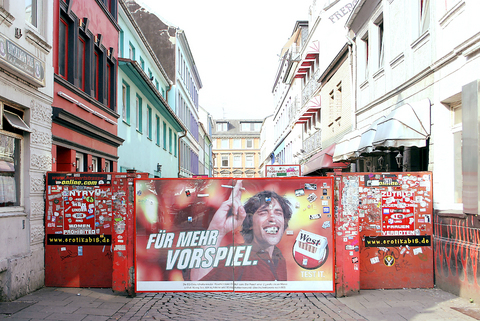
electric streets, it's as if you've passed through the looking glass into the throbbing secret heart of the city -- and happened upon its most exciting scene. While one still passes by more pornographic-video window displays and East European streetwalkers than groovy DJ lounges, the street houses some of the city's more exclusive night-life venues.
"I had a friend from New York
visiting recently and he fell in love with the club scene here," said Scott McCormack, who moved from Manhattan to Hamburg last year to write a historical novel.
When the party crowd from some of Hamburg's wealthier circles head to St. Pauli, they're frequently found at East, an upscale hotel and restaurant-lounge that opened in a former iron foundry last fall, designed by the
Chicago-based architect Jordan Mozer.
It's not just the colorful design or designer cocktails that make East so fresh, it's that such a place exists just a few minutes' walk from the Reeperbahn. Like the other posh lounges and restaurants sandwiched between the neighborhood's dark car lots and sex shops, the extreme juxtaposition works amazingly well.
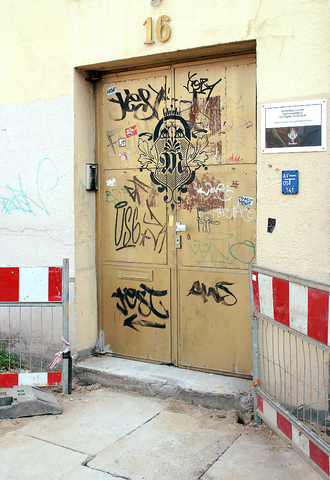
One might find that same polished East crowd sweating to electro music at the underground Bar Morphine (open only Friday after midnight), behind a nondescript door on a nearby block. Just a few strides from the renowned Herbertstrasse, a block-long street of bordellos closed off to women and anyone under 18 (enforced by the prostitutes themselves), stylish regulars dine well in the sleek Italian restaurant Cuneo.
At a St. Pauli soccer match last month it was possible to spot locals and heirs alike. But at the stadium (a quick walk from East and the Reeperbahn), the fans converged into what looked like a dancing and cheering band of pirates.
Local residents are less accepting of the big investors who have started to invade the area, obvious from the various construction sites. For the moment, the hope is that the Spielbudenplatz will become a market that would serve as a lively daily commercial hub; while the area around the Reeperbahn is extremely colorful and electric at night, by day it's faded and hung over.
But the neighboring hip Schanzen district, within St. Pauli's northern borders, is usually buzzing by noon. "This is absolutely my favorite part of the city," McCormack said. "It's like the East and West Villages combined."
At the new Eisheiligen on Wohlwillstrasse, a cafe-style ice cream shop, parents with brightly dyed hair and leather jackets exchanged licks of melon and biscuit with their urban offspring. It was a scene that captured a Hamburg that's both relaxed and cutting edge.
Quick guide to Hamburg:
Getting there:
Return ticket to Hamburg from Taipei costs NT$25,300 plus tax (around NT$8,000) with Swissair. Through Interlink Travel (call (02) 2578 0611).
Where to stay:
■ East: Simon-von-Utrecht-Strasse 31, (309 930), www.east-hamburg.de, has 103 modern-styled rooms for US$174 to US$445.
■ Kogge: Bernhard-Nocht-Strasse 59, (312 872); www.kogge-hamburg.com, is a former bordello. Its 12 small rooms have been decorated by local artists: US$57.
■ Schanzenstern: Bartelsstrasse 12, (439 8441), www.schanzenstern.de, is a simple, clean hostel in Schanzen. Rooms go for US$40 to US$100.
Where to eat:
■ Schauermann: Hafenstrasse 136-138, (3179 4660), serves "new German" cuisine with a Mediterranean twist amid coolly
elegant 1960s decor.
■ Artisan: Kampstrasse 27, (4210 2915), is an intimate place serving contemporary
cuisine. Fixed-price dinners are US$40 to US$100, without wine. Closed Sunday and Monday.
■ Zirkus Erich: Erichstrasse 19, (6887 3033), a stylish Mediterranean restaurant at the Erotic Art Museum. A meal for two without wine is about US$45.
■ Cuneo: Davidstrasse 11, (312 580), serves classic Italian entrees, ranging from US$12 to US$26. Closed Sunday.
What to See and do:
■ Erotic Art Museum: Bernhard-Nocht Strasse 69, (317 8410); www.eroticartmuseum.de (German only): With an impressive permanent collection of artwork from Picasso to David Hockney, the museum is now showing an exhibit of fetish art.
■ Kurverwaltung St. Pauli: (3179 0747), ww.kurverwaltungstpauli.de, offers tours of St. Pauli. For an English-speaking guide call ahead and book Kiki, who specializes in the area's architecture and future projects. A more than two-hour-long tour costs US$30 for up to five people.
■ FC St Pauli: A legendary soccer team but now in the third division, plays its games at Millerntor Stadium, in the center of St. Pauli. Tickets are US$10 to US$100.
Note: To call Hamburg, dial 49-40 before for the numbers above.
Last week Joseph Nye, the well-known China scholar, wrote on the Australian Strategic Policy Institute’s website about how war over Taiwan might be averted. He noted that years ago he was on a team that met with then-president Chen Shui-bian (陳水扁), “whose previous ‘unofficial’ visit to the US had caused a crisis in which China fired missiles into the sea and the US deployed carriers off the coast of Taiwan.” Yes, that’s right, mighty Chen caused that crisis all by himself. Neither the US nor the People’s Republic of China (PRC) exercised any agency. Nye then nostalgically invoked the comical specter

Relations between Taiwan and the Czech Republic have flourished in recent years. However, not everyone is pleased about the growing friendship between the two countries. Last month, an incident involving a Chinese diplomat tailing the car of vice president-elect Hsiao Bi-khim (蕭美琴) in Prague, drew public attention to the People’s Republic of China’s (PRC) operations to undermine Taiwan overseas. The trip was not Hsiao’s first visit to the Central European country. It was meant to be low-key, a chance to meet with local academics and politicians, until her police escort noticed a car was tailing her through the Czech capital. The
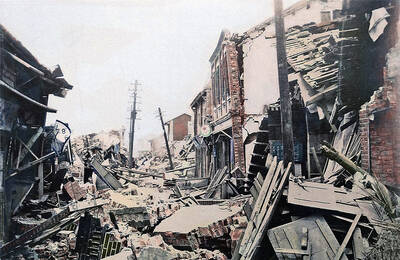
April 15 to April 21 Yang Kui (楊逵) was horrified as he drove past trucks, oxcarts and trolleys loaded with coffins on his way to Tuntzechiao (屯子腳), which he heard had been completely destroyed. The friend he came to check on was safe, but most residents were suffering in the town hit the hardest by the 7.1-magnitude Hsinchu-Taichung Earthquake on April 21, 1935. It remains the deadliest in Taiwan’s recorded history, claiming around 3,300 lives and injuring nearly 12,000. The disaster completely flattened roughly 18,000 houses and damaged countless more. The social activist and

Over the course of former President Ma Ying-jeou’s (馬英九) 11-day trip to China that included a meeting with Chinese Communist Party (CCP) leader Xi Jinping (習近平) a surprising number of people commented that the former president was now “irrelevant.” Upon reflection, it became apparent that these comments were coming from pro-Taiwan, pan-green supporters and they were expressing what they hoped was the case, rather than the reality. Ma’s ideology is so pro-China (read: deep blue) and controversial that many in his own Chinese Nationalist Party (KMT) hope he retires quickly, or at least refrains from speaking on some subjects. Regardless


 RSS
RSS