


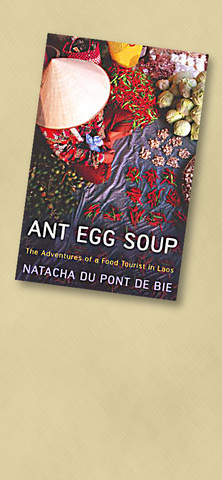
This book, subtitled Adventures of a Food Tourist in Laos, manages to be many things -- a travel narrative filled with descriptions of landscapes and people, a cookery book with many recipes for Laotian dishes and, finally, a polemical plea for better and more authentic standards in world cuisine.
Du Pont de Bie is naturally equipped for her "food tourist" role. Raised in Paris, the self-styled gastronomic capital of the world, and with an adventurous appetite for esoteric flavors, she embarks on her visit to the East with an eager spirit.
It's nonetheless true that the most exquisite and the most repulsive food items are frequent bed-fellows, and Laotian cuisine is a case in point. Besides grubs and assorted insects (including the eponymous ant eggs), all manner of offal -- arteries, lungs and raw blood -- combine with ginger,
chillies, garlic and coriander to create a memorable gastronomic experience for her in many an
apparently enjoyable dish.
The author's sympathy and respect for the people of Laos (chiefly for their joyful attitude and generosity of spirit) is what distinguishes her account of their plight. Having been on the receiving end of the most intensive bombing ever experienced anywhere in the world, the Laotians still face the threat of unexploded mines in prodigious numbers, as well as China's
aspirations to build six further
hydroelectric dams along the Mekong river, in defiance of neighboring countries' concerns for the likely ecological damage.
Laos' landscapes are here displayed as rich in waterfalls, flora and fauna. A diversity of fish splash through the author's feet in its rivers, while myriad species of butterfly circle in clouds overhead, giving the reader a strong sense of a paradise regained. Natacha du Pont de Bie is at her most potent when conveying her wonder at this beauty. On her way to Luang
Prabang, she observes: "Even with a hangover, everything they say about the enchantment of Luang Prabang is true. The gauzy tranquility of the place puts a languid drift into your step and causes you to forget to breathe. As the silvery haze that envelops the town softens your vision, a diaphanous cloak of dreamy carelessness descends upon you and you just have to give in to it.
While the Laotians remain a source of admiration and constant surprise, the company of fellow Western tourists quickly prompts irritation. The author sees these as bent on hedonism at the expense of courtesy to their hosts and her disenchantment becomes
increasingly militant. After an
unsatisfactory evening in a sub-standard cafe with some Australian backpackers, for instance, her fury rises to a diatribe against blinkered tourist attitudes, leading on to a plea for better standards in world food.
"The cafes had sold out," she writes. "They were all serving the same limited menu of poor quality dishes to people passing through, too lazy to care. Sadly, I see it
happening all the time, all over the world."
Bemoaning our acceptance of preprepared food pumped with chemicals, she surmises that "it now takes more time, effort and money to eat locally grown real food than purchase processed pap from abroad. In the name of choice we end up eating cattle fodder, dressed up to look enticing, exotic and international, while our own traditional produce and recipes quietly die out."
In Laos, however, she still finds a choice, and to eat well and naturally is a real option. Practically everything is grown locally, seasonally and without chemicals, and prepared in a traditional manner, she finds. Ironically, the main reason for this availability is lack of interest by the multinationals due to the difficulty of finding a profitable market in such a poor country.
Like the Laotians, du Pont de Bie takes a delight in food, in the nutritional value of mulberry-leaf tea (good for preventing diabetes, reducing cholesterol and high blood pressure), for instance, and in the river algae of Luang Prabang,
"supposedly one of the most nutritious foods for its weight in the world." She also displays a sensuous feel for the alchemy of smell and texture represented by a Lao chicken Laap "placed hot and steaming in front of you." She marvels at the taste of a baked potato, cooked in banana leaves in the embers of a fire,"small and hot and infused with the aroma of the leaves in which it was cooked."
Yet it's the Lao people who hold a special place in her heart. When she's given a child's flower hat as a gift from a woman whose baby she's been admiring -- grubby and missing its silver buttons, yet "exquisitely appliqued and topped with pom-poms" -- she reflects on the source of their generosity.
"Throughout my tour," she writes, "I found the Laotian people to be genuinely benevolent, rich or poor, Buddhist or Taoist. The idea of community lies at the center of this: the old and the very young are seen as valued contributors to society, familial and neighborly relationships are nurtured to the benefit of all, and people look beyond their own individual needs to help others less fortunate than themselves. My own culture began to look cold and self-referential by comparison."
That such people are in daily danger of having their legs blown away by cluster bombs and landmines manufactured by the world's most sophisticated industrial processes, and casually left uncleared despite the enormous wealth available for the job, makes me so angry I can scarcely read any book on the country without the blackest of thoughts.
Nonetheless Ant Egg Soup (which does devote a chapter to this terrible situation) remains a gift for anyone with an adventurous palette, and pure gold for those hungering to venture beyond the cheap allure of fast-food. In addition, the author's vigorous approach to whatever life throws at her makes, on its own, reading this book a memorable experience.

Last week Joseph Nye, the well-known China scholar, wrote on the Australian Strategic Policy Institute’s website about how war over Taiwan might be averted. He noted that years ago he was on a team that met with then-president Chen Shui-bian (陳水扁), “whose previous ‘unofficial’ visit to the US had caused a crisis in which China fired missiles into the sea and the US deployed carriers off the coast of Taiwan.” Yes, that’s right, mighty Chen caused that crisis all by himself. Neither the US nor the People’s Republic of China (PRC) exercised any agency. Nye then nostalgically invoked the comical specter

Relations between Taiwan and the Czech Republic have flourished in recent years. However, not everyone is pleased about the growing friendship between the two countries. Last month, an incident involving a Chinese diplomat tailing the car of vice president-elect Hsiao Bi-khim (蕭美琴) in Prague, drew public attention to the People’s Republic of China’s (PRC) operations to undermine Taiwan overseas. The trip was not Hsiao’s first visit to the Central European country. It was meant to be low-key, a chance to meet with local academics and politicians, until her police escort noticed a car was tailing her through the Czech capital. The
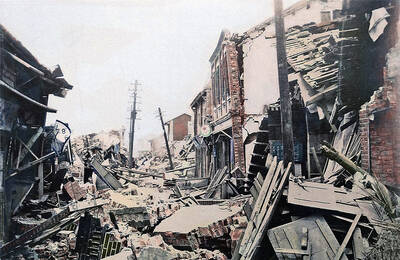
April 15 to April 21 Yang Kui (楊逵) was horrified as he drove past trucks, oxcarts and trolleys loaded with coffins on his way to Tuntzechiao (屯子腳), which he heard had been completely destroyed. The friend he came to check on was safe, but most residents were suffering in the town hit the hardest by the 7.1-magnitude Hsinchu-Taichung Earthquake on April 21, 1935. It remains the deadliest in Taiwan’s recorded history, claiming around 3,300 lives and injuring nearly 12,000. The disaster completely flattened roughly 18,000 houses and damaged countless more. The social activist and

Over the course of former President Ma Ying-jeou’s (馬英九) 11-day trip to China that included a meeting with Chinese Communist Party (CCP) leader Xi Jinping (習近平) a surprising number of people commented that the former president was now “irrelevant.” Upon reflection, it became apparent that these comments were coming from pro-Taiwan, pan-green supporters and they were expressing what they hoped was the case, rather than the reality. Ma’s ideology is so pro-China (read: deep blue) and controversial that many in his own Chinese Nationalist Party (KMT) hope he retires quickly, or at least refrains from speaking on some subjects. Regardless


 RSS
RSS