


Currently on view at TIVAC is a historical photography exhibition by Long Chin-shan (
The Hidden Glamour -- The Unpublished Photography Works by Long Chin-Shan commemorates his prolific life on the 10th anniversary of his death. Long left behind an archive of 12,000 images with some 1,000 original negatives still in prime condition. Many photos document the turbulent changes of China during the war with Japan; others are of Taiwan's landscape.
Even though Long lived in China, his work deeply influenced aesthetic sensibilities in Taiwan.
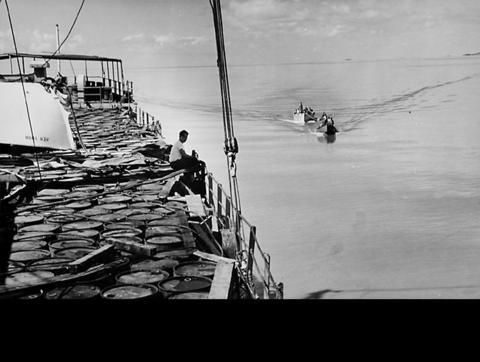
PHOTO COURTESY OF TIVAC
For this exhibition 50 black-and-white photographs are on show, including pastoral landscape and portraits of famous Chinese figures. Photographs from Long's travels are also available to view.
To learn about the history of photography in China makes for a fascinating subject as two completely diverse and disparate cultures collided with the proliferation of photographic technology. Western daguerreotypes and photography were introduced into China around the mid-1800s, and by 1874, the new technology was widely embraced with professional Chinese photographers setting up lucrative portrait studios as well shooting landscapes and popular Chinese operas.
To learn more about this historical photographer and his influence on Taiwan, you may want to check out the two lecture sessions, to be
conducted in Chinese, that have been scheduled. On Saturday Oct. 8 at 2:30pm, "The Archeology Research of the Unfinished Photograph" will be moderated by scholars Hsiao Yung-Sheng (
If you have a chance to go to Hsinchu, check out the National Hsinchu University of Education, HCTC Artist Space to see a solo exhibition of Lin Pey-chwen's (
The installations of sparkling light boxes with digital and video imagery capture the beauty of nature but contain a powerful message.
One of Taiwan's prominent feminist artists, Lin switched to making less politically driven work after teh 921 Earthquake rattled her spiritual self. She delved deeper into issues of faith and discovered Christianity. As a result the theme of man vs. nature and the return to nature, especially to the Garden of Eden dominante her work.
In the large technical piece City Matrix a large orb contains flashing neon lights and emits traffic sounds that mimic the artificiality of the metropolis. Peeping through a small lens at the top one can glimpse a butterfly. Wire tentacles extend from the orb toward individual panels of digital butterflies that change color via LED screens. In addition, a Web-cam captures the audience
viewing the work, yet its purpose is not to record the viewer but to symbolize the inescapability of the City Matrix -- since members of the audience are complicit in the art work's construction.
Even though the work seems light and airy at first, it conveys a pessimistic, alarmist message. Lin warns that humanity must protect the natural environment at all costs.
Exhibition notes:
What: `The Hidden Glamour -- The unpublished Photography Works' by Long Chin-Shan (
Where: Taiwan International Visual Arts Center
(TIVAC)(
Telephone: (02) 2773 3347
When: Until Oct 26.
What: `Fascination and Frustration,' a solo Exhibition by Lin Pey-chwen (
Where: National Hsinchu University of Education HCTC Artist Space (
Telephone: (03) 5213132
When: Until Oct. 27, Mon to Fri 9-5

Last week Joseph Nye, the well-known China scholar, wrote on the Australian Strategic Policy Institute’s website about how war over Taiwan might be averted. He noted that years ago he was on a team that met with then-president Chen Shui-bian (陳水扁), “whose previous ‘unofficial’ visit to the US had caused a crisis in which China fired missiles into the sea and the US deployed carriers off the coast of Taiwan.” Yes, that’s right, mighty Chen caused that crisis all by himself. Neither the US nor the People’s Republic of China (PRC) exercised any agency. Nye then nostalgically invoked the comical specter

Relations between Taiwan and the Czech Republic have flourished in recent years. However, not everyone is pleased about the growing friendship between the two countries. Last month, an incident involving a Chinese diplomat tailing the car of vice president-elect Hsiao Bi-khim (蕭美琴) in Prague, drew public attention to the People’s Republic of China’s (PRC) operations to undermine Taiwan overseas. The trip was not Hsiao’s first visit to the Central European country. It was meant to be low-key, a chance to meet with local academics and politicians, until her police escort noticed a car was tailing her through the Czech capital. The
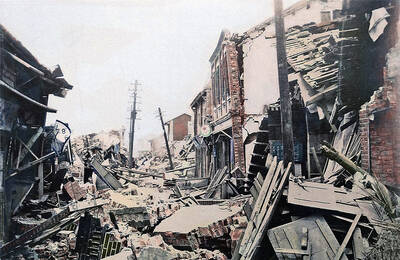
April 15 to April 21 Yang Kui (楊逵) was horrified as he drove past trucks, oxcarts and trolleys loaded with coffins on his way to Tuntzechiao (屯子腳), which he heard had been completely destroyed. The friend he came to check on was safe, but most residents were suffering in the town hit the hardest by the 7.1-magnitude Hsinchu-Taichung Earthquake on April 21, 1935. It remains the deadliest in Taiwan’s recorded history, claiming around 3,300 lives and injuring nearly 12,000. The disaster completely flattened roughly 18,000 houses and damaged countless more. The social activist and

Over the course of former President Ma Ying-jeou’s (馬英九) 11-day trip to China that included a meeting with Chinese Communist Party (CCP) leader Xi Jinping (習近平) a surprising number of people commented that the former president was now “irrelevant.” Upon reflection, it became apparent that these comments were coming from pro-Taiwan, pan-green supporters and they were expressing what they hoped was the case, rather than the reality. Ma’s ideology is so pro-China (read: deep blue) and controversial that many in his own Chinese Nationalist Party (KMT) hope he retires quickly, or at least refrains from speaking on some subjects. Regardless


 RSS
RSS