


In his hilarious stand-up routine, Chris Rock talks about the ubiquitous television drug commercials that "keep naming symptoms till they get one that" the viewer's got. Sometimes, he says, the ads don't even tell you what the pill does: "You see a lady on a horse or a man in a tub, and they just keep naming symptoms: `Are you depressed?' `Are you lonely?' `Do your teeth hurt?"' He adds that one commercial he saw went, "Do you go to bed at night and wake up in the morning?"
"They got that one!" he says. "I got that. I'm sick. I need that pill!"
Rock's observations are almost too close to the actual truth to be considered satire, as Greg Critser's provocative new book, Generation RX, makes clear. Indeed, baby boomers and their offspring have become the most medicated

generation ever, devoted consu-mers from cradle to grave of every manner of pharmaceutical imaginable -- pills that not only cure real diseases, but that also promise, in Critser's words, to "do everything from guarding us against our excesses of drink, food and tobacco, to increasing our children's performance at school, to jump-starting our own productivity at work, to extending our very time on this mortal coil."
Boomers, who grew up using drugs recreationally, have become a generation that lives almost full time in the Valley of the Dolls: bombarded by direct-to-consumer ads, they are happy to self-medicate, and their cost-conscious HMOs are happy to substitute antidepressants for expensive talk therapy, prescriptions for repeated doctor visits.
Little wonder, then, that drug use -- of the legal sort -- has soared. Americans routinely take pills for high cholesterol and high blood pressure, and they also routinely take pills to sleep, pills to focus, pills to chill and pills to perk up, pills for more sex and pills for less stress. Critser notes that "the average number of prescriptions per person, annually, in 1993 was seven," but had risen to 11 by 2000, and 12 last year.
"The total number of annual prescriptions in the United States now stands at about 3 billion," he writes. "The cost per year? About US$180 billion, headed to an estimated US$414 billion by 2011."He adds that spending on all forms of drugs to treat childhood and adolescent behavioral disorders rose by 77 percent between 2000 and 2003, "with 65 percent of all children on such drugs taking at least one antidepressant." On college campuses, the portion of students who went to health centers and "who were already taking psych meds went from 7 percent in 1992 to 18 percent in 2000."
There is little in Generation RX that hasn't been reported before -- in the flurry of articles about the pharmaceutical business, which appeared in the wake of the Vioxx recall last fall, or in the slew of recent books by experts like Marcia Angell (The Truth About the Drug Companies), Jerry Avorn (Powerful Medicines) and John Abramson (Overdosed America).
What Critser has done in these pages is synthesize a lot of
information and reserve it to the reader in an accessible, easily
digested form -- much as he did with information about obesity in his 2003 book, Fat Land. While his prose sometimes buckles from his efforts to be chatty and conversational -- at one point, he describes the liver, which can regenerate itself, as "a kind of Donald Trump of the human body" -- he does a lucid job conveying the dramatic ways in which the development and marketing of pharmaceuticals have changed over the last two decades and the equally dramatic and often disturbing consequences of this phenomenon.
Like Angell in The Truth About the Drug Companies, Critser traces the big changes in the drug business back to what he calls "newly loosened and speeded-up regulatory processes" that began with the Bayh-Dole Act of 1980, which "made it easier for the industry to use research discoveries that originated in publicly funded laboratories," and the Hatch-Waxman Act of 1984, which made it easier for cheaper generics to find their way to the market but also made it easier for drug companies to get extensions on their monopolies. As for the Prescription Drug User Fee Act, passed in 1992, Critser says it in effect resulted in "a clientized" Food and Drug Administration, by allowing companies to pay "user fees" to expedite the reviews of new drugs.
In recent years, Critser goes on, the two great buffers between Big Pharma and the public have grown increasingly porous. The government, besieged by pharmaceutical lobbyists, has grown more and more accommodating toward drug companies, while doctors -- coping with growing workloads, demanding patients, and the strictures of managed care -- have started to change their prescription-writing habits. Needless to say, Big Pharma has done everything it can to promote its own interests: Critser estimates that the business spends "between US$8,000 and US$15,000 annually per physician to sell its wares."
At the same time, drug companies have employed a host of other strategies to maximize sales and profits: focusing on the development of drugs for chronic conditions and drugs with large patient populations; enlarging the patient base for existing drugs by selling them as cures for related disorders (Paxil, for instance, eventually won approval for treating depression, panic disorder, obsessive-compulsive disorder, and social anxiety disorder); and promoting drugs like Viagra as "quality of life" products that patients would ask their doctors to prescribe.
"The principal forces that have so deeply pharmaceuticalized American life are hardly likely to abate anytime soon," he writes. "Managed care over the next decades will continue to depend heavily upon pills as a proxy for physician care. Cost-conscious employers and insurers will make sure of that. As will Wall Street -- particularly as baby boomers begin to cash in their retirement funds, which have been floating on that nice, easy cushion of double-digit pharmaceutical company returns."

In late October of 1873 the government of Japan decided against sending a military expedition to Korea to force that nation to open trade relations. Across the government supporters of the expedition resigned immediately. The spectacle of revolt by disaffected samurai began to loom over Japanese politics. In January of 1874 disaffected samurai attacked a senior minister in Tokyo. A month later, a group of pro-Korea expedition and anti-foreign elements from Saga prefecture in Kyushu revolted, driven in part by high food prices stemming from poor harvests. Their leader, according to Edward Drea’s classic Japan’s Imperial Army, was a samurai

Located down a sideroad in old Wanhua District (萬華區), Waley Art (水谷藝術) has an established reputation for curating some of the more provocative indie art exhibitions in Taipei. And this month is no exception. Beyond the innocuous facade of a shophouse, the full three stories of the gallery space (including the basement) have been taken over by photographs, installation videos and abstract images courtesy of two creatives who hail from the opposite ends of the earth, Taiwan’s Hsu Yi-ting (許懿婷) and Germany’s Benjamin Janzen. “In 2019, I had an art residency in Europe,” Hsu says. “I met Benjamin in the lobby
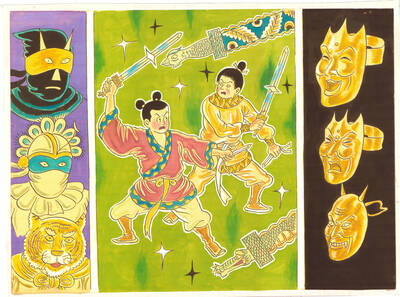
April 22 to April 28 The true identity of the mastermind behind the Demon Gang (魔鬼黨) was undoubtedly on the minds of countless schoolchildren in late 1958. In the days leading up to the big reveal, more than 10,000 guesses were sent to Ta Hwa Publishing Co (大華文化社) for a chance to win prizes. The smash success of the comic series Great Battle Against the Demon Gang (大戰魔鬼黨) came as a surprise to author Yeh Hung-chia (葉宏甲), who had long given up on his dream after being jailed for 10 months in 1947 over political cartoons. Protagonist

Peter Brighton was amazed when he found the giant jackfruit. He had been watching it grow on his farm in far north Queensland, and when it came time to pick it from the tree, it was so heavy it needed two people to do the job. “I was surprised when we cut it off and felt how heavy it was,” he says. “I grabbed it and my wife cut it — couldn’t do it by myself, it took two of us.” Weighing in at 45 kilograms, it is the heaviest jackfruit that Brighton has ever grown on his tropical fruit farm, located


 RSS
RSS