


There is no doubt this is an important debut, a collection of 10 short stories by a young writer who arrived in the US from China in 1996. Some of the tales have appeared as single items in prestigious publications such as The New Yorker and The Paris Review. But taken together they constitute a highly original book.
This originality doesn't consist of experimental modes of narration or quirkiness of prose style. It consists of the fact that the stories all deal with very different kinds of experiences, are told from a variety of viewpoints, and yet all share the same high level of intelligence. They're skeptical, astute and even at times sardonic. And most of them are cleverly plotted into the bargain.
The subject matter is the life experience of Chinese people, either in contemporary, or near-contemporary China, or in the US. Very different though these experiences not surprisingly are, the author gives them unity by the application of her economical style and, above all else, her eye for irony and paradox.
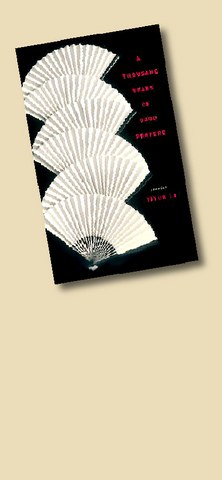
One story, Immortality, quite took my breath away. It is set in a town that traditionally provided many eunuchs for service in the imperial Chinese court. The process is duly described -- selected boys of seven or eight were castrated ("cleaned" as it was called) and then went on to grow into "Great Papas," venerable public servants who sent money back to their families in the form of silver coins, and were finally given honorable burials along with what remained of their withered
"severed male roots."
In this town is born a boy who carries a striking resemblance to "the dictator," clearly Mao Zedong (毛澤東). He wins a competition to find the perfect look-alike, and proceeds to enjoy a life of honor and riches, both during and after the life of the "dear leader." Only one thing is missing, however. He doesn't marry, partly because he's quite simply too famous. What woman could be worthy of such greatness? Finally, however, the cult of which he is the living embodiment begins to fade, and with it the man's fortunes. One day he "cleans himself" on his mother's tomb, and goes on to live a life sitting staring at butterflies in the pale sunlight.
What makes this story so strong is the implication that nothing has really changed in China. The town, in other words, continues to produce "Great Papas," even in the Communist era. Various paradoxes are visited along the way -- the encouragement, shortly after 1949, of women to produce large families, followed by the one-child policy, being only one of them. Fertility, marriage, mutilation and the rewards or otherwise of each option are all carefully woven into the narrative. "There will be no end to his story," the tale concludes.
Another story, After a Life, features two married couples. The two husbands meet at work dealing in stocks while their wives regularly communicate by phone. One is convinced, quite rightly, that her husband is unfaithful. The problem for her husband is that he still cares for his wife enough to prevent him leaving her. The other couple are in a far more unusual and complex situation, however.
They have two children, the younger one a healthy and successful son, the other a retarded daughter, kept secretly in an upper room where she screams all day unless pacified with sedatives. The couple, apparently so caring, as well as so devious in concealing the existence of their first child -- both female and retarded -- from the authorities. But the reality is that the pair, lovers since their early teens, have quietly lost their passion for each other, not after the birth of their retarded daughter, but, paradoxically, after the birth of their healthy and successful son.
The story's ending is mysterious. It appears the daughter will not survive an overdose of sleeping tablets, and somehow the parents come back together on account of this. "Her husband comes close and strokes her hair, gray and thin now," the story concludes, "but his touch, gentle and timid, is the same one from a lifetime ago, when they were playing in their grandparents' garden, where the pomegranate blossoms, fire-hued and in the shape of bells, kept the bees busy and happy."
A Thousand Years of Good Prayers, the title story, is the last one in the book. It's set in the US where an ageing immigrant tells people that back in China he worked as a rocket scientist. His recently divorced daughter has started a relationship with a Romanian, while the old man is getting to know a woman from Iran he meets in a park. It appears at first that it is the daughter whose US-style love-life is violating traditional Chinese expectations, but it transpires later that the father's former life was hardly what tradition required either.
Son deals with a man of 33 who returns to China from the US to visit his mother. He's gay, and expects to have to resist once again his mother's match-making activities. She's recently become a Christian, but to the son this is simply the replacement of one unthinking orthodoxy (her earlier Marxism) by another. Once again, though, things don't quite turn out as expected. This tale, though not quite as skillfully plotted as most of the others, nonetheless exhibits once again this author's avoidance of the predictable development.
There is much more in this fascinating collection -- an old woman who befriends an orphan boy in a school where she has been assigned as a cleaner, a boy drowned in a reservoir as the direct result of the self-importance of the authorities. Over and over again a strongly ironic attitude to Communism is blended with a humane insight into imagined individuals, the people the statistics conceal, their only lives blighted by what social commentators are all too prone to see as just the passing phases of social and political development.
Yiyun Li is a writer to watch. She could just come up with something wonderful, a novel, perhaps, in which her US and Chinese experiences and insights are woven together into something really memorable and important.

In late October of 1873 the government of Japan decided against sending a military expedition to Korea to force that nation to open trade relations. Across the government supporters of the expedition resigned immediately. The spectacle of revolt by disaffected samurai began to loom over Japanese politics. In January of 1874 disaffected samurai attacked a senior minister in Tokyo. A month later, a group of pro-Korea expedition and anti-foreign elements from Saga prefecture in Kyushu revolted, driven in part by high food prices stemming from poor harvests. Their leader, according to Edward Drea’s classic Japan’s Imperial Army, was a samurai

The following three paragraphs are just some of what the local Chinese-language press is reporting on breathlessly and following every twist and turn with the eagerness of a soap opera fan. For many English-language readers, it probably comes across as incomprehensibly opaque, so bear with me briefly dear reader: To the surprise of many, former pop singer and Democratic Progressive Party (DPP) ex-lawmaker Yu Tien (余天) of the Taiwan Normal Country Promotion Association (TNCPA) at the last minute dropped out of the running for committee chair of the DPP’s New Taipei City chapter, paving the way for DPP legislator Su

Located down a sideroad in old Wanhua District (萬華區), Waley Art (水谷藝術) has an established reputation for curating some of the more provocative indie art exhibitions in Taipei. And this month is no exception. Beyond the innocuous facade of a shophouse, the full three stories of the gallery space (including the basement) have been taken over by photographs, installation videos and abstract images courtesy of two creatives who hail from the opposite ends of the earth, Taiwan’s Hsu Yi-ting (許懿婷) and Germany’s Benjamin Janzen. “In 2019, I had an art residency in Europe,” Hsu says. “I met Benjamin in the lobby
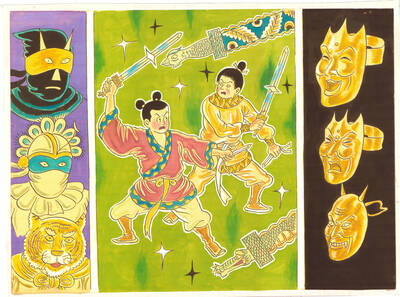
April 22 to April 28 The true identity of the mastermind behind the Demon Gang (魔鬼黨) was undoubtedly on the minds of countless schoolchildren in late 1958. In the days leading up to the big reveal, more than 10,000 guesses were sent to Ta Hwa Publishing Co (大華文化社) for a chance to win prizes. The smash success of the comic series Great Battle Against the Demon Gang (大戰魔鬼黨) came as a surprise to author Yeh Hung-chia (葉宏甲), who had long given up on his dream after being jailed for 10 months in 1947 over political cartoons. Protagonist


 RSS
RSS