


Film-lovers who enjoy experiencing different lives in faraway places without leaving home will have a ball this weekend at the 2005 Taiwan International Ethnographic Film Festival (TIEFF). Founded in 2001, TIEFF is a biennial event that aims to broaden perceptions and encourage communication between ethnic groups and cultures through the medium of ethnographic cinema. Gaining international recognition from the past two events, the festival received more than 250 entries from around the world, and the best 37 films were selected for local audiences.
Choosing the theme of family variations for this year's programs, festival curator Lin Wen-ling (林文玲) said the aim is to present cultural differences and diversity from cross-cultural perspectives on families from various regions.
As a basic social unit, the family is not only closely related to kinship and marital systems, gender roles and customs, but also heavily influenced by social, economic, political and cultural conditions of society. Lin believes that an insightful understanding on the social construction of families can be gained from examining family relationships.
Among the line-up, US director Murray Nossel looks at the issues of gay parenting and surrogate motherhood through the portrait of a new type of American family in his Paternal Instinct. Bride Kidnapping in Kyrgyzstan tells of the story of the abduction of women in the Central Asian country. In Children by Remote Control, director Nahum Landau makes a provoking commentary on the globalization of labor through his knowledge of Thai workers who are torn between heavy economic pressure and their bonds with relatives back home. The Perfect Dream is a film-about-a-film conceived by a group of young refugees from the Third World living in Germany. In the film, they portray mafia members, but in real life, the young actors have to face hardship and misunderstanding in a foreign land.
This year's "Director Spotlight" will introduce two distinguished Australian directors, David and Judith MacDougall, and the late American master John Marshall. The MacDougalls are veteran filmmakers and scholars who have significantly influenced the theory and practice of ethnographic cinema. Two parts of the MacDougalls' renowned Turkana Trilogy, made in the 1980s, will be screened at the festival. Lorang's Way and A Wife Among Wives both examine the society of the semi-nomadic herders of northwestern Kenya and their polygamous marital structure.
In the program dedicated to John Marshall, as a leading figure in ethnographic cinema, the festival will present the first two films of his five-part series of A Kalahari Family that documents 50 years of the lives of tribespeople in South Africa's Karahari Desert. Marshall began his remarkable interaction with the tribe during his first trip to Africa in 1951 and followed closely the changing lives of the tribe members and also got deeply involved in the tribe's fight for the survival of their culture until the series was completed in 2002.
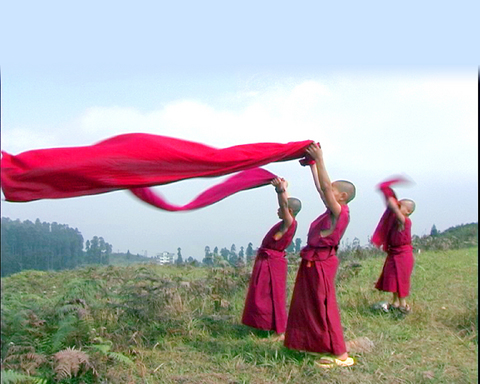
PHOTO COURTESY OF TIEFF
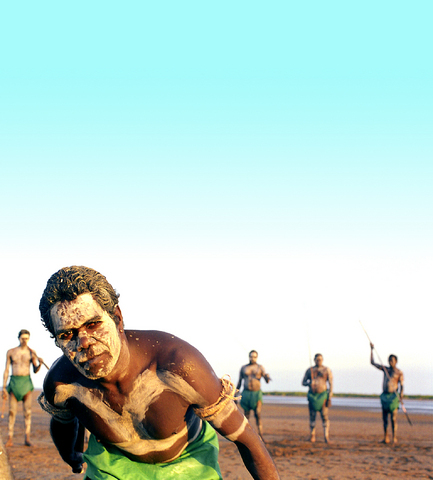
Apart from the family variations series three programs grouped under the theme of new vision will introduce works that examine various issues affecting human rights and indigenous cultures. Indigenous Perspectives presents award-winning films from Australia, Canada, China and Taiwan that document cultural conflicts and the political and social oppression faced by native tribes. The :"Human Rights and Autonomy" section includes What Remains of Us from Canada, a brave documentary about a young director who carried video messages recorded by the former spiritual and political leader of Tibet, the Dalai Lama, into the "largest prison in the world" and shot the film without the knowledge of Chinese authorities. Before the screening, the festival staff will ask the audience to leave all recording equipment outside the theater for the protection and safety of the people featured in the film.
Due to the tight budgets faced by most fringe festivals in Taiwan, the festival will show one screening per day for each film in its five-days. The organizer has invited more than half of the participating foreign directors to Taipei for an international exchange on ethnographic cinema and to hold question and answer sessions after each screening. For more information about the films and screening schedule visit TIEFF's bilingual official Web site at http://www.tieff.sinica.edu.tw.

PHOTO COURTESY OF TIEFF

In late October of 1873 the government of Japan decided against sending a military expedition to Korea to force that nation to open trade relations. Across the government supporters of the expedition resigned immediately. The spectacle of revolt by disaffected samurai began to loom over Japanese politics. In January of 1874 disaffected samurai attacked a senior minister in Tokyo. A month later, a group of pro-Korea expedition and anti-foreign elements from Saga prefecture in Kyushu revolted, driven in part by high food prices stemming from poor harvests. Their leader, according to Edward Drea’s classic Japan’s Imperial Army, was a samurai

Located down a sideroad in old Wanhua District (萬華區), Waley Art (水谷藝術) has an established reputation for curating some of the more provocative indie art exhibitions in Taipei. And this month is no exception. Beyond the innocuous facade of a shophouse, the full three stories of the gallery space (including the basement) have been taken over by photographs, installation videos and abstract images courtesy of two creatives who hail from the opposite ends of the earth, Taiwan’s Hsu Yi-ting (許懿婷) and Germany’s Benjamin Janzen. “In 2019, I had an art residency in Europe,” Hsu says. “I met Benjamin in the lobby
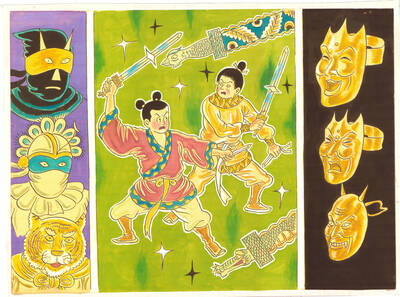
April 22 to April 28 The true identity of the mastermind behind the Demon Gang (魔鬼黨) was undoubtedly on the minds of countless schoolchildren in late 1958. In the days leading up to the big reveal, more than 10,000 guesses were sent to Ta Hwa Publishing Co (大華文化社) for a chance to win prizes. The smash success of the comic series Great Battle Against the Demon Gang (大戰魔鬼黨) came as a surprise to author Yeh Hung-chia (葉宏甲), who had long given up on his dream after being jailed for 10 months in 1947 over political cartoons. Protagonist

A fossil jawbone found by a British girl and her father on a beach in Somerset, England belongs to a gigantic marine reptile dating to 202 million years ago that appears to have been among the largest animals ever on Earth. Researchers said on Wednesday the bone, called a surangular, was from a type of ocean-going reptile called an ichthyosaur. Based on its dimensions compared to the same bone in closely related ichthyosaurs, the researchers estimated that the Triassic Period creature, which they named Ichthyotitan severnensis, was between 22-26 meters long. That would make it perhaps the largest-known marine reptile and would


 RSS
RSS