


The number of hurricanes in the most powerful categories -- like Katrina and Andrew -- has increased sharply over the past few decades, according to a new analysis sure to stir debate over whether global warming is worsening these deadly storms.
While studies have not found an overall increase in tropical storms worldwide, the number of storms reaching categories 4 and 5 grew from about 11 per year in the 1970s to 18 per year since 1990, according to a report in Friday's issue of the journal Science.
Peter Webster, of the Georgia Institute of Technology, said it's the warm water vapor from the oceans that drives tropical storms, and as the water gets warmer the amount of evaporation increases, providing more fuel for the tempests. Between 1970 and 2004 the average sea surface temperature in the tropics rose nearly 1 degree.
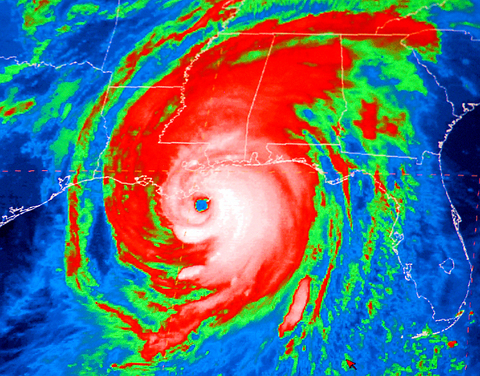
PHOTO: AP
Co-author Greg Holland of the National Center for Atmospheric Research said the researchers can't say rising sea-surface temperatures caused Hurricane Katrina. But their study shows the potential for more Katrina-like events to occur, he said.
Katrina was a category 5 storm at sea and was category 4 when it made landfall. The increase in storms they found is for category 4 and 5. Category 4 storms have wind speeds of 211kph to 249kph and Category 5 is for storms with sustained winds of 251kph and over.
Co-author Judith Curry of Georgia Tech said the team is confident that the measured increase in sea surface temperatures is associated with global warming, adding that the increase in category 4 and 5 storms ``certainly has an element that global warming is contributing to.''
There is a natural variability of the climate and some would interpret the changing number of storms to be part of that variability, Holland said. But the variability in the past has been over 10-year periods, and this is sustained over 30 years.
Webster added that sea surface temperatures ``are rising everywhere in the tropics and that is not connected to any natural variability we know.''
In their analysis of hurricanes -- known as typhoons or cyclones in other parts of the world -- the researchers counted 16 category 4 and 5 storms in the Atlantic-Caribbean-Gulf of Mexico from 1975 to 1989. This increased to 25 in the 1990 to 2004 period.
In the eastern Pacific the increase was from 36 to 49 storms and it went from 85 to 116 in the western Pacific. In the southwest Pacific the increase was from 10 to 22 powerful storms, while the total went from one to seven in the north Indian Ocean and from 23 to 50 in the south Indian Ocean.
Kerry Emanuel, a climatologist at Massachusetts Institute of Technology, reported in August in the journal Nature that hurricanes in both the Atlantic and Pacific have increased in duration and intensity since the 1970s.
While the new study looks at the problem differently, ``we are clearly seeing the same signal in the data,'' Emanuel said.
But other researchers were cautious.
Christopher Landsea, a meteorologist at the National Oceanic and Atmospheric Administration's Hurricane Research Division in Miami, questioned the data showing an increase in major storms, saying the estimates of the wind speed in storms in the 1970s may not be accurate.
The study looked at storms worldwide, and ``for most of the world there was no way to determine objectively what the winds were in 1970,'' he said. The techniques used today were invented later and infrared satellite studies weren't available until the 1980s, Landsea said.
The Atlantic-Caribbean-Gulf of Mexico region is the best monitored in the world and that region had the smallest increase, he noted.
``This really highlights the need to go back and get all the original data ... and reanalyze the storms with today's
techniques,'' Landsea said in a telephone interview. ``These are billion-dollar questions and we need to better answer them.''
Holland agreed there have been changes in the observing system since the 1970s but noted the increase has been steady over the period, ``it didn't just kick in when the new measurement methods kicked in.''
The fact that the trend is smaller in the Atlantic basin is beside the point, he added, because it has gone up there too.
``The end result is that there is no doubt that there is a substantial increase here,'' Holland said.
Roger Pielke, director of the Center for Science and Technology Policy Research at the University of Colorado, said the report ``reinforces the view that we should pay even greater attention to preparing for the inevitability of future intense hurricanes striking vulnerable locations around the world. In the context of ever-growing coastal development, the costs of hurricanes are going to continue to escalate.''
Emanuel, Landsea and Pielke were not part of Webster's research team. Webster's research was funded by the National Science Foundation and the National Center for Atmospheric Research.

In late October of 1873 the government of Japan decided against sending a military expedition to Korea to force that nation to open trade relations. Across the government supporters of the expedition resigned immediately. The spectacle of revolt by disaffected samurai began to loom over Japanese politics. In January of 1874 disaffected samurai attacked a senior minister in Tokyo. A month later, a group of pro-Korea expedition and anti-foreign elements from Saga prefecture in Kyushu revolted, driven in part by high food prices stemming from poor harvests. Their leader, according to Edward Drea’s classic Japan’s Imperial Army, was a samurai

Located down a sideroad in old Wanhua District (萬華區), Waley Art (水谷藝術) has an established reputation for curating some of the more provocative indie art exhibitions in Taipei. And this month is no exception. Beyond the innocuous facade of a shophouse, the full three stories of the gallery space (including the basement) have been taken over by photographs, installation videos and abstract images courtesy of two creatives who hail from the opposite ends of the earth, Taiwan’s Hsu Yi-ting (許懿婷) and Germany’s Benjamin Janzen. “In 2019, I had an art residency in Europe,” Hsu says. “I met Benjamin in the lobby

April 22 to April 28 The true identity of the mastermind behind the Demon Gang (魔鬼黨) was undoubtedly on the minds of countless schoolchildren in late 1958. In the days leading up to the big reveal, more than 10,000 guesses were sent to Ta Hwa Publishing Co (大華文化社) for a chance to win prizes. The smash success of the comic series Great Battle Against the Demon Gang (大戰魔鬼黨) came as a surprise to author Yeh Hung-chia (葉宏甲), who had long given up on his dream after being jailed for 10 months in 1947 over political cartoons. Protagonist

Peter Brighton was amazed when he found the giant jackfruit. He had been watching it grow on his farm in far north Queensland, and when it came time to pick it from the tree, it was so heavy it needed two people to do the job. “I was surprised when we cut it off and felt how heavy it was,” he says. “I grabbed it and my wife cut it — couldn’t do it by myself, it took two of us.” Weighing in at 45 kilograms, it is the heaviest jackfruit that Brighton has ever grown on his tropical fruit farm, located


 RSS
RSS