


It's only recently that the world has begun to perceive the 1920s in China as having been a fascinating period. That it was a time of dissension and competing ideologies, not to mention warring factions, has long been understood. But now it is becoming clear that it was also a time of a considerable internationalism among the educated classes, as well as an era when significant numbers of the more adventurous from Europe and elsewhere opted to go there and see what the other side of the planet was like.
It's in 1920s China that Adam Williams sets his second blockbusting historical adventure. His first, The Palace of Heavenly Pleasures, reviewed in the Taipei Times on Jan. 11, 2004, dealt with events surrounding the Boxer Rebellion of 1900. It's now a generation later, and several of the off-spring of the characters from the first book now take center-stage, notably the Airton family.
This time, however, Williams offers us a heroine of at least nominal complexity. Her name is Catherine Cabot, and he gives her elements of the life-story, although not the personality, of his own grandmother ("she never behaved as badly as my Catherine"). He presents her as both a compassionate nurse in World War I, and an independently-minded woman who has sex with her fiancee's brother a few nights before her wedding.
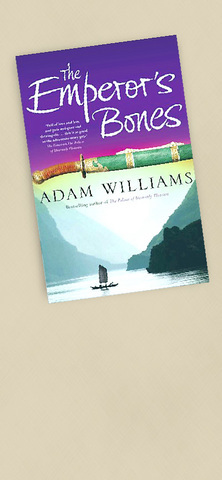
Great novels are supposed to be characterized by their characters' complexity as well as their variety. This is not a "great novel" in the way War and Peace is. It is, instead, a red-blooded, vigorous, easy-to-read adventure story based on a large amount of historical knowledge. And, being an intelligent man, Adam Williams is not averse to taking a leaf out of greater writers' books. This seems to me a virtue, and this long story benefits from, among other things, the unpredictability of Catherine's behavior.
Then there is Yu Fu-kuei, a young Chinese woman with Communist sympathies. Despite a stint studying at Oxford, where she is punted down the River Cherwell as she reads the poetry of Andrew Marvell, she retains her radical beliefs. The university's quasi-orthodoxy that there's something to be said on every side of almost every question fails to deter her, though later events back home in China prove another matter.
There are grotesquely horrific scenes, with atrocities perpetrated by all sides. On one occasion Catherine and Fu-kuei are captured and brought before a night-time kangaroo court presided over by the son of a Shanghai tycoon. Students suspected of being Communists are flung alive, after "court hearings" lasting seconds, into a furnace, and the two women only escape at dawn by a slightly contrived last-moment intervention. (It seems acceptable to give away this plot twist here because there are innumerable others waiting to surprise and amaze the reader).
The author comments in an afterword that, "writers of fiction rapidly realize that it is difficult to invent stranger things than actually happened," and as a result many of the characters here are based on real-life historical models. Williams's fictional journalist Willie Lampsett, for instance, is based on a Danish original, A. Krarup Neilsen. But many historical figures appear in their own right -- Mikhail Borodin, Soviet adviser to the Kuomintang and a leading influence on the Chinese Communist Party, Chang Tso-lin, warlord of Manchuria, "tiger of the north" and conservative opponent of Chiang Kai-shek, and Colonel Doihara Kenji, celebrated at the time, possibly with a shiver of irony, as "the Japanese T.E. Lawrence".
Most of all, however, the author uses the experiences of his own family, members of which, he states, have now been living and working in China for five generations. "In the afterword to my first novel I wrote of how my ancestors would be rolling in their graves if they knew what I had done to them in my fiction. They will continue rolling through this book."
The action certainly embraces many of the main political events of the era -- the Fengtian-Chihli Wars of 1922 and 1924, the Northern Expedition of 1926 to 1928, the Nanjing Outrage and the Shanghai massacre of 1927.
The Emperor's Bones can be thoroughly recommended. It's not Tolstoy, but it does have some of his more easily assimilated virtues -- events ranging over a wide historical panorama, real characters from history conversing with imagined ones, and so on. Moreover, it doesn't claim to be anything it isn't. Many swashbuckling historical narratives conceal a cynical manipulation of the allure that scenes of sex and of brutality have for many readers. For some reason Adam Williams, for all the violence and unashamed eroticism in his two books, doesn't feel like that. There is an almost school-boyish innocence about him, making these romances akin to Rider Haggard's 100-year-old adventure stories, or John Buchan's of a generation later. Altogether, it feels a very English approach -- relishing high-spirited forays into distant lands without looking over-closely at the darker motivations that more skeptical souls would readily perceive as lying beneath them.
This, then, is a rollicking, action-packed, lusty tale of adventure. It's certain to be very successful, and it deserves to be. It would make an excellent film. Anyone who wants many hours of none-too-taxing thrills will enjoy it. But it's also very well-researched, and readers will receive a painless education in the politics of China in the 1920s while relishing the rolls in the hay, the grand set-pieces, and the rapid movement of characters and events across the landscapes of eastern China.

Last week Joseph Nye, the well-known China scholar, wrote on the Australian Strategic Policy Institute’s website about how war over Taiwan might be averted. He noted that years ago he was on a team that met with then-president Chen Shui-bian (陳水扁), “whose previous ‘unofficial’ visit to the US had caused a crisis in which China fired missiles into the sea and the US deployed carriers off the coast of Taiwan.” Yes, that’s right, mighty Chen caused that crisis all by himself. Neither the US nor the People’s Republic of China (PRC) exercised any agency. Nye then nostalgically invoked the comical specter

Relations between Taiwan and the Czech Republic have flourished in recent years. However, not everyone is pleased about the growing friendship between the two countries. Last month, an incident involving a Chinese diplomat tailing the car of vice president-elect Hsiao Bi-khim (蕭美琴) in Prague, drew public attention to the People’s Republic of China’s (PRC) operations to undermine Taiwan overseas. The trip was not Hsiao’s first visit to the Central European country. It was meant to be low-key, a chance to meet with local academics and politicians, until her police escort noticed a car was tailing her through the Czech capital. The
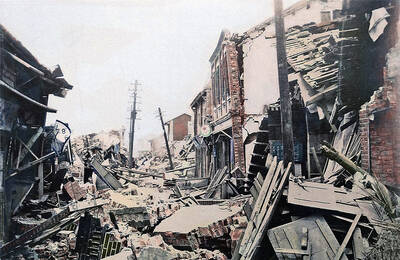
April 15 to April 21 Yang Kui (楊逵) was horrified as he drove past trucks, oxcarts and trolleys loaded with coffins on his way to Tuntzechiao (屯子腳), which he heard had been completely destroyed. The friend he came to check on was safe, but most residents were suffering in the town hit the hardest by the 7.1-magnitude Hsinchu-Taichung Earthquake on April 21, 1935. It remains the deadliest in Taiwan’s recorded history, claiming around 3,300 lives and injuring nearly 12,000. The disaster completely flattened roughly 18,000 houses and damaged countless more. The social activist and

Over the course of former President Ma Ying-jeou’s (馬英九) 11-day trip to China that included a meeting with Chinese Communist Party (CCP) leader Xi Jinping (習近平) a surprising number of people commented that the former president was now “irrelevant.” Upon reflection, it became apparent that these comments were coming from pro-Taiwan, pan-green supporters and they were expressing what they hoped was the case, rather than the reality. Ma’s ideology is so pro-China (read: deep blue) and controversial that many in his own Chinese Nationalist Party (KMT) hope he retires quickly, or at least refrains from speaking on some subjects. Regardless


 RSS
RSS