


They came from the same remote mountains of southwestern France, in the heart of Basque country, but their fateful first encounter took place in Paris.
"It was," recalled Pierre Oteiza, dressed in his region's signature black beret and red neck scarf, "un coup de coeur," or love at first sight.
That Oteiza had never laid eyes on the hairy, lop-eared Basque pigs indigenous to his own backyard was hardly surprising: classified as an endangered species, there were only 25 specimens in all of France when he stumbled across them at an agricultural fair in 1988.
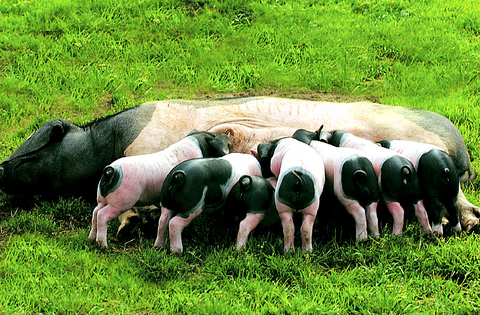
PHOTO: AFP
He bought two and brought them home to his wife.
Today -- thanks to Oteiza -- the Basque pig population stands at over 3,000, scattered around this luxuriant valley where Oteiza and neighboring farmers raise the pigs and produce a much prized cured ham, along with other pork products, sold throughout France and abroad.
"It pleased me greatly to have a Basque breed of pig and to be able to use it here," Oteiza said. "It is a species that is completely adapted to the Basque country -- its climate, countryside, recipes."
The pigs, in other words, have thrived. But the relationship is definitely symbiotic. "Thanks to the pig we have been able to keep the valley alive," said Oteiza, who has built a flourishing business including eight stores in southern France and Paris.
Not only have the black-and-white hogs provided a source of livelihood for some 50 small farmers, they also "help preserve the forest by cleaning the undergrowth," he explained.
Hardy and wily, the pigs snuffle out acorns, chestnuts, roots and grass. Rings in their noses prevent damage to pasture land.
The ecological approach to pig farming practiced by Oteiza dovetails with both a growing international appetite for authentic and natural products, and the French notion of "terroir": the indelible link between food -- be it fruits, wine, cheese or cured ham -- and the micro-environment that nourishes it.
Indeed, Oteiza's story is not just about the revival of a dying breed of domesticated pig. It's also about the survival of a way of life and the region's distinctive Basque culture.
To give outsiders a glimpse of his world, Oteiza has created a marked discovery trail near his farm.
First stop is the "nursery," a small grassy enclosure with little teepee-shaped, thatched shelters inhabited by pregnant sows and tiny piglets. A pair of expectant sows amble up to the fence to inspect visitors, while a huddle of piglets squeal gleefully while scrabbling in the mud.
Moving on to wooded lower slopes covered with beech, chestnut trees, and century-old oaks, one sees a drove of about 60 young pigs let out to instill their natural tribal instinct, along with an older troop roaming freely on the deep red soil of the mountainside amidst sheep and pottok ponies. Wild vultures fly overhead.
Oteiza culls about 2,000 pigs per year. The 4,000 hams they produce are cured in a new, state-of-the-art factory he shares on a cooperative basis with other "charcutiers," or pork butchers.
The workplace is stainless-steel spic-n-span, but the savoir faire is strictly old school. Each ham is vigorously rubbed with a secret blend of salt from the Adour basin and Espelette pepper, and then hung to dry from tall wooden racks for at least a year. Temperature and humidity are carefully controlled.
Unlike the better known "jambon de Bayonne" (or Bayonne ham) which, though cured locally, can be made from any type of pig raised anywhere in France, Oteiza's more savory "jambon de porc Basque" can only be made with his beloved Basque pigs.
The pigs' foraging diet gives the meat -- a darker blackish-red than most cured hams -- a special flavor and texture.
"It's method of drying, and the type of pig give it a flesh that is particularly tender and finely marbled. Its flavor has a hint of hazelnut," says Alain Souliac, chef at Alain Ducasse's luxury rural inn, the Auberge Ostapi, in nearby Bidarray.
Souliac serves the ham at breakfast, with brioche, a flaky buttered bread, or on top of scrambled eggs.
Oteiza also sells to other luxury hotels and restaurants, as well as in his own network of stores (www.pierreoteiza.com). About 10 percent of his production is exported, mainly to Japan and elsewhere in Europe.
At US$198 for 7kg, a whole leg of jambon de porc Basque sells for nearly twice as much as another cured ham Oteiza makes from locally raised "ordinary" white pigs.
Today the Basque pigs of the Aldudes Valley are officially recognized as a pure breed. Oteiza has also applied for a prized "appellation d'origine controlee," a government-certified guarantee of origin that would bring official recognition of the special quality of the pig and its affinity with its native land.
Next February Oteiza will once again go to the annual agriculture fair in Paris where he first spotted the Basque pigs. Except this time he will be the one exhibiting them.

In late October of 1873 the government of Japan decided against sending a military expedition to Korea to force that nation to open trade relations. Across the government supporters of the expedition resigned immediately. The spectacle of revolt by disaffected samurai began to loom over Japanese politics. In January of 1874 disaffected samurai attacked a senior minister in Tokyo. A month later, a group of pro-Korea expedition and anti-foreign elements from Saga prefecture in Kyushu revolted, driven in part by high food prices stemming from poor harvests. Their leader, according to Edward Drea’s classic Japan’s Imperial Army, was a samurai

The following three paragraphs are just some of what the local Chinese-language press is reporting on breathlessly and following every twist and turn with the eagerness of a soap opera fan. For many English-language readers, it probably comes across as incomprehensibly opaque, so bear with me briefly dear reader: To the surprise of many, former pop singer and Democratic Progressive Party (DPP) ex-lawmaker Yu Tien (余天) of the Taiwan Normal Country Promotion Association (TNCPA) at the last minute dropped out of the running for committee chair of the DPP’s New Taipei City chapter, paving the way for DPP legislator Su

Located down a sideroad in old Wanhua District (萬華區), Waley Art (水谷藝術) has an established reputation for curating some of the more provocative indie art exhibitions in Taipei. And this month is no exception. Beyond the innocuous facade of a shophouse, the full three stories of the gallery space (including the basement) have been taken over by photographs, installation videos and abstract images courtesy of two creatives who hail from the opposite ends of the earth, Taiwan’s Hsu Yi-ting (許懿婷) and Germany’s Benjamin Janzen. “In 2019, I had an art residency in Europe,” Hsu says. “I met Benjamin in the lobby

April 22 to April 28 The true identity of the mastermind behind the Demon Gang (魔鬼黨) was undoubtedly on the minds of countless schoolchildren in late 1958. In the days leading up to the big reveal, more than 10,000 guesses were sent to Ta Hwa Publishing Co (大華文化社) for a chance to win prizes. The smash success of the comic series Great Battle Against the Demon Gang (大戰魔鬼黨) came as a surprise to author Yeh Hung-chia (葉宏甲), who had long given up on his dream after being jailed for 10 months in 1947 over political cartoons. Protagonist


 RSS
RSS