


he sad and sonorous sound of the erhu, the musical instrument that epitomizes Chinese music, is weathering an attack from nature lovers who fear its snake skin covered sound box is driving the mighty python into extinction.
Favorably compared to the violin, the erhu is revered in China for its natural sound and has long been viewed as the instrument that best reflects the human voice, most notably a weeping lady.
Countless pieces of music, mostly sad and melancholy, have been written for the long-necked two-stringed instrument, played with a horsehair bow and boasting a more than 1,000 year history.
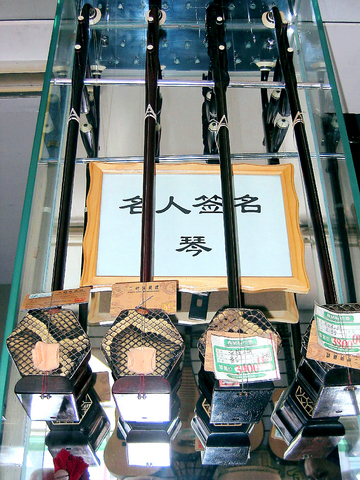
PHOTO: AFP
"The most important part of the erhu is the python skin, the reverberations of the skin give the erhu its unique sound," said Yang Youlin, manager of the Beijing Music Book Store.
"Without the python skin, an erhu is not an erhu. Snake skin, sheep skin, wood, won't do."
Even the cost of an erhu, which range up to 8,000 yuan (US$1,000), depends on what part of the python is used for the sound box membrane, with seasoned erhu players preferring the belly side of the snake near the tail, Yang said.

PHOTO: AFP
"A lot of factors go into the sound -- the age of the snake, the size and the uniformity of the scales and the thickness of the skin are all important," Yang said.
The problem is that with China's economy booming, more and more people are buying and learning to play the instrument.
China's opening up to the West has also ensured that an increasing number of overseas fans, especially in Japan and Singapore, are also buying the instrument.
Other instruments, like the sanxian, a three stringed plucked instrument, also uses a python skinned sound box, while python skins have long been used for Chinese drums and tambourines.
The nation's growing demand for python is further stepping up competition internationally where python skins are valued in the usual reptilian fare of purses, wallets, jackets, boots, belts and bags.
"The python has been nearly extinct in China in the wild since the 1980s and much of this is because of the demand for python skins in the music industry," said Xu Hongfa, a wildlife trade expert for TRAFFIC East Asia, a group that monitors the trafficking in endangered species.
"Since then, the wild populations in Southeast Asia have begun to fall and the smuggling of python skins from Southeast Asia into China has grown."
A relish for python meat in southern China, he said, has also played a role in the demise of the snake that thrives in a jungle setting and can grow to up to 6m long.
After ratifying the UN Convention on the International Trade in Endangered Species (CITES), China passed its Law on the Protection of Endangered Species in 1988, effectively making the unlicensed use and trade in pythons illegal, Xu said.
But implementation of the law has not been easy, prompting TRAFFIC East Asia and other environmental groups to work with the State Forestry Administration to set up a certification process between python skin sellers in Southeast Asia and musical instrument factories in China.
New regulations that went into effect on Jan. 1 also require that all erhus have a certificate from the administration, which certify that the erhu python skin is not made with wild pythons, but from farm-raised pythons, he said.
Individuals are now only allowed to take two erhus out of China when travelling, while commercial buyers also need additional export certificates.
"The situation was getting out of hand, so the government had to do something," said Feng Yuankai, spokesman for the China Musical Instrument Association.
"Basically the manufacturers have supported and embraced the new policy as a way to maintain a sustainable industry, the certification also means that they are legally trading in python skins, which was not the case before the new regulations."
In 2003, China's nearly 100 erhu manufacturing enterprises used some 30,000 python skins to produce about 400,000 erhus, with production expected to continue rising with growing international demand, Feng said.
"This is a 1,000-year-old tradition in China, so at first I think that the manufacturers were not too happy about the new policy," said TRAFFIC East Asia's Hu.
"The new regulations have resulted in the price of python skin rising by almost 100 percent, but now the manufacturers are finding that they can raise the price of their erhu as well, which I think they like."

The year was 1991. A Toyota Land Cruiser set out on a 67km journey up the Junda Forest Road (郡大林道) toward an old loggers’ camp, at which point the hikers inside would get out and begin their ascent of Jade Mountain (玉山). Little did they know, they would be the last group of hikers to ever enjoy this shortcut into the mountains. An approaching typhoon soon wiped out the road behind them, trapping the vehicle on the mountain and forever changing the approach to Jade Mountain. THE CONTEMPORARY ROUTE Nowadays, the approach to Jade Mountain from the north side takes an

Relations between Taiwan and the Czech Republic have flourished in recent years. However, not everyone is pleased about the growing friendship between the two countries. Last month, an incident involving a Chinese diplomat tailing the car of vice president-elect Hsiao Bi-khim (蕭美琴) in Prague, drew public attention to the People’s Republic of China’s (PRC) operations to undermine Taiwan overseas. The trip was not Hsiao’s first visit to the Central European country. It was meant to be low-key, a chance to meet with local academics and politicians, until her police escort noticed a car was tailing her through the Czech capital. The

Last week Joseph Nye, the well-known China scholar, wrote on the Australian Strategic Policy Institute’s website about how war over Taiwan might be averted. He noted that years ago he was on a team that met with then-president Chen Shui-bian (陳水扁), “whose previous ‘unofficial’ visit to the US had caused a crisis in which China fired missiles into the sea and the US deployed carriers off the coast of Taiwan.” Yes, that’s right, mighty Chen caused that crisis all by himself. Neither the US nor the People’s Republic of China (PRC) exercised any agency. Nye then nostalgically invoked the comical specter

April 15 to April 21 Yang Kui (楊逵) was horrified as he drove past trucks, oxcarts and trolleys loaded with coffins on his way to Tuntzechiao (屯子腳), which he heard had been completely destroyed. The friend he came to check on was safe, but most residents were suffering in the town hit the hardest by the 7.1-magnitude Hsinchu-Taichung Earthquake on April 21, 1935. It remains the deadliest in Taiwan’s recorded history, claiming around 3,300 lives and injuring nearly 12,000. The disaster completely flattened roughly 18,000 houses and damaged countless more. The social activist and


 RSS
RSS