


Scientists have created embryos from a single parent for the first time in the UK.
Paul de Sousa, a researcher at the Roslin Institute, which also cloned Dolly the sheep, told a press briefing at the British Association festival of science in Dublin last week that his team had created so-called parthenotes, early-stage embryos that are made from a single egg, without the need for sperm.
The researchers have so far created six parthenotes by taking donated eggs from women who were undergoing sterilization. The eggs were given an electric shock to make them divide.
Dr De Sousa said that the intention was to harvest stem cells for the parthenotes but, as yet, the team had not been successful.
Embryonic stem cells are the body's master cells that can turn into any tissue in the body. They can be harvested when the embryo is just a few days old and in the form of a ball of cells called the blastocyst.
Scientists want to use the cells for research into developing treatments for a range of conditions including Parkinson's and Alzheimer's disease.
Parthenogenesis occurs naturally in a number of animals. Bees and ants use it to produce their worker drones and some larger animals can also reproduce this way -- lizards, for example -- but it is rare.
Dr De Sousa said his human parthenotes would never be implanted into a womb, which is prohibited by his research license in any case.
Scientists in the US have already produced human parthenotes, but they have not been successful in extracting stem cells.
Organ trials
Clinical trials using animal organs to keep humans alive may be just five years away, an expert has said.
Anthony Warrens, from Imperial College London, said the technical obstacles to successful transplantation of animal organs into humans had almost been surmounted, revitalizing research in the area.
"If you had asked me five years ago, I'd have been very pessimistic. But there have been significant developments in the course of the last year that make one feel this is a problem we can get around," he told the British Association festival.
Dr Warrens said the shortfall in the number of donor organs needed by doctors was intense: for every human organ that becomes available for transplant, there are five people on waiting lists who could benefit.
"If it were feasible to use animals as organ donors, an unlimited supply would potentially become instantly available," said Dr Warrens.
Pigs are the main focus of interest for researchers in this area, because they are of similar size to humans and can be cultivated in large numbers. They are also genetically similar enough for their organs to work in people, but sufficiently distant to reduce likelihood of transfer of infections.
Silent night
Silent aeroplanes could be flying within 20 years Cambridge University engineers said at the British Association festival in Dublin.
A GBP2.3m project has come up with plans for a radical aircraft, with four engines on top of a wing-shaped fuselage,which should be so quiet no noise would be heard outside an airport.
Paul Collins, the project manager of the Silent Aircraft Initiative, a collaboration between Cambridge University and the Massachusetts Institute of Technology, said, "The purpose is to bring in an aircraft that could really reduce noise disturbance."
The flying wing means that there is less air turbulence, hence less noise."The turbulence around the aircraft, the undercarriage and all the flaps creates as much noise as the engines. What we now need to do is to silence those as well."
Anurag Agarwal, an engineer on the project, said that the engine noise would be shielded by the fuselage. "If you think of light waves coming out of the forward section of the engines, then these rays would bounce off the upper surface of the wing and it would leave a shadow region underneath," he said.

In late October of 1873 the government of Japan decided against sending a military expedition to Korea to force that nation to open trade relations. Across the government supporters of the expedition resigned immediately. The spectacle of revolt by disaffected samurai began to loom over Japanese politics. In January of 1874 disaffected samurai attacked a senior minister in Tokyo. A month later, a group of pro-Korea expedition and anti-foreign elements from Saga prefecture in Kyushu revolted, driven in part by high food prices stemming from poor harvests. Their leader, according to Edward Drea’s classic Japan’s Imperial Army, was a samurai
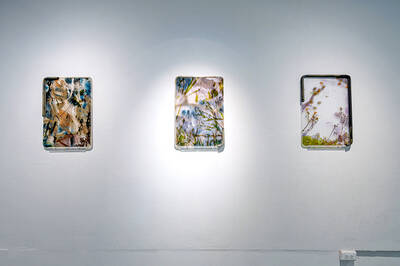
Located down a sideroad in old Wanhua District (萬華區), Waley Art (水谷藝術) has an established reputation for curating some of the more provocative indie art exhibitions in Taipei. And this month is no exception. Beyond the innocuous facade of a shophouse, the full three stories of the gallery space (including the basement) have been taken over by photographs, installation videos and abstract images courtesy of two creatives who hail from the opposite ends of the earth, Taiwan’s Hsu Yi-ting (許懿婷) and Germany’s Benjamin Janzen. “In 2019, I had an art residency in Europe,” Hsu says. “I met Benjamin in the lobby

April 22 to April 28 The true identity of the mastermind behind the Demon Gang (魔鬼黨) was undoubtedly on the minds of countless schoolchildren in late 1958. In the days leading up to the big reveal, more than 10,000 guesses were sent to Ta Hwa Publishing Co (大華文化社) for a chance to win prizes. The smash success of the comic series Great Battle Against the Demon Gang (大戰魔鬼黨) came as a surprise to author Yeh Hung-chia (葉宏甲), who had long given up on his dream after being jailed for 10 months in 1947 over political cartoons. Protagonist

Peter Brighton was amazed when he found the giant jackfruit. He had been watching it grow on his farm in far north Queensland, and when it came time to pick it from the tree, it was so heavy it needed two people to do the job. “I was surprised when we cut it off and felt how heavy it was,” he says. “I grabbed it and my wife cut it — couldn’t do it by myself, it took two of us.” Weighing in at 45 kilograms, it is the heaviest jackfruit that Brighton has ever grown on his tropical fruit farm, located


 RSS
RSS