


In an incisive and eloquent new book, the Washington Post reporter Anthony Shadid tells the story of a man named Sabah who is accused of being a US informer in the town of Thuluyah. Sabah is blamed by villagers for the deaths of a teenager and two men in an American raid, and his case becomes a matter of tribal justice: Relatives of the dead men make it clear to Sabah's relatives that "either they kill Sabah, or villagers would murder the rest of his family."
According to Shadid, Sabah's father and brother, carrying AK-47s, take him out to their backyard orchard and take aim and fire.
"Even the prophet Abraham didn't have to kill his son," the father later tells Shadid, sadly adding that in his case "there was no other choice."

Sabah's story is only one of many tragic stories to be found in Night Draws Near, a book that gives a harrowing portrait of life in postwar Iraq and the fallout that the American war has had on ordinary Iraqi civilians, from a 14-year-old girl coping with the bombing of Baghdad to a 62-year-old academic and former Baath Party member to the reporter's own "fixer" and government minder, Nasir Mehdawi, who would later became a colleague and friend.
The volume draws heavily upon Shadid's reporting for the Washington Post. (His dispatches from Iraq won the 2004 Pulitzer Prize for international reporting.) It leaves the reader with a devastating sense of the gap between the war's aims and its aftermath and the gap between the administration's rhetoric and the realities on the ground. Though much of the factual material in the book will be familiar to dedicated newspaper readers, Shadid does a fluent job of pulling all this information into a riveting narrative that is animated by his up-close and personal portraits of individual Iraqis.
At the same time, Night Draws Near, much like Larry Diamond's book Squandered Victory, which appeared this summer, also provides a damning account of the Bush administration's failure to prepare adequately for the postwar occupation of Iraq and its missteps and miscalculations after toppling former president Saddam Hussein.
"There was never really a plan for post-Saddam Iraq," Shadid writes. "There was never a realistic view of what might ensue after the fall. There was hope that became faith, and delusions that became fatal."
Trusting Iraqi exiles like Ahmad Chalabi and believing "their own rhetoric of liberation," he argues, US officials naively assumed that "everything would fall into place after Saddam's departure."
As a result too few troops were committed to secure the victory, and looting, score-settling and lawlessness followed. Even months after the collapse of Saddam's regime, many Iraqis were still lacking basic services like electricity and water; unemployment and food prices had soared, and daily life for many had turned into a minefield.
The political consequences of the continuing violence would be severe, as Shadid's sources attest. Even many of those Iraqis who were joyous at Saddam's fall and who were prepared to think the best of the Americans began to question the failure of the US, the most powerful nation on the face of the earth, to establish order.
As Shadid puts it, "Saddam had ruled for 35 years, the Americans had toppled him in less than three weeks, and relatively few of their soldiers and died in the task. How could these same Americans be so feeble in the aftermath?"
As the weeks of violence turned into months, frustration turned to bitterness and resentment at what was perceived by many Iraqis as "malicious inattention or inattentive malice" on the part of the US. Memories of the Reagan administration's support for Saddam's government during the Iran-Iraq war resurfaced, as well as grievances over the US-supported sanctions that took such a toll on the civilians. "God Curse Saddam and the Americans" became a popular graffiti. One man Shadid interviewed even asserted that Saddam had been in cahoots with the Americans, giving them a pretext to occupy Iraq.
As the months passed and Shadid continued his travels through the volatile streets of Baghdad and the even more volatile streets of smaller towns and villages, he witnessed the seeds of the insurgency blossom and take root. Given the power vacuum created by the fall of a government that had held sway for decades and the US decision to dissolve the Iraqi army, vociferous religious leaders like Muqtada al-Sadr stepped forward, and disparate groups (including former supporters of Saddam, Iraqi nationalists, radical Islamists and foreign agitators) started to come together under the banner of resistance.
"Rather than Iraq changing the Arab world" as American leaders had hoped, Shadid writes, "the Arab world, with its complement of impressions, prejudices,
aspirations, and resentments, began changing Iraq. As time passed, towns in the Sunni regions began to feel more and more recognizable to reporters like me who had spent years in Arab places."
Shadid sees the elections in January as a sign of hope. But he points out that after those elections, the "forces of religious revival, growing militancy, and hardening sectarianism, underlined by grievance and a threat of even more strife, returned to the stage."
He reports that Iraqi police and security forces are often denounced as collaborators or traitors, that Iraqi society is growing increasingly atomized.
For ordinary Iraqis, who lived through the repressive regime of Saddam, the harrowing losses of the Iran-Iraq war, the ravages of the Persian Gulf War of 1991 and the hardships of international sanctions, the invasion by America and the continuing insurgency represent yet another chapter in what seems like a Sisyphean litany of suffering.

Last week Joseph Nye, the well-known China scholar, wrote on the Australian Strategic Policy Institute’s website about how war over Taiwan might be averted. He noted that years ago he was on a team that met with then-president Chen Shui-bian (陳水扁), “whose previous ‘unofficial’ visit to the US had caused a crisis in which China fired missiles into the sea and the US deployed carriers off the coast of Taiwan.” Yes, that’s right, mighty Chen caused that crisis all by himself. Neither the US nor the People’s Republic of China (PRC) exercised any agency. Nye then nostalgically invoked the comical specter

Relations between Taiwan and the Czech Republic have flourished in recent years. However, not everyone is pleased about the growing friendship between the two countries. Last month, an incident involving a Chinese diplomat tailing the car of vice president-elect Hsiao Bi-khim (蕭美琴) in Prague, drew public attention to the People’s Republic of China’s (PRC) operations to undermine Taiwan overseas. The trip was not Hsiao’s first visit to the Central European country. It was meant to be low-key, a chance to meet with local academics and politicians, until her police escort noticed a car was tailing her through the Czech capital. The
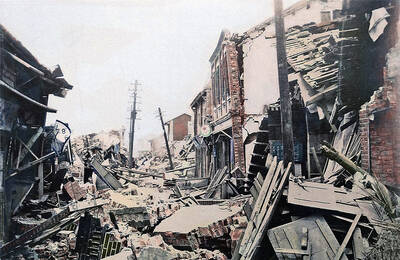
April 15 to April 21 Yang Kui (楊逵) was horrified as he drove past trucks, oxcarts and trolleys loaded with coffins on his way to Tuntzechiao (屯子腳), which he heard had been completely destroyed. The friend he came to check on was safe, but most residents were suffering in the town hit the hardest by the 7.1-magnitude Hsinchu-Taichung Earthquake on April 21, 1935. It remains the deadliest in Taiwan’s recorded history, claiming around 3,300 lives and injuring nearly 12,000. The disaster completely flattened roughly 18,000 houses and damaged countless more. The social activist and

Over the course of former President Ma Ying-jeou’s (馬英九) 11-day trip to China that included a meeting with Chinese Communist Party (CCP) leader Xi Jinping (習近平) a surprising number of people commented that the former president was now “irrelevant.” Upon reflection, it became apparent that these comments were coming from pro-Taiwan, pan-green supporters and they were expressing what they hoped was the case, rather than the reality. Ma’s ideology is so pro-China (read: deep blue) and controversial that many in his own Chinese Nationalist Party (KMT) hope he retires quickly, or at least refrains from speaking on some subjects. Regardless


 RSS
RSS