


Now the curtain has come down on the Taipei 2005 Summer Jazz Festival and organizers are still busy finalizing the line up for this year's Taichung Fall Jazz Festival, fans of the musical genre looking for something a little bit different should consider checking out the new crossover creations of popular local jazz ensemble Metamorphosis at Taipei's Red House Theater this weekend.
Founded in 1997, Metamorphosis has done more than most to promote jazz in a nation more in tune with Mando-pop and Western rock. In the late 1990s it became the in-house band for Taipei's oldest and most respected jazz venue, The Blue Note, and was one of the first local jazz acts to incorporate its own original works into its sets.
The largely improvisational pieces proved hugely popular with the local jazz crowd. In 2001 the combo released the first-ever locally produced jazz album to feature original works by a Taiwanese jazz band. Metamorphosis Live (
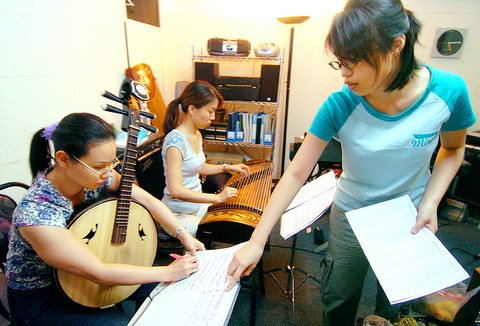
PHOTO: CHEN TSE-MING, TAIPEI TIMES
"The popularity of jazz five years ago was incredibly small. The record company published the album, but promotion was really left up to us," said Metamorphosis founding member Peng Yu-wen (
Since the band's early days' jazz has taken hold in Taiwan. And although it's still a genre enjoyed by a minority, the combo's home-grown brand of jazz has proven hugely successful. Metamorphosis is now a regular not only at the Blue Note but it also performs several times a month at Taipei's Witch House and the Riverside Music Cafe.
Members of the popular local jazz combo will be moving far away from their jazzy roots this weekend, however, and will hopefully be creating a whole new buzz with a set of original jazz based vibes.
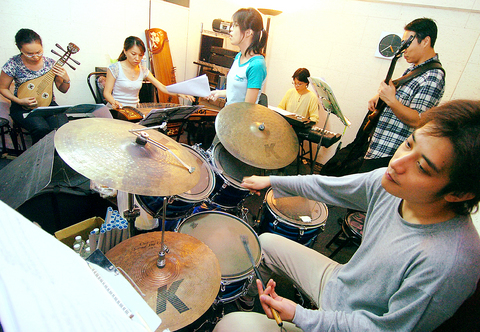
Metamorphosis has, for a limited period, joined forces with several classical Chinese musicians and morphed itself into a hybrid ensemble that combines contemporary jazz standards with traditional oriental sounds. The auxiliary combo consists of three traditional jazz musicians and five classical Chinese instrumentalists and was the brainchild of Peng and composer Lai Hsiao-li (
The integration of traditional Chinese music into various genres of music is not uncommon, but its amalgamation with jazz standards is something that, according to Peng, has never been attempted in Taiwan before.
"Traditional Chinese music has been incorporated into rock and pop. And of course it's widely used in world music, but as far as I know nobody in Taiwan has [fused] it with jazz," said Peng. "It is a difficult thing to do, as the musical vocabulary between jazz and classical Chinese music is very different."
Although Peng had some prior experience of writing scores for classical Chinese instruments, her knowledge was limited. In order to better understand classical Chinese music and how best to incorporate it into contemporary jazz, both Peng and Lai went back to school for a couple of months.
Along with spending long hours listening to recordings of various forms of traditional Chinese music both took lessons in nanguan opera and learnt all they could about the classical instruments. And, while the southern Chinese style of opera, which originated during the Han Dynasty (206BC to 220AD) is a far cry from jazz, Peng and Lai learned enough about its musical nuances to create a whole new style of crossover music.
"Combining jazz with classical Chinese music is a new sound and I learned that it needed a new musical vocabulary in order to successfully assimilate the two very different sounds," Peng said. "Jazz rhythms maybe [alien] to Chinese instruments, but I discovered the variations that can be created on Chinese instruments are far more abundant than on Western instruments."
In order to create the never-before-heard sound Metamorphosis will, along with the Chinese mandolin, be employing the violin-like erhu, the zither-like gujiang, various types of classical Chinese cymbals known as logu, the Chinese flute and several traditional Chinese drums.
While the classical musicians have, according to Lai, done a great of job adapting to the different pace and style of music demanded of them for the upcoming performance, getting Chinese instruments to perform alongside Western instruments proved a little trickier. After two months of practice in the group's cramped and tiny basement rehearsal studio, however, Lai feels she's finally got the balance just right.
"When I was writing the [music] I obviously had to take into consideration the balance of the instruments. We had to ensure that the drums and bass guitar didn't drown out the quieter instruments," Lai said. "We found that the simplest way to do this was to push the louder instruments to the back of the stage and have the erhu and so on at the front. It's not perfect, but as long as the amps aren't too loud it should be OK."
The crossover jazz that Lai has composed for Metamorphosis differs from other musical genres that have borrowed from classical Chinese music in many ways, but the most significant difference is in the way in which the Chinese instruments play a major, rather than minor role.
"In quite a lot of crossover music, be it pop or rock, we usually find that the Chinese instruments act more like decoration," Lai said. "But they are often more expressive in many regards and we have written the music to demonstrate and prove just how [versatile] these instruments can be."
Just how Taipei's small but loyal jazz circle will take to Metamorphosis' breakthrough crossover sounds is yet to be seen, but after two months of hard work both Peng and Lai feel that the time is right to discover if crossover jazz can be treated as an equal to other popular forms of crossover music.
"It's unorthodox and it will probably surprise [the audience]. And it will be strange, but it will still be wonderful. Whatever happens, though, we will certainly have given jazz a new voice," Lai said.

In late October of 1873 the government of Japan decided against sending a military expedition to Korea to force that nation to open trade relations. Across the government supporters of the expedition resigned immediately. The spectacle of revolt by disaffected samurai began to loom over Japanese politics. In January of 1874 disaffected samurai attacked a senior minister in Tokyo. A month later, a group of pro-Korea expedition and anti-foreign elements from Saga prefecture in Kyushu revolted, driven in part by high food prices stemming from poor harvests. Their leader, according to Edward Drea’s classic Japan’s Imperial Army, was a samurai

Located down a sideroad in old Wanhua District (萬華區), Waley Art (水谷藝術) has an established reputation for curating some of the more provocative indie art exhibitions in Taipei. And this month is no exception. Beyond the innocuous facade of a shophouse, the full three stories of the gallery space (including the basement) have been taken over by photographs, installation videos and abstract images courtesy of two creatives who hail from the opposite ends of the earth, Taiwan’s Hsu Yi-ting (許懿婷) and Germany’s Benjamin Janzen. “In 2019, I had an art residency in Europe,” Hsu says. “I met Benjamin in the lobby
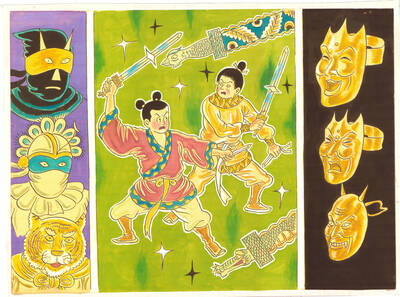
April 22 to April 28 The true identity of the mastermind behind the Demon Gang (魔鬼黨) was undoubtedly on the minds of countless schoolchildren in late 1958. In the days leading up to the big reveal, more than 10,000 guesses were sent to Ta Hwa Publishing Co (大華文化社) for a chance to win prizes. The smash success of the comic series Great Battle Against the Demon Gang (大戰魔鬼黨) came as a surprise to author Yeh Hung-chia (葉宏甲), who had long given up on his dream after being jailed for 10 months in 1947 over political cartoons. Protagonist

Peter Brighton was amazed when he found the giant jackfruit. He had been watching it grow on his farm in far north Queensland, and when it came time to pick it from the tree, it was so heavy it needed two people to do the job. “I was surprised when we cut it off and felt how heavy it was,” he says. “I grabbed it and my wife cut it — couldn’t do it by myself, it took two of us.” Weighing in at 45 kilograms, it is the heaviest jackfruit that Brighton has ever grown on his tropical fruit farm, located


 RSS
RSS