


Major league baseball players can't be wrong. Or at least that's what some of their fans think. All summer, an increasing number of professional ballplayers have been wearing necklaces and bracelets embedded with titanium for their supposed energy-boosting properties. Now their fans have begun to wear them, too.
Greg Benoit, 23, an amateur center fielder in Anaheim, California, learned about the necklaces, made by a Japanese company, when he saw his cousin Joaquin Benoit, a pitcher for the Texas Rangers, wearing one last year.
"Then when I saw guys like Randy Johnson, Curt Schilling and a lot of the World Series Champion Boston Red Sox wearing it, I had to ask about it," said Benoit, who now owns two necklaces and two bracelets he bought at a Phiten store in Torrance, California.

"The guys in the majors are the ones doing what we want to do. They're superstar pro athletes, and we want to be superstar athletes, so if they have it, we'll try it."
Phiten, the company that makes the necklaces and bracelets -- nylon strands embedded with titanium -- claims on its Web site that they produce an electrical charge that enhances the body's "energy management system, increasing the capacity of every cell."
The absence of any scientific evidence to bolster the company's claim seems not to have slowed sales. This month alone, Phiten says, it has sold 25,000 necklaces and bracelets, which retail for US$23 and US$15 respectively, in the US. That is more than seven times the 3,500 sold nationwide in April.
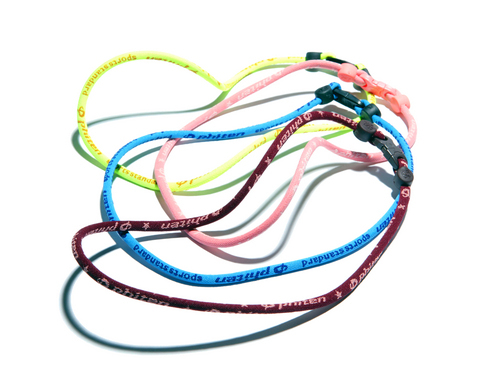
But sports medicine experts doubt that the thousands of new customers are getting what they pay for.
"We have a long history in our society of looking for quick fixes," said Michael Voight, an exercise physiologist at the University of Southern California who also advises five of the university's sports teams. "Athletes are bombarded with images of these necklaces on TV and in print media, so they assume it works. That kind of exposure can have a very profound psychological effect and the resulting psychosomatic feelings cannot be underestimated."
Titanium products appeal not only to athletes like Greg Benoit but also to ordinary exercisers, who hope they will make everyday workouts easier. Some people think of them as a kind of alternative medicine that assuages their aches and makes them feel better.
Clayton Everline, 27, of Short Hills, New Jersey, has been wearing a titanium necklace since friends recommended it a few years ago. "Every time I wear the necklace or another Phiten accessory, I do perform better," said Everline, a third-year resident at St Michael's Medical Center in Newark. "I surf and lift weights. I attribute my improvement in those activities to Phiten."
At first he wore the necklace only at the gym. But soon he stopped taking it off after workouts, and even took to wearing a Phiten T-shirt under his hospital scrubs and has observed an effect at work, too. "I feel an increased blood flow throughout the day," he said.
How are the products supposed to work?
According to Phiten, a water-soluble form of the element titanium is given an electrical charge. After processing, the company says the special titanium can make the bioelectric currents in people flow more efficiently, increasing energy levels and stamina, said Joe Furuhata, a Phiten spokesman.
Physicians do not buy the idea. Dr David Baron, chairman of family medicine at Santa Monica-UCLA Medical Center, said Phiten's claims are based on wrong assumptions about the electrical energy in living things.
"The human body absolutely generates certain electrical fields," he said. But that does not mean that those fields can be influenced by charged titanium or even if they could, that it would have any effect on a person's energy level, he said.
Alice Ishikawa, 63, a hairstylist from Gardena, California, a few years ago started wrapping Phiten titanium athletic tape around her wrists, to alleviate symptoms of carpal tunnel syndrome. Later she bought a black and white necklace and started wearing it to the gym and found that it had many virtues.
"I work out five days a week," said Ishikawa, who goes to a Curves gym. "I have felt a significant difference as I've worn the necklace -- just an overall sense of wellness."
Earlier this month, to deal with her arthritis pain, Ishikawa tripled up, donning two bracelets and a necklace. She said her symptoms have lessened. Such testimonials do not amount to evidence that there any physiological effects.
"There is no real science behind this and many other gimmicks that surface from time to time," said Roland Carlstedt, a sports psychologist and the chairman of the American Board of Sport Psychology. "Lack of objective proof may be irrelevant to susceptible and superstitious athletes who are very prone to the placebo effect."
Other experts agree that the titanium jewelry may provide a placebo effect. Jeffrey Wildfogel, a professor of psychology at Stanford University, said that when athletes put their faith in the necklaces, it can affect their performance. "If you believe that you're going to do well in your head, your preparation will be done in a confident manner," Wildfogel said.

In late October of 1873 the government of Japan decided against sending a military expedition to Korea to force that nation to open trade relations. Across the government supporters of the expedition resigned immediately. The spectacle of revolt by disaffected samurai began to loom over Japanese politics. In January of 1874 disaffected samurai attacked a senior minister in Tokyo. A month later, a group of pro-Korea expedition and anti-foreign elements from Saga prefecture in Kyushu revolted, driven in part by high food prices stemming from poor harvests. Their leader, according to Edward Drea’s classic Japan’s Imperial Army, was a samurai

The following three paragraphs are just some of what the local Chinese-language press is reporting on breathlessly and following every twist and turn with the eagerness of a soap opera fan. For many English-language readers, it probably comes across as incomprehensibly opaque, so bear with me briefly dear reader: To the surprise of many, former pop singer and Democratic Progressive Party (DPP) ex-lawmaker Yu Tien (余天) of the Taiwan Normal Country Promotion Association (TNCPA) at the last minute dropped out of the running for committee chair of the DPP’s New Taipei City chapter, paving the way for DPP legislator Su

It’s hard to know where to begin with Mark Tovell’s Taiwan: Roads Above the Clouds. Having published a travelogue myself, as well as having contributed to several guidebooks, at first glance Tovell’s book appears to inhabit a middle ground — the kind of hard-to-sell nowheresville publishers detest. Leaf through the pages and you’ll find them suffuse with the purple prose best associated with travel literature: “When the sun is low on a warm, clear morning, and with the heat already rising, we stand at the riverside bike path leading south from Sanxia’s old cobble streets.” Hardly the stuff of your

Located down a sideroad in old Wanhua District (萬華區), Waley Art (水谷藝術) has an established reputation for curating some of the more provocative indie art exhibitions in Taipei. And this month is no exception. Beyond the innocuous facade of a shophouse, the full three stories of the gallery space (including the basement) have been taken over by photographs, installation videos and abstract images courtesy of two creatives who hail from the opposite ends of the earth, Taiwan’s Hsu Yi-ting (許懿婷) and Germany’s Benjamin Janzen. “In 2019, I had an art residency in Europe,” Hsu says. “I met Benjamin in the lobby


 RSS
RSS