


You start with a small, slightly heavy clump of soft, light gray clay and after a few simple steps and some high temperatures you end up with a professional-quality piece of silver jewelry.
At first, this may seem as magical as the fabled alchemy that could turn any substance to gold. But jeweler-chemist Chang Chi-cheng (張志成), who runs De Color silver jewelry shop (第卡兒銀飾) in Danshui (淡水), is used to explaining away the magic of silver clay.
Chang describes silver clay as a mixture of pure silver powder, water and glue. Except for the water, silver clay has no ingredients in common with natural clay, but the texture is similar. Silver clay has a much higher density, however, and you can feel this when you hold a piece of it in your hand: A clump half the size of a fast-food ketchup packet weighs around twice as much, about 20g.

PHOTOS: CHANG CHIA-MING, TAIPEI TIMES
Ingredients and density aside, it's the consistency of silver clay that makes all the difference. It can be easily molded into a wide variety of shapes, which are then fired in a kiln and transformed into solid silver. Now anyone with an inclination for crafts can produce the work of a trained silversmith.
"It's so easy to use -- that's the whole point," Chang said. "To make a ring from solid silver you have to keep banging on it with a hammer until it gets flat and thin, then you have to pull it into a circle. It's very tiring," he said.
Then he plucked a small piece of silver clay from the clump rolled it out into a noodle, then shaped it into a circle around a baton-shaped piece of wood to show how a ring could be made in a matter of minutes using silver clay (not counting the 20 minutes to half an hour required to dry, fire and polish the object).

Precious metal clay, or PMC, was first developed in Japan around 1990 by Mitsubishi Motors. When news of the invention reached Taiwan, Chang, a third-generation jeweler trained in chemistry, decided to hit the laboratory to develop his own version.
The result after two years of experimenting was De Color's very own silver clay.
To illustrate the production process, Chang picked up a bag of the tiny silver balls in one hand and a bulb containing fine silver powder in the other. "So you just grind it up really fine?" I asked. He laughed. Apparently you can't "just grind up" silver.

The silver balls are subjected to a chemical process that breaks them up into extremely fine grains about one-20th the size of a grain of salt. The powder is then mixed with water and naturally occurring organic binders to form a clay-like substance.
The clay is then shaped using an array of modeling implements. One such implement is apoxy bond, a sticky, malleable substance that becomes rubber-like once a
hardener is added. To make a mold of a small shell, for example, the apoxy and hardener are kneaded together, and then a shell is pressed into the mixture before it hardens. In no time at all you have a pliable, temperature resistant shell-shaped mold.

The shell mold is filled in with silver clay and then popped into an oven for speedy drying. A blow dryer can also be used for this step. Once dry and hard, the fragile clay shell is taken carefully out of the mold and inserted into a small kiln where it cooks for 10 minutes at 860?C. The heat burns off the binder and allows the tiny grains of silver fuse together. While no step of the process is toxic, the firing produces carbon dioxide, so air circulation is necessary in the studio. Care must also be taken when dealing with the high temperatures produced by the kiln.
Inside the kiln, the silver never becomes liquid -- that would require another 100?C. Instead, the tiny silver crystals fuse together naturally. According to the Society of American Silversmiths' Web site on PMC, "under the proper conditions, crystals of metal fuse together in the same way that droplets of water run together to make larger puddles on the window pane."
This doesn't happen with most metals due to a coating of oxide or rust. Thus only precious, non-oxidizing metals can be manipulated in this way. Even sterling silver, which is 92.5 percent silver and the rest copper, would oxidize at such high temperatures and fail to fuse. Objects produced with De Color's silver clay are 99.99 percent silver. Pure gold clay also exists, but is less common because of the expense.
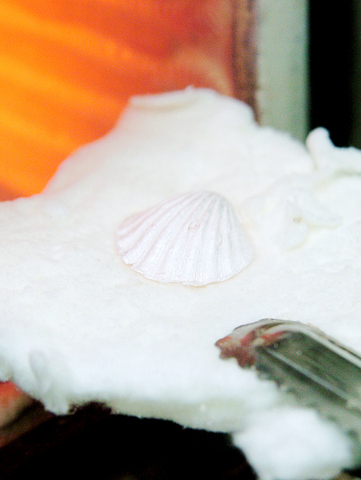
When the shell emerges from the kiln it is white and glowing orange a bit around the edges. Slightly smaller than when it went in, the object now clinks brightly when dropped onto Chang's metal worktable. The full extent of the transformation becomes clear when the shell is polished with a metal brush and the familiar gleam of silver is revealed. A loop for the chain is attached to the back using a blowtorch and the shell becomes a necklace.
Customers who venture into De Color on Danshui's old street can opt for a one-time DIY for NT$500 plus the cost of materials (a 20g packet of silver clay is NT$700), or a long-term course for NT$12,900. The former usually tend to walk away with simple pendants. The latter, however, learn to create rings, chains or pretty much whatever they want.
Some former students have gone off to open their own workshops, which are listed on De Color's Web site.

The shop is at 160 Zhongzheng Rd, Danshui, Taipei County
(台北縣淡水鎮中正路160號).
De Color's phone number is (02) 8631 0011 and the Web site is www.silverclay.com.tw.

For more information on PMC, visit www.silversmithing.com/1clay.htm.

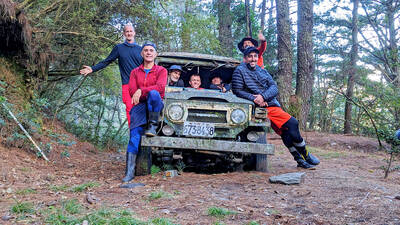
The year was 1991. A Toyota Land Cruiser set out on a 67km journey up the Junda Forest Road (郡大林道) toward an old loggers’ camp, at which point the hikers inside would get out and begin their ascent of Jade Mountain (玉山). Little did they know, they would be the last group of hikers to ever enjoy this shortcut into the mountains. An approaching typhoon soon wiped out the road behind them, trapping the vehicle on the mountain and forever changing the approach to Jade Mountain. THE CONTEMPORARY ROUTE Nowadays, the approach to Jade Mountain from the north side takes an

Relations between Taiwan and the Czech Republic have flourished in recent years. However, not everyone is pleased about the growing friendship between the two countries. Last month, an incident involving a Chinese diplomat tailing the car of vice president-elect Hsiao Bi-khim (蕭美琴) in Prague, drew public attention to the People’s Republic of China’s (PRC) operations to undermine Taiwan overseas. The trip was not Hsiao’s first visit to the Central European country. It was meant to be low-key, a chance to meet with local academics and politicians, until her police escort noticed a car was tailing her through the Czech capital. The

Last week Joseph Nye, the well-known China scholar, wrote on the Australian Strategic Policy Institute’s website about how war over Taiwan might be averted. He noted that years ago he was on a team that met with then-president Chen Shui-bian (陳水扁), “whose previous ‘unofficial’ visit to the US had caused a crisis in which China fired missiles into the sea and the US deployed carriers off the coast of Taiwan.” Yes, that’s right, mighty Chen caused that crisis all by himself. Neither the US nor the People’s Republic of China (PRC) exercised any agency. Nye then nostalgically invoked the comical specter
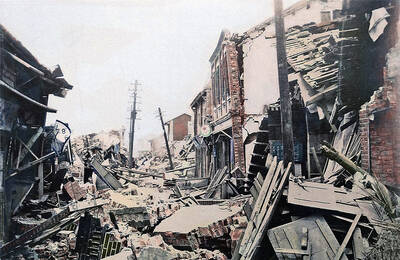
April 15 to April 21 Yang Kui (楊逵) was horrified as he drove past trucks, oxcarts and trolleys loaded with coffins on his way to Tuntzechiao (屯子腳), which he heard had been completely destroyed. The friend he came to check on was safe, but most residents were suffering in the town hit the hardest by the 7.1-magnitude Hsinchu-Taichung Earthquake on April 21, 1935. It remains the deadliest in Taiwan’s recorded history, claiming around 3,300 lives and injuring nearly 12,000. The disaster completely flattened roughly 18,000 houses and damaged countless more. The social activist and


 RSS
RSS