


Lau Yan-on puts the finishing touches to an elaborate paper and bamboo model of a house, complete with windows and doors, an outdoor swimming pool and a water fountain.
His workshop in the busy working-class Kowloon district of Hong Kong is brimming with similarly intricate models of sports cars, luxury goods like plasma TVs and mundane everyday items including computers and mobile phones.
By yesterday, however, all these works of art were gone.
Although crafted often by hand and worth up to US$1,300, they were burnt to a cinder in ritual pyres that have been a part of Chinese culture for almost 2,000 years.
Lau, 50, has made a career of crafting models that believers in Chinese Taoist-Buddhist teachings burn as offerings to ward off evil "ghosts."
According to Chinese custom, incinerating facsimiles of luxuries will pass the real things to spirits in the afterlife and distract them from causing havoc during Zhongyuan Pudu (
Zhongyuan Pudu occurs during the seventh month of the Chinese Lunar calendar and is known as the Hungry Ghosts Festival. This year its feast days fall on Thursday and yesterday.
Lau compares the practice to mailing gifts to the afterlife.
"We Chinese people think, everyone works for a lifetime so that they can buy a house," he said. "Even though we can't afford one during our lifetime, people will `post' one to their ancestors. They might also send them a pair of servants to care for them," Lau said.
According to believers, the evil spirits are the ghosts of people who died with no descendants.
Only the dead that are prayed for by surviving family go to heaven, and so by offering gifts to evil spirits it is also believed they can be released from purgatory.
The festival is celebrated primarily in Taiwan, Hong Kong, Malaysia and Singapore but celebrants can also be found wherever there is a sizeable Chinese community.
China's communist government all but banned observance during the Cultural Revolution of the late 1960s. As a result, Zhongyuan Pudu is hardly marked in China.
The origins of the festival can be traced back to the introduction of Buddhism to China in the first century.
The faith clashed with the beliefs of the Chinese, who predominantly followed the teachings of the 6th-century BC philosopher Confucius.
However, the Buddhists adapted their practices to include the Confucian custom of ancestor worship. This proved to be more acceptable to the Chinese.
Different stories exist to explain the origins of Zhongyuan Pudu, but one of the most popular centers on Mulien, a Buddhist monk blessed with "divine sight" who saw his mother suffering as a diseased hungry ghost in hell.
He tried to feed his mother but was unable to because the food crumbled into charcoal. Buddha instructed Mulien to offer his fellow monks gifts of a variety of foods and delicacies on behalf of his mother and his ancestors.
By the monks' acceptance of these offerings Mulien's mother and ancestors were released from hell and ascended to heaven, according to the story.
Even today, food is still offered and at this time of the year it is common to see the burnt remains of fruit, sweets or meat in small communal shrines found in older apartment blocks.
Wealthy observers like to give offerings in keeping with their status. Model-maker Lau was asked, for instance, to create an entire pop band, including instruments and stage, for relatives of Hong Kong singer Anita Mui, who died of cervical cancer in 2003.
"I was asked to make a whole band for her with several singers, microphones and all the musical instruments. It took me a week to make," Lau said.
Observers have asked Lau to make refrigerators, radios and washing machines -- anything that can make the life of a ghost more bearable.
The most popular requests are for mobile phones, plasma televisions and personal computers.
Most of the small items are machine-made and shipped from factories in Dongguan, southern China. But big items like houses, cars and servants are made by hand in Hong Kong.
Many superstitions surround the festival, especially the idea that people should not wander alone late at night during this month, for fear of being possessed. They are warned away from swimming in case ghosts trying to drown them.
As a result, roadside traditional Chinese operas are often held to entertain and distract the spirits from their pursuit of havoc.
In more superstitious times, seats at these operas remained empty as they were believed to be occupied by ghostly guests. Today, believers are increasingly ready to fill them, after politely inquiring whether the seats are taken.

In late October of 1873 the government of Japan decided against sending a military expedition to Korea to force that nation to open trade relations. Across the government supporters of the expedition resigned immediately. The spectacle of revolt by disaffected samurai began to loom over Japanese politics. In January of 1874 disaffected samurai attacked a senior minister in Tokyo. A month later, a group of pro-Korea expedition and anti-foreign elements from Saga prefecture in Kyushu revolted, driven in part by high food prices stemming from poor harvests. Their leader, according to Edward Drea’s classic Japan’s Imperial Army, was a samurai

Located down a sideroad in old Wanhua District (萬華區), Waley Art (水谷藝術) has an established reputation for curating some of the more provocative indie art exhibitions in Taipei. And this month is no exception. Beyond the innocuous facade of a shophouse, the full three stories of the gallery space (including the basement) have been taken over by photographs, installation videos and abstract images courtesy of two creatives who hail from the opposite ends of the earth, Taiwan’s Hsu Yi-ting (許懿婷) and Germany’s Benjamin Janzen. “In 2019, I had an art residency in Europe,” Hsu says. “I met Benjamin in the lobby
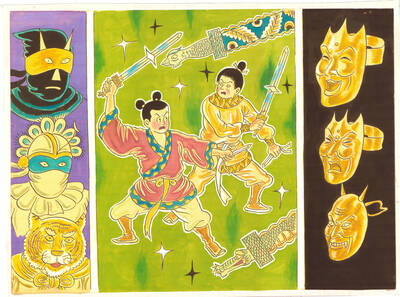
April 22 to April 28 The true identity of the mastermind behind the Demon Gang (魔鬼黨) was undoubtedly on the minds of countless schoolchildren in late 1958. In the days leading up to the big reveal, more than 10,000 guesses were sent to Ta Hwa Publishing Co (大華文化社) for a chance to win prizes. The smash success of the comic series Great Battle Against the Demon Gang (大戰魔鬼黨) came as a surprise to author Yeh Hung-chia (葉宏甲), who had long given up on his dream after being jailed for 10 months in 1947 over political cartoons. Protagonist

A fossil jawbone found by a British girl and her father on a beach in Somerset, England belongs to a gigantic marine reptile dating to 202 million years ago that appears to have been among the largest animals ever on Earth. Researchers said on Wednesday the bone, called a surangular, was from a type of ocean-going reptile called an ichthyosaur. Based on its dimensions compared to the same bone in closely related ichthyosaurs, the researchers estimated that the Triassic Period creature, which they named Ichthyotitan severnensis, was between 22-26 meters long. That would make it perhaps the largest-known marine reptile and would


 RSS
RSS