


He calls himself a "professional traveler." He is an artist who is captivated by landscapes and cities and is driven by music. Nevertheless, Wim Wenders did not become a painter or a musician, but one of the most important German film directors with a great international reputation.
Since his career began in the 1970s, Wenders, who turned 60 yesterday, has put together stories of inner discovery with impressive pictures and strong soundtracks, creating highly personal quests on the screen.
After spending years in the US, he wants to make his next film in Germany. In his old homeland, this doctor's son from Dusseldorf is something of a stranger. "(I must) drive around a bit in this country before I have the right to make a film here again," says Wenders, who lives in Los Angeles and Berlin with his wife Donata.
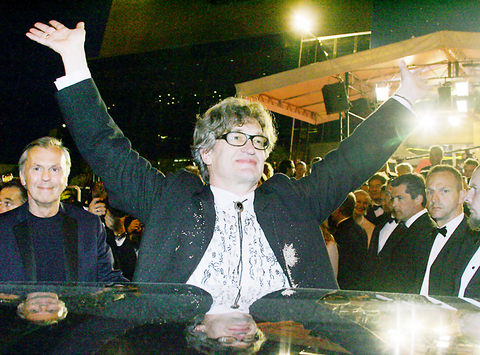
"At the moment it is much more unknown to me here than in the American west, which I know quite well now -- much better than Saxony, Mecklenburg or even Bavaria." Wenders' new film Don't Come Knocking is set in the classic landscape of American Westerns.
"You can't buy eyes," Wenders once said. And the quality of his best work lies in special visual moments -- when Bruno Ganz as an angel looks down on a divided Berlin from the Victory Column in Wings of Desire (1987), when Natassja Kinski wearing a red angora jumper bears her soul in Paris, Texas (1984), when Dennis Hopper in The American Friend (1977) swaggers through Hamburg in cowboy hat and boots as if across his own ranch, when the wrinkled faces of the musicians in Buena Vista Social Club (1998) appear as dignified as the vintage cars on the streets of Havana -- these are camera portraits that say more than words.
Wenders' films have made him internationally famous. He has won a Golden Palm and many other awards at Cannes, the Lion in Venice, the Silver Bear at the Berlinale, various German film awards, Oscar nominations and many other honors.

He is the only figure of "New German Cinema" -- a golden era dating back 30 years -- to still be producing films one after the other three decades later.
His films include political dramas such as Land of Plenty (2004), music documentaries such as "Buena Vista" or The Soul of a Man (2003) and thrillers like The Million Dollar Hotel (2000).
Since filming his 1970 graduation film Summer in the City in Munich, he has made over forty films. In 1971 he founded the Auteurs' Film Publishers along with 12 other directors and made a film based on the book The Goalkeeper's Fear of the Penalty by his friend Peter Handke.
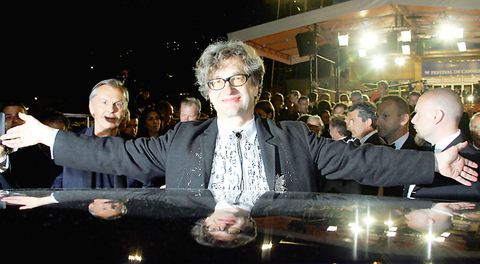
PHOTOS: AP
The term "auteur film" became a mark of quality for individual works developed for their artistic independence and creativity, and not necessarily for commercial gain. Wenders built a reputation with road movies like Alice in the Cities (1973) or Kings of the Road (1976).
His first job in the US at the end of the 1970s turned into a nightmare. Wenders was supposed to film the thriller Hammet for Francis Ford Coppola. The project dragged on for four years. However, it was at the time of the Hammet crisis that Wenders produced his masterpieces The State of Things and Paris, Texas.
In the 1990s he devoted a lot of interest to the technical future of cinema. "I am a great advocate of the digital revolution," he said.
Wenders, who often comes across as brooding, is a "committed Christian" and a man with many passions. Fashion and music are favorite subjects.
Wenders has produced a film on the Japanese fashion artist Yohji Yamamoto (A Notebook on Clothes and Cities, 1989) and proudly wears his torn jackets and jeans. His ties with Yamamoto are just one of many very productive friendships he has with artists such as Ry Cooder and Bono from U2.
His love of music was evident at his beach party at Cannes this year where he hardly left the dance floor, partying away the night to the greatest soul and rock hits of the 1970s and 1980s.

In late October of 1873 the government of Japan decided against sending a military expedition to Korea to force that nation to open trade relations. Across the government supporters of the expedition resigned immediately. The spectacle of revolt by disaffected samurai began to loom over Japanese politics. In January of 1874 disaffected samurai attacked a senior minister in Tokyo. A month later, a group of pro-Korea expedition and anti-foreign elements from Saga prefecture in Kyushu revolted, driven in part by high food prices stemming from poor harvests. Their leader, according to Edward Drea’s classic Japan’s Imperial Army, was a samurai

The following three paragraphs are just some of what the local Chinese-language press is reporting on breathlessly and following every twist and turn with the eagerness of a soap opera fan. For many English-language readers, it probably comes across as incomprehensibly opaque, so bear with me briefly dear reader: To the surprise of many, former pop singer and Democratic Progressive Party (DPP) ex-lawmaker Yu Tien (余天) of the Taiwan Normal Country Promotion Association (TNCPA) at the last minute dropped out of the running for committee chair of the DPP’s New Taipei City chapter, paving the way for DPP legislator Su

Located down a sideroad in old Wanhua District (萬華區), Waley Art (水谷藝術) has an established reputation for curating some of the more provocative indie art exhibitions in Taipei. And this month is no exception. Beyond the innocuous facade of a shophouse, the full three stories of the gallery space (including the basement) have been taken over by photographs, installation videos and abstract images courtesy of two creatives who hail from the opposite ends of the earth, Taiwan’s Hsu Yi-ting (許懿婷) and Germany’s Benjamin Janzen. “In 2019, I had an art residency in Europe,” Hsu says. “I met Benjamin in the lobby

It’s hard to know where to begin with Mark Tovell’s Taiwan: Roads Above the Clouds. Having published a travelogue myself, as well as having contributed to several guidebooks, at first glance Tovell’s book appears to inhabit a middle ground — the kind of hard-to-sell nowheresville publishers detest. Leaf through the pages and you’ll find them suffuse with the purple prose best associated with travel literature: “When the sun is low on a warm, clear morning, and with the heat already rising, we stand at the riverside bike path leading south from Sanxia’s old cobble streets.” Hardly the stuff of your


 RSS
RSS