


What's old is new again, kind of, in the amiably raunchy sex comedy Wedding Crashers. A wink-wink, nudge-nudge Trojan horse of a story, the film pivots on two cut-rate Lotharios persuasively inhabited by Owen Wilson and Vince Vaughn, who love the ladies, but really and truly, cross their chea-ting hearts, just want a nice girl to call wife. The latest chapter in the endless movie epic about childish men and the women who mother them, this film basically presents an R-rated riff on the usual Mutt and Jeff, Hope and Crosby pairings, The Road to Bootytown for Maxim page-flippers.
Credited to the screenwriters Steve Faber and Bob Fisher, and directed by David Dobkin, the film trumpets an amusingly tasteless premise: Wilson and Vaughn play John Beckwith and Jeremy Grey, Washington divorce mediators, who ritually embark on the smooth operator's version of big-game hunting. Armed with elaborate back stories (they masquerade as fabulous successes) and equally baroque rules, the two attend the nuptials of complete strangers specifically to pick up women, the idea being that tears and booze will have critically weakened such quarries' defenses. The movie takes off at the opening of the new wedding season, with the guys revving up for 17 ceremonies and potentially twice the number of boudoir kills.
The two stars do much of the heavy lifting in the film, with Wilson, as expected, best in show. With his easy manner and deceptively lazy drawl, he has carved out a singular movie niche as our reigning dude, the quintessential US guy who, whether ensconced in Texas or Manhattan, never lets anything (including whacks on the schnoz) take him out of his groove. That easygoing vibe makes Wilson extremely likable and it also obscures his flexibility; as an actor, he's both comfortable in high-concept bagatelles like Zoolander and high-art gems like The Royal Tenenbaums, which he helped write and in which he plays a Cormac McCarthy-style author who waxes about "the friscalating dusklight."
PHOTOS: AGENCIES
Vaughn labors twice as hard as his co-star, and it's the strain of that effort, the sights and sounds of his motor-mouth furiously whirring, that makes the character work. Wedding Crashers is, after all, meant to be a lighthearted comedy about men who, at least at first, see women only as prey. For that conceit to fly, John and Jeremy have to be played by actors who seem not only naturally appealing, but also harmless. That may explain why Vaughn, who has convincingly played killers in Gus Van Sant's remake of Psycho and in Dobkin's obnoxious first movie, Clay Pigeons, looks covered in flop sweat even when he appears bone dry. For him, nice isn't easy.
Nominally more high-minded than Porky's and many of the sex comedies to follow in that film's crude wake (American Pie, Old School), Wedding Crashers belongs to a familiar class of movie. These movies revolve around a sensitive alpha guy and his faithful sidekicks, all of whom are pigs but really nice pigs. In the first act, the guys swap locker-room jokes and hustle anything without a penis while making the requisite gay-panic jokes along the way. In the second act, the sensitive alpha meets a woman whose brain seems bigger than her breasts or at least more interesting. They hook up, he blows it, and she splits, only to return for the ostensibly happy ending.
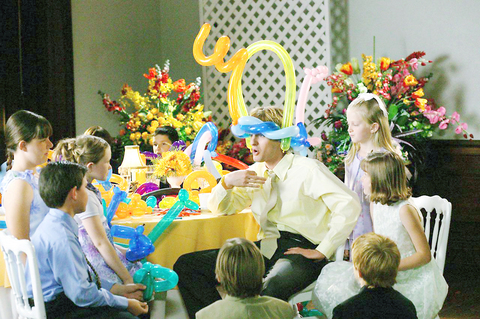
That's what more or less happens in Wedding Crashers, which is reasonably enjoyable until its guys are forced to grow up. Because bad behavior is usually more fun to watch than good, the movie is especially fine during the preliminaries. With their lies neatly tucked away, the conspirators hit churches, synagogues and other houses of worship. John deploys eyedrops to simulate weeping during one ceremony; Jeremy twists balloons into shapes at a reception so it looks as if he's good with kids. Finally, in an orgiastic sequence set to the song Shout that grows progressively faster and funnier, the pair party with and then bed a succession of women amid a flurry of edits.
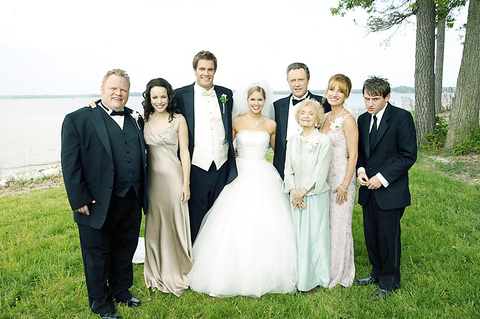
It's crude, yes, but also funny; too bad these lost boys can't stay lost. Although Rachel McAdams, as John's inevitable love interest, and Isla Fisher, as Jeremy's, are watchable in their different ways, the film predictably starts to lose its fizz when they enter the picture. McAdams, who grows more appealing with every new role, makes the most of her underdeveloped character, Claire, the goody-two-shoes daughter of a powerful politician (Christopher Walken, doing his usual weird thing, but doing it well). As her considerably naughtier sister, Gloria, Fisher brings some serious Rick James-style freakiness to a supporting role that might otherwise barely register. She even manages to steal scenes from Vaughn, an inveterate scene-stealer.
Like clockwork, the film soon mutates from a guy-oriented sex comedy into a wish-fulfillment chick flick. Love blooms and almost withers after the sisters take John and Jeremy to their family estate, where men wear colors rarely seen outside of a restricted country club. Something happens, something else happens, but before the filmmakers tie everything up with a bow, they throw in a surprisingly resonant scene in which Claire's fiance, Sack, wallops John. The beating, however, seems like a pretext for the smirking remark Sack makes about a waitress as he enters his own engagement party. For him, the only difference between a woman he lusts after and a woman he marries is that he calls one his wife. Crude? Yes. Funny? Well, that's up to you.

“Taiwan’s Opposition Leader Comes to US With a Message Straight Out of Beijing” read a May 31 headline in the Wall Street Journal. Top US administration officials and members of Congress almost certainly read the WSJ, and if there was a bullet point takeaway that people in Washington should absorb ahead of Chinese Nationalist Party (KMT) Chair Cheng Li-wun’s (鄭麗文) arrival in DC on June 9, that headline is it. The last few columns have discussed this very topic, and the timing is not coincidental. While those top officials likely do not read the Taipei Times, judging by the number

With weighty, anxiety-inducing geopolitical topics dominating the headlines, checking in on the wild and weird state of local politics can take some of the edge off. This November’s elections will determine who will be in charge of fixing potholes in your neighborhood, not the potholes in Taiwan’s complicated geopolitical space. Recently, after an online interview with a Taipei-based journalist, I commented that Taipei journalists never go further than the MRT can take them. He laughed and agreed. Naturally, the Taipei mayoral race is eating up much of the press attention. TAIPEI CITY Democratic Progressive Party (DPP) candidate Puma Shen (沈伯洋) has
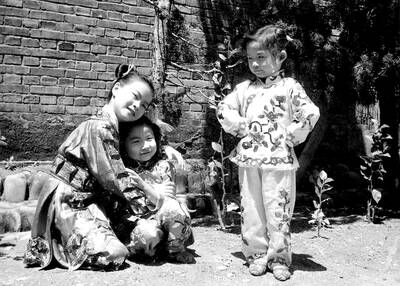
Audiences in Leicester, Cardiff, London and Sheffield will this month gather to watch a series of black-and-white Taiwanese-language films made more than 70 years ago. On the surface, these screenings commemorate the seventieth anniversary of taiyupian (台語片) — Taiwanese-language cinema. Yet the significance of these events extends far beyond nostalgia or film history. They represent a remarkable chapter in Taiwan’s ongoing effort to recover, preserve and reinterpret a cultural heritage that was once thought to have largely disappeared. The centerpiece of the program is the Ho Chi-ming (何基明) directed Xue Pinggui and Wang Baochuan (薛平貴與王寶釧), a film produced in 1955 and

In December of 2008 Lee E-tin (李乙廷), a Miaoli county legislative hopeful, was convicted of vote-buying. Rather than buy votes retail, voter by voter, in the usual manner, Lee had done it wholesale, in a commendably efficient manner: he had visited local temples and made donations to gain their support. Because he did not normally make donations to temples, the court ruled he was attempting to improperly influence voter behavior. The case indicates how important temples are in influencing political life. Both judge and politician appeared to see them in the same way. Beijing sees them that way as well. Democratic Progressive


 RSS
RSS