


Kan Shing-yi (
The art gallery, founded in 1996, is on the East Coast and has a view of the Pacific Ocean. A-Kan's staff serve tea or coffee and simple meals to visitors, as many of them have likely traveled a long way to find the gallery. On a cozy porch at the back of the establishment, visiting guests find canopied seats and tables.
It's a relaxing place to spend some time in the summer, sipping freshly brewed coffee and appreciating the Pacific Ocean scenery, as waves crash onto rocks and if you're lucky, dolphins or whales can be seen passing by.
PHOTOS COURTESY OF JOKI
Alternatively you can take the Shiti Harbor (
A-Kan is a slim, middle-aged man with a small moustache who often wears a white peaked cap. He has been creating works of art in Hualian for more than 20 years and has married a woman from the Amei tribe.
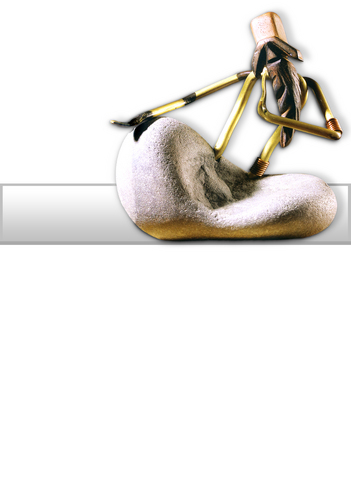
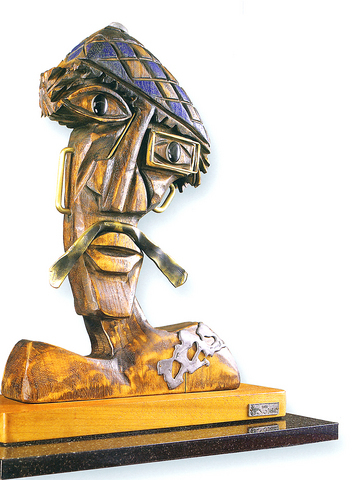
Driftwood from the ocean, cobblestones on the seashore and manmade copper tubes are the three major components of A-Kan's multi-media art pieces.
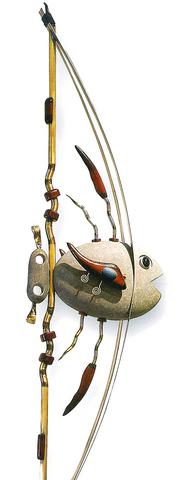
"Stone symbolizes antiquity since it existed a long time ago. Wood implies life for the reason that it has annual rings; and copper, a product of modern science, stands for technology and the future of human society," A-Kan says.
His overriding idea is to utilize natural and ancient substances with a touch of modernity to show human history through the creation of art.
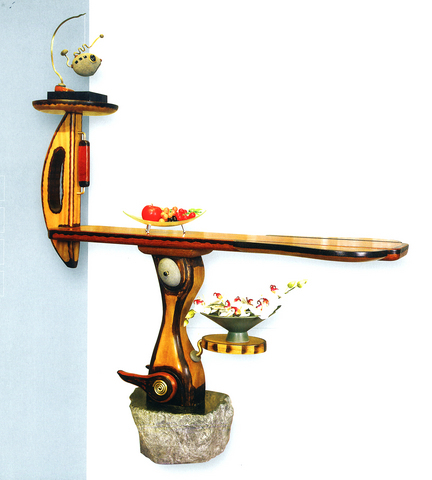
A-Kan's Art Chair series is full of stylish humor and combines practical usage and beauty. Those who have seen Art Chair can clearly see the artistic touches that have been applied to the chairs. The result of such art comes from a sophisticated thinking about the relationship between people and furniture before such a piece is produced.
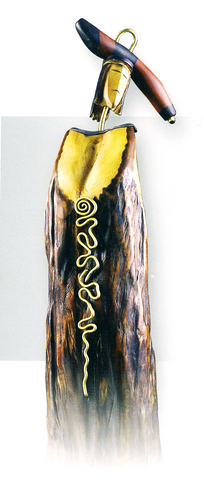
Another of A-Kan's series of pieces is Seaward, which uses big and small fish, carved and polished from seaside cobblestones, as an image to echo the sound of the ocean, which A-Kan believes to be the origin of life. Many of his other works such as Zen and the Turandot series are so creative and witty that one would find it hard to not be overwhelmed by such artistic ingenuity.
Some of A-Kan's artworks are not just appreciated by ordinary visitors to his gallery but also by the wealthy and powerful, who happen to be collectors of his works. Such rich and famous fans include the Tsai family, which owns the newly renovated Sheraton Taipei Hotel, the Wu family which owns the Shin Kong Group, construction tycoon Nita Ing (
collectors.
Once upon a time A-Kan was given the opportunity to stay in Germany to create art, but he decided to leave after a short period of time due to lack of inspiration from the country.
Connie Lin (
"A-Kan has been able to apply simple and natural media to all of his works and yet through his creative ways of working things out I can imagine that he constantly tries out different methods to solve problems. This kind of working attitude reminds me of Taiwan," Lin says. "Whenever people down here encounter a difficulty they seek out various ways to overcome it. It is this same powerful imagination that is driving the country and its people to look forward to a better future."
Another local art commentator Lin Chia-hua (
"[The artist] has produced his artwork from his imagination and from feelings that he has about life. He first puts into use his ingenuity to dissect compositions or the constituents of a physical object. He then executes every dot, line and irregular shape from the new composition to set free [the object] from the bondage of physical appearances, to let his newly created art piece speak directly to the viewer's heart and mind."
Big feet and big black eyes are two prominent elements that epitomize the spirit of A-Kan's works, which articulates endless curiosity towards life.
Laheici (
"A-Kan's multi-media masterpieces stand out noticeably from the others. He is very keen to adopt ideas, both from the creative ways modern cartoons are produced and also using the latest scientific technology to ingeniously formulate the surrealistic configurations of his works of art. Yet, too many series may give people the impression of repetitive works of a similar artistic style," Laheici says.
A-Kan claims, however, he enjoys creating mainstream artworks and does not appreciate art intended for highbrow audiences only. He believes that a person needs to observe life with his own eyes and to confirm the experience with his own feet. This is the only truthful way to comprehend the rich and versatile aspects of life, he says. All art, as it is perceived by the artist, should originate from such feelings of human life, he adds.
The artist is now trying to introduce glass bottles of different shapes and colors as the fourth component to his experimental flower vase series. In A-Kan's eyes his decorative art pieces will comfort people in the same way a pleasant environment soothes the the mood.
Factbox:
What: A-Kan's JOKI
Where: 3, Shihmen, Gangkou Village, Fengbin Township, Hualian County (花蓮縣豐濱鄉港口村石門3號).
How to get there: Drive along Provincial Highway 11 from Hualien City, about 10 minutes after reaching Fengbin Township but before arriving at Shihti Harbor.
Open: 10am to 5pm, everyday.
Contact: (038) 781 616

In late October of 1873 the government of Japan decided against sending a military expedition to Korea to force that nation to open trade relations. Across the government supporters of the expedition resigned immediately. The spectacle of revolt by disaffected samurai began to loom over Japanese politics. In January of 1874 disaffected samurai attacked a senior minister in Tokyo. A month later, a group of pro-Korea expedition and anti-foreign elements from Saga prefecture in Kyushu revolted, driven in part by high food prices stemming from poor harvests. Their leader, according to Edward Drea’s classic Japan’s Imperial Army, was a samurai

The following three paragraphs are just some of what the local Chinese-language press is reporting on breathlessly and following every twist and turn with the eagerness of a soap opera fan. For many English-language readers, it probably comes across as incomprehensibly opaque, so bear with me briefly dear reader: To the surprise of many, former pop singer and Democratic Progressive Party (DPP) ex-lawmaker Yu Tien (余天) of the Taiwan Normal Country Promotion Association (TNCPA) at the last minute dropped out of the running for committee chair of the DPP’s New Taipei City chapter, paving the way for DPP legislator Su

Located down a sideroad in old Wanhua District (萬華區), Waley Art (水谷藝術) has an established reputation for curating some of the more provocative indie art exhibitions in Taipei. And this month is no exception. Beyond the innocuous facade of a shophouse, the full three stories of the gallery space (including the basement) have been taken over by photographs, installation videos and abstract images courtesy of two creatives who hail from the opposite ends of the earth, Taiwan’s Hsu Yi-ting (許懿婷) and Germany’s Benjamin Janzen. “In 2019, I had an art residency in Europe,” Hsu says. “I met Benjamin in the lobby

It’s hard to know where to begin with Mark Tovell’s Taiwan: Roads Above the Clouds. Having published a travelogue myself, as well as having contributed to several guidebooks, at first glance Tovell’s book appears to inhabit a middle ground — the kind of hard-to-sell nowheresville publishers detest. Leaf through the pages and you’ll find them suffuse with the purple prose best associated with travel literature: “When the sun is low on a warm, clear morning, and with the heat already rising, we stand at the riverside bike path leading south from Sanxia’s old cobble streets.” Hardly the stuff of your


 RSS
RSS