


Paying NT$1,200 isn't too much for a remarkable venture indeed -- 10 paperback volumes, each of over 180 pages, containing a bilingual history of Taiwan in cartoon form, all in full color. But it's only when you look into these books that you discover what an enormous amount of in-depth historical research and tactical skill has gone into each of them.
The set has many virtues. Firstly, the books are in Chinese and English, and hence will be a godsend to students of either language whose mother-tongue is the other one. The excitement of the narrative will carry you along, and your linguistic proficiency will improve almost without you
noticing it.
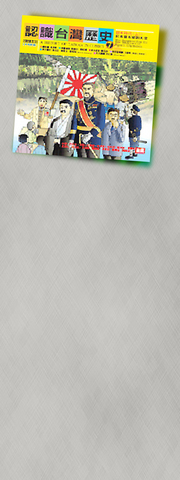
Secondly, these books perform what I would have thought was a near-impossible balancing act. They combine accessibility for quite young readers with a really astonishing level of historical sophistication.
On the one hand continuity is provided by a modern boy called Tai and a modern girl called Wan who skip around the island and give a point of entry to young imaginations. Thus, in Volume 3, Tai asks "Was Jheng Jhihlong really loyal to the Ming court?" with Wan replying "You're pretty sharp! You already see the flip side!"
Yet at the same time -- and this is the set's real glory -- the historical detail at times feels as if it's approaching graduate studies level. Take the issue of the origins of Taiwan's Aboriginal population. Look at Volume 1 and you'll discover this isn't glossed over with some vague generalities. Instead, the opposing theories are
explained, and the archeological sites supporting one side or the other of the argument illustrated.
For the book to reach out so gently to the youngest readers, then, rather than condescending to them, to offer instead serious historical material many adults will learn a lot from is a truly stellar achievement.
Thirdly, and perhaps most importantly, this balancing act between accessibility and seriousness is repeated on another level. Different interpretations of a particular event are often offered. What characterized relations with China at various points in history? What was the nature of the Dutch episode in the 17th century? Was Japanese rule beneficial or exploitative? What were the results of the KMT take-over in 1945? What really happened on Feb. 28, 1947?
Every one of these controversial questions is faced head-on, and in many cases opposing interpretations are offered. It's rather as if a stage acrobat, having performed one near-impossible feat, nonchalantly follows it up with another.
The issue of Japanese rule is a good example. On the one hand you see Taiwan' s citizens suffering under colonial rule, with their human rights abused. But on the other you watch the modernization that Japan brought with it. And somewhere in between the two you also get the mid-way analysis that, yes, Japanese rule did bring improvements, but they were largely to serve Japanese eco-nomic interests; but the Taiwanese benefited nonetheless.
In the last analysis, this refusal to come down heavily on one side or another is an educational lesson in itself. Education in Asia has too often been a case of learning by rote, but that is the last thing offered here. Look at the evidence and make up your own minds. This is the moral of these highly colorful volumes.
This is an approach that is expected by adults, but will be enormously beneficial to children. And these fine books will, I hope, be extensively used in local schools.
Of course, there is in reality no ideal answer to the historical and analytical questions posed above. Certain facts apart, no one
definitively knows any historical answers. There are sure to be readers who will complain that this or that has been omitted, especially in the final volume dealing with the last 30 years.
Taiwanese society has become so diversified this could hardly not be the case. And there will be some, too, who will feel that emphases of even as balanced a narrative as this one are too favorable to this or that social group. Even so, this looks to me to be as good a shot at a moving target as could be hoped for - and far better than what even the most averagely optimistic observer might have expected.
The book existed in an earlier form back in 1999, in black-and-white and with no English renderings. Now it has appeared in all its bilingual, full-color glory, and with the changes and improvements that time has allowed.
A number of government agencies agreed in advance to buy
certain numbers of copies, but the book doesn't have the feel of a partisan interpretation, for the reasons given above. If there are any special sympathies expressed, they are probably for the aboriginal communities.
Winkler told me that his law firm is currently working on
indigenous land rights and other issues in "depth ecology," and the same company has already published Traditional Stories of Taiwan's Indigenous Peoples, similarly multi-volumed, brightly colored, bilingual and in cartoon format. For more information on both products go to
www.thirdnature.com.tw
This publication represents for me the spirit of Taiwan, and what makes it such a pleasurable place to live in. In fact, given the unavoidably political nature of the enterprise, and its innumerable potential pitfalls, it' s hard to imagine anything similar being published anywhere else in Asia.
In late October of 1873 the government of Japan decided against sending a military expedition to Korea to force that nation to open trade relations. Across the government supporters of the expedition resigned immediately. The spectacle of revolt by disaffected samurai began to loom over Japanese politics. In January of 1874 disaffected samurai attacked a senior minister in Tokyo. A month later, a group of pro-Korea expedition and anti-foreign elements from Saga prefecture in Kyushu revolted, driven in part by high food prices stemming from poor harvests. Their leader, according to Edward Drea’s classic Japan’s Imperial Army, was a samurai

The following three paragraphs are just some of what the local Chinese-language press is reporting on breathlessly and following every twist and turn with the eagerness of a soap opera fan. For many English-language readers, it probably comes across as incomprehensibly opaque, so bear with me briefly dear reader: To the surprise of many, former pop singer and Democratic Progressive Party (DPP) ex-lawmaker Yu Tien (余天) of the Taiwan Normal Country Promotion Association (TNCPA) at the last minute dropped out of the running for committee chair of the DPP’s New Taipei City chapter, paving the way for DPP legislator Su

Located down a sideroad in old Wanhua District (萬華區), Waley Art (水谷藝術) has an established reputation for curating some of the more provocative indie art exhibitions in Taipei. And this month is no exception. Beyond the innocuous facade of a shophouse, the full three stories of the gallery space (including the basement) have been taken over by photographs, installation videos and abstract images courtesy of two creatives who hail from the opposite ends of the earth, Taiwan’s Hsu Yi-ting (許懿婷) and Germany’s Benjamin Janzen. “In 2019, I had an art residency in Europe,” Hsu says. “I met Benjamin in the lobby
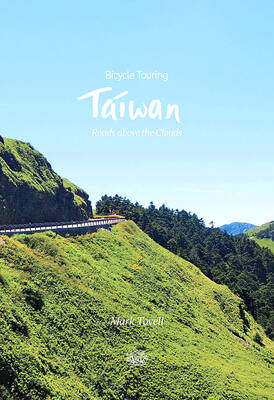
It’s hard to know where to begin with Mark Tovell’s Taiwan: Roads Above the Clouds. Having published a travelogue myself, as well as having contributed to several guidebooks, at first glance Tovell’s book appears to inhabit a middle ground — the kind of hard-to-sell nowheresville publishers detest. Leaf through the pages and you’ll find them suffuse with the purple prose best associated with travel literature: “When the sun is low on a warm, clear morning, and with the heat already rising, we stand at the riverside bike path leading south from Sanxia’s old cobble streets.” Hardly the stuff of your


 RSS
RSS