


Tsai Lin (
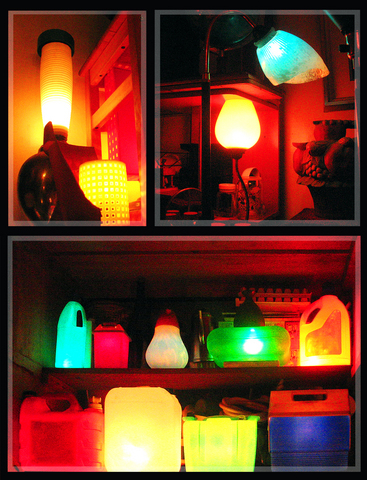
Although transforming used plastic, bottles, jars and toys into table lamps has earned him praise from the local fashion scene, in addition to a few magazines and newspapers articles, Tsai struggles to pay the rent for his small shop. Like any designer, he hopes to someday see his logo on lamps sold around the world. In the meantime, he is realistic about such ambitions and he also sells secondhand furniture and and other items.
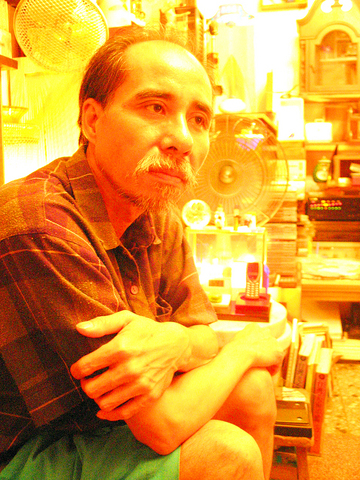
Not formally trained as an artist, Tsai considers himself an entrepreneur. Before investing all his savings into his lamp business five years ago, he ran a coffee shop and sold paintings from local artists. His first attempt at manufacturing and selling lamps was run from a combined coffee and tea store, but as the volume of secondhand merchandise increased, the tables were removed.
PHOTOS: DIANA FREUNDL, TAIPEI TIMES
It's a shame to see Tsai's talent buried amongst the secondhand bags and toys, but until the public is enlightened about the potential for refuse material the clutter is necessary to make ends meet, he said.
"More people have shown an interest in vintage furniture and ornaments but lamps made from empty cleaning pro-duct bottles, are still unusual to most people."
The general public could also use a few lessons on appropriate lighting, according to Tsai, who claimed it was the most overlooked aspect of a living space. "Most people don't use suitable lighting. Florescent bulbs are fine for the office, but unacceptable in a home," he said recommending four or five light sources per room.

Lamps can be subdivided into those for ambiance (to illuminate a room), those for work (for reading) and those for mood (to provide an accent). Many homes have replaced glaring overhead lights with dimmers and softer bulbs, but few take into consideration the importance of good mood lighting, which can add a sense of style to the room, Tsai said.
His lamps use 10-watt to 20-watt bulbs so they are ill-suited for work lighting, but they are economical and fun. He divides his products into two types: those focusing on color and those in which shape, pattern or size is most significant. The former are made from empty plastic containers and colored bulbs, while the latter include toys, baskets and glass jars, all of which use white bulbs and create shadow effects on the wall.
Utilizing recycled materials makes Tsai's designs one-of-a-kind, but it also limits the amount of mass-production he can do. He has patented a logo -- KTWF -- which is written on every piece, but he is keen to license out the copyright to interested companies. So far, his requests have been from students eager to learn the trade.
"Ideally I would like to have two lines -- one for consumer use and a separate line for design exhibitions," he said.
Tsai has difficultly reaching the mainstream consumer due to his poor location. Though located only minutes from the central shopping district of Zhongxiao, apart from visitors on their way to Shenkeng (
Dependent upon word of mouth, Tsai said most of his clientele are from the film, fashion and arts communities. During our interview, a regular costumer and admirer dropped by with his two adult children. Zhen Lian-zhi (
Tsai's prices begin at NT$300 and continue upward to NT$3,000, depending on materials. He says the use of re-cycled materials keeps production costs low. He also takes costumer orders for those who have a particular idea in mind.
"If there is a way, I will convert it into a lamp," he said.
Tsai Lin's Store (

In late October of 1873 the government of Japan decided against sending a military expedition to Korea to force that nation to open trade relations. Across the government supporters of the expedition resigned immediately. The spectacle of revolt by disaffected samurai began to loom over Japanese politics. In January of 1874 disaffected samurai attacked a senior minister in Tokyo. A month later, a group of pro-Korea expedition and anti-foreign elements from Saga prefecture in Kyushu revolted, driven in part by high food prices stemming from poor harvests. Their leader, according to Edward Drea’s classic Japan’s Imperial Army, was a samurai
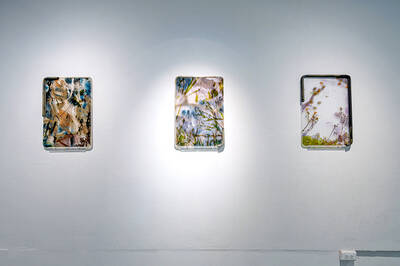
Located down a sideroad in old Wanhua District (萬華區), Waley Art (水谷藝術) has an established reputation for curating some of the more provocative indie art exhibitions in Taipei. And this month is no exception. Beyond the innocuous facade of a shophouse, the full three stories of the gallery space (including the basement) have been taken over by photographs, installation videos and abstract images courtesy of two creatives who hail from the opposite ends of the earth, Taiwan’s Hsu Yi-ting (許懿婷) and Germany’s Benjamin Janzen. “In 2019, I had an art residency in Europe,” Hsu says. “I met Benjamin in the lobby
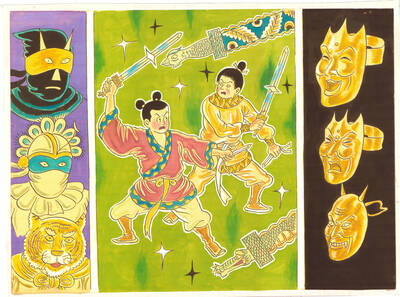
April 22 to April 28 The true identity of the mastermind behind the Demon Gang (魔鬼黨) was undoubtedly on the minds of countless schoolchildren in late 1958. In the days leading up to the big reveal, more than 10,000 guesses were sent to Ta Hwa Publishing Co (大華文化社) for a chance to win prizes. The smash success of the comic series Great Battle Against the Demon Gang (大戰魔鬼黨) came as a surprise to author Yeh Hung-chia (葉宏甲), who had long given up on his dream after being jailed for 10 months in 1947 over political cartoons. Protagonist

A fossil jawbone found by a British girl and her father on a beach in Somerset, England belongs to a gigantic marine reptile dating to 202 million years ago that appears to have been among the largest animals ever on Earth. Researchers said on Wednesday the bone, called a surangular, was from a type of ocean-going reptile called an ichthyosaur. Based on its dimensions compared to the same bone in closely related ichthyosaurs, the researchers estimated that the Triassic Period creature, which they named Ichthyotitan severnensis, was between 22-26 meters long. That would make it perhaps the largest-known marine reptile and would


 RSS
RSS