


As one of the rulers of the Hong Kong film industry in the 1980s and 1990s, director Tsui Hark (徐克) has made a remarkably smooth transition into the 21st century with Seven Swords (七劍), an ambitious project that reopens the world of wuxia martial arts. Determined to draw a clear distinction between hot films from the East such as Hero (英雄) and House of Flying Daggers (十面埋伏), Tsui has made a splash by providing an alternative vision of the martial arts saga.
Letting go of the stagy and surrealistic costumes, settings and dazzling special effects of many mainstream martial arts movies, Tsui has once again proved himself a master of narration, with playful yet pointed camera angles, ingenious composition and editing. There are also beautifully choreographed action scenes and his juxtaposition of close-ups and long shots admirably convey the inner development of characters.
In the world of Seven Swords, there is no line between good and evil. Instead ordinary people are confronted with their own demons and weakness. Each character is painted as an ordinary human being, with a loveable side and a dark side. For example, the greedy, blood-thirsty general who chases after the seven swords master, Fire-Wind, is not merely an incarnation of pure evil, but rather a morbidly charming persona with a sense of childlike innocence.

PHOTO COURTESY OF CATALYST LOGIC COMPANYN
Tsui wants to present a world of wuxia that is not divorced from reality. His themes are the issue of universal humanity and contemporary society.
The film is not without its weaknesses, however. As in most of Tsui's movies, the characters' personalities develop throughout the film. But here the personalities do not seem to fully mature and are rather shadowy in their portrayal. Perhaps the reason for this is that Tsui originally conceived a four hour film, rather than two-and-a-half hours.
Another problem is the music composed by Kenki Kawai, who creates a grand score which is nevertheless devoid of human emotions and merely serves as a supportive role to the visual elements.
Despite the defects, Seven Swords sees a director who has total confidence and control in his craftsmanship and artistry. As intended, Tsui has made a film that is a worthy homage to Akira Kurosawa's Seven Samurais.

Last week Joseph Nye, the well-known China scholar, wrote on the Australian Strategic Policy Institute’s website about how war over Taiwan might be averted. He noted that years ago he was on a team that met with then-president Chen Shui-bian (陳水扁), “whose previous ‘unofficial’ visit to the US had caused a crisis in which China fired missiles into the sea and the US deployed carriers off the coast of Taiwan.” Yes, that’s right, mighty Chen caused that crisis all by himself. Neither the US nor the People’s Republic of China (PRC) exercised any agency. Nye then nostalgically invoked the comical specter

Relations between Taiwan and the Czech Republic have flourished in recent years. However, not everyone is pleased about the growing friendship between the two countries. Last month, an incident involving a Chinese diplomat tailing the car of vice president-elect Hsiao Bi-khim (蕭美琴) in Prague, drew public attention to the People’s Republic of China’s (PRC) operations to undermine Taiwan overseas. The trip was not Hsiao’s first visit to the Central European country. It was meant to be low-key, a chance to meet with local academics and politicians, until her police escort noticed a car was tailing her through the Czech capital. The
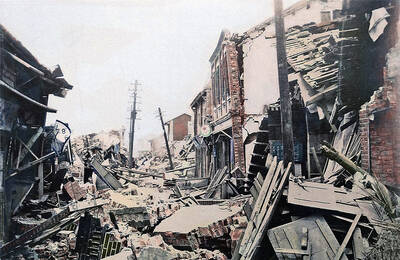
April 15 to April 21 Yang Kui (楊逵) was horrified as he drove past trucks, oxcarts and trolleys loaded with coffins on his way to Tuntzechiao (屯子腳), which he heard had been completely destroyed. The friend he came to check on was safe, but most residents were suffering in the town hit the hardest by the 7.1-magnitude Hsinchu-Taichung Earthquake on April 21, 1935. It remains the deadliest in Taiwan’s recorded history, claiming around 3,300 lives and injuring nearly 12,000. The disaster completely flattened roughly 18,000 houses and damaged countless more. The social activist and

Over the course of former President Ma Ying-jeou’s (馬英九) 11-day trip to China that included a meeting with Chinese Communist Party (CCP) leader Xi Jinping (習近平) a surprising number of people commented that the former president was now “irrelevant.” Upon reflection, it became apparent that these comments were coming from pro-Taiwan, pan-green supporters and they were expressing what they hoped was the case, rather than the reality. Ma’s ideology is so pro-China (read: deep blue) and controversial that many in his own Chinese Nationalist Party (KMT) hope he retires quickly, or at least refrains from speaking on some subjects. Regardless


 RSS
RSS