


Before striking out for the hills of Anatolia near the end, Monsieur Ibrahim, confines its attention to the Rue Bleue, a narrow, slightly shabby street in a working-class section of Paris. Adapted from Eric-Emmanuel Schmitt's novel (which was also made into a play), this modest, sentimental film looks nostalgically back on Paris in the mid-1960's and casts a loving, oblique glance at the French movies of that era.
At one point, Brigitte Bardot herself (played by a latter-day cinema sex goddess, Isabelle Adjani) shows up to shoot a few scenes on the Rue Bleue, where she wins the envious admiration of the local prostitutes.
For its part, Monsieur Ibrahim, written and directed by Francis Dupeyron, has a deci-dedly new wave look and feel, with street-level, hand-held cameras and bursts of French and English pop music on the soundtrack (including, as it
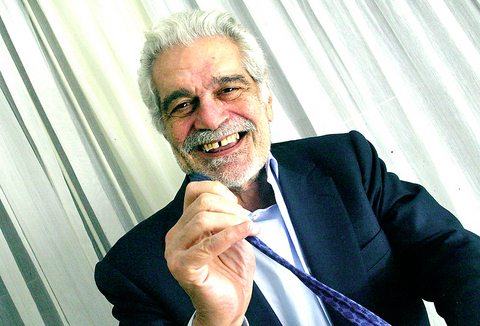
PHOTO: NY TIMES
happens, Richard Anthony singing the praises of the new wave in nouvelle vague).
Much of the music issues from a radio belonging to Momo (Pierre Boulanger), a Jewish teenager who lives in a state of low-intensity domestic war with his cold, depressive father (Gilbert Melki). In search of affection, and eager to grow up, Momo, at the start of the film, breaks open his piggy bank to purchase the services of a prostitute named Sylvie (Anne Suarez). While she and her colleagues function, in classic French-movie fashion, as both lovers and surrogate mothers, Momo also finds a second father in the person of Ibrahim (Omar Sharif), who keeps a small grocery store across the street from Momo's apartment.
The story of their cross-generational, cross-cultural friendship is introduced by an anthem to universal brotherhood (one of the musical specialties of those days) called Why Can't We Live Together? The question has hardly lost its pertinence, and Dupeyron, without overt didacticism, turns the story of an elderly Muslim and his young Jewish protege into a parable of tolerance and understanding.
The two central performances help the lesson go down easily, and Duperyon's unassuming, slightly ragged realism gives the movie a sweet, lived-in charm. Sharif, grizzled and white-haired at 71, has lost none of the charisma that made him an international movie star in the 1960's, and Boulanger, in his first feature film, shows impressive self-assurance. Sharif's character is, in some ways, a dubious conceit; he is the selfless repository of exotic Eastern wisdom whose main purpose in life is to shepherd his young friend through life's difficulties. In a Hollywood melodrama, Ibrahim would most likely be a spiritually gifted black man. But Sharif is a wry and subtle actor, and he gives the cliche some humor and life.

In late October of 1873 the government of Japan decided against sending a military expedition to Korea to force that nation to open trade relations. Across the government supporters of the expedition resigned immediately. The spectacle of revolt by disaffected samurai began to loom over Japanese politics. In January of 1874 disaffected samurai attacked a senior minister in Tokyo. A month later, a group of pro-Korea expedition and anti-foreign elements from Saga prefecture in Kyushu revolted, driven in part by high food prices stemming from poor harvests. Their leader, according to Edward Drea’s classic Japan’s Imperial Army, was a samurai

The following three paragraphs are just some of what the local Chinese-language press is reporting on breathlessly and following every twist and turn with the eagerness of a soap opera fan. For many English-language readers, it probably comes across as incomprehensibly opaque, so bear with me briefly dear reader: To the surprise of many, former pop singer and Democratic Progressive Party (DPP) ex-lawmaker Yu Tien (余天) of the Taiwan Normal Country Promotion Association (TNCPA) at the last minute dropped out of the running for committee chair of the DPP’s New Taipei City chapter, paving the way for DPP legislator Su
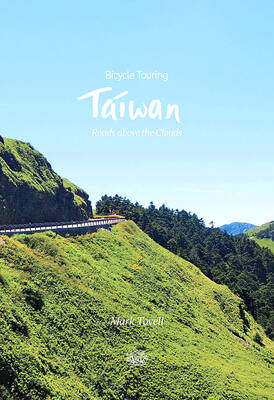
It’s hard to know where to begin with Mark Tovell’s Taiwan: Roads Above the Clouds. Having published a travelogue myself, as well as having contributed to several guidebooks, at first glance Tovell’s book appears to inhabit a middle ground — the kind of hard-to-sell nowheresville publishers detest. Leaf through the pages and you’ll find them suffuse with the purple prose best associated with travel literature: “When the sun is low on a warm, clear morning, and with the heat already rising, we stand at the riverside bike path leading south from Sanxia’s old cobble streets.” Hardly the stuff of your
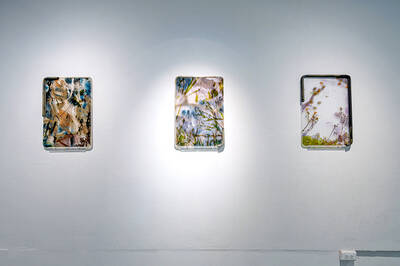
Located down a sideroad in old Wanhua District (萬華區), Waley Art (水谷藝術) has an established reputation for curating some of the more provocative indie art exhibitions in Taipei. And this month is no exception. Beyond the innocuous facade of a shophouse, the full three stories of the gallery space (including the basement) have been taken over by photographs, installation videos and abstract images courtesy of two creatives who hail from the opposite ends of the earth, Taiwan’s Hsu Yi-ting (許懿婷) and Germany’s Benjamin Janzen. “In 2019, I had an art residency in Europe,” Hsu says. “I met Benjamin in the lobby


 RSS
RSS