


When Anh Thu, a tall woman with black-rimmed glasses, walks into a designer boutique to choose a wedding outfit she knows exactly what she wants -- something bright.
Trying on a blood red silk rose-embroidered top, the 25-year-old secretary for a trading company in Ho Chi Minh City, says sedate hues would not be fitting for her big day.
"The style of the collection here is suited to my Vietnamese taste," she says.
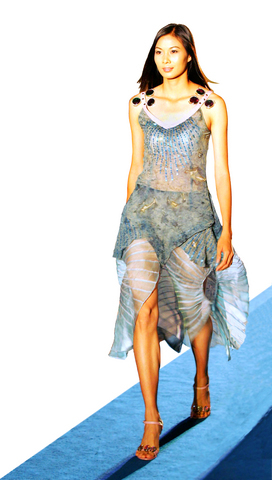
Thu's fashion sense may stand out in this traditionally staid communist country but it lights the way ahead for Vietnam's fledgling fashion industry, both domestically and if it is to attempt to make its mark in the global market for haute couture.
The emerging industry is concentrated around Ho Chi Minh City with its growing population of trendy and relatively affluent urbanites.
Critics say most designers here simply copy or improvise Western and Chinese patterns. But a band of young designers in the southern business capital is seeking to assert a separate identity with works partly inspired by Vietnamese traditions that are catching the eye of foreign designers.

Nguyen Quoc Binh, 25, the designer and owner of the "QB Mode" boutique helps Thu tuck in a long, orange-colored cloth beneath the top and lets it cascade in front of her.
The fabric will be turned into an ankle-length skirt and acquire some pink, blue and purple layers, setting Thu back US$300.
In between attending to her customer, Binh says, "I like to mix many colors because I want to have fun and create the image of a happy life."
After nearly two decades of economic reforms and rising affluence, fun and a happy life are becoming affordable for many Vietnamese people.
"People have so far been used to wearing something that lasts long, synthetic fabrics," says Nguyen Kieu Thu, a prominent make up artist in the fashion industry.
"Now the living standards are upgraded and people care about what they wear. It is a good sign for fashion. They realize that silk or cotton or linen is good and they begin to use many different kinds of material and colors. But I think fashion in Vietnam is too young compared with other countries," she says.
Binh's design and those of another young designer, Nguyen Trong Nguyen, were recently displayed at a show in Hanoi which also featured Italian fashion company Erreuno.
The show was overseen by Dang Thi Minh Hanh, director of the Ho Chi Minh City-based Fashion Design Institute, who has had her works displayed on catwalks abroad.
Erreuno designer Sonia Speciale was impressed with what she saw.
"They are ready to be exported," Speciale says of the collections presented by Binh and Nguyen. "The only thing is that in order to be exported they have to have a proper organization and a proper base of people working for them to get the best they want. But at this point, they can be exported, no problem."
Speciale marvels at the color schemes preferred by Binh and Nguyen.
"What struck me was the eccentricity, especially for the skirts, they were using textiles which were like raw silk."
The outfits the designers presented at the show are aimed at special evenings or parties and bring into play the tradition of embroidery and
needlework in Vietnam.
"There were a good series of outfits which had orange and red as colors and it really struck me because it reminded me of fire," she says.
Nguyen, 27, has an approach similar to that of Binh.
Minh Hanh agrees with Speciale that Vietnam is producing talent and believes the potential is there for rapid growth.
"The development of the fashion industry is the development of Vietnamese culture and society," she says.
She wants a three-pronged approach to boost the industry -- train designers, educate people about fashion and promote greater exchanges between Vietnamese and foreigners in the field.
"I think young designers have rich ideas ... they use a lot of embroidery and Vietnamese silk, it is very good but they don't have the basics of fashion techniques," Minh Hanh says.
Vietnamese people are unfamiliar with the concept of fashion and have little access to fashion magazines, books and academic courses, she says.
"We have a lot of factories which can make very good quality products but they don't have the designs. I think if we have more and more young designers, who have learned the basics of fashion, I think Vietnamese fashion industry will grow rapidly."

In late October of 1873 the government of Japan decided against sending a military expedition to Korea to force that nation to open trade relations. Across the government supporters of the expedition resigned immediately. The spectacle of revolt by disaffected samurai began to loom over Japanese politics. In January of 1874 disaffected samurai attacked a senior minister in Tokyo. A month later, a group of pro-Korea expedition and anti-foreign elements from Saga prefecture in Kyushu revolted, driven in part by high food prices stemming from poor harvests. Their leader, according to Edward Drea’s classic Japan’s Imperial Army, was a samurai

Located down a sideroad in old Wanhua District (萬華區), Waley Art (水谷藝術) has an established reputation for curating some of the more provocative indie art exhibitions in Taipei. And this month is no exception. Beyond the innocuous facade of a shophouse, the full three stories of the gallery space (including the basement) have been taken over by photographs, installation videos and abstract images courtesy of two creatives who hail from the opposite ends of the earth, Taiwan’s Hsu Yi-ting (許懿婷) and Germany’s Benjamin Janzen. “In 2019, I had an art residency in Europe,” Hsu says. “I met Benjamin in the lobby
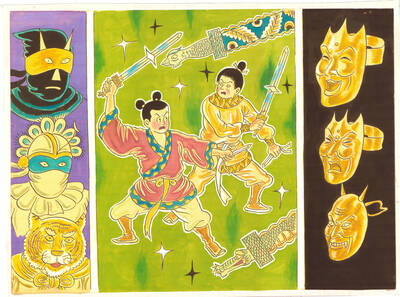
April 22 to April 28 The true identity of the mastermind behind the Demon Gang (魔鬼黨) was undoubtedly on the minds of countless schoolchildren in late 1958. In the days leading up to the big reveal, more than 10,000 guesses were sent to Ta Hwa Publishing Co (大華文化社) for a chance to win prizes. The smash success of the comic series Great Battle Against the Demon Gang (大戰魔鬼黨) came as a surprise to author Yeh Hung-chia (葉宏甲), who had long given up on his dream after being jailed for 10 months in 1947 over political cartoons. Protagonist

Peter Brighton was amazed when he found the giant jackfruit. He had been watching it grow on his farm in far north Queensland, and when it came time to pick it from the tree, it was so heavy it needed two people to do the job. “I was surprised when we cut it off and felt how heavy it was,” he says. “I grabbed it and my wife cut it — couldn’t do it by myself, it took two of us.” Weighing in at 45 kilograms, it is the heaviest jackfruit that Brighton has ever grown on his tropical fruit farm, located


 RSS
RSS