


First there's shock tinged with disbelief. A moment of wonder follows. Then, a desperate scramble to rack your brains and work out just how you've been had. There's no denying the effects of a good magic trick. From the great escapes of Harry Houdini and the surreal mental trickery of Derren Brown to the conjurors at children's parties, the appeal is universal.
"Magic's been around for a very long time and it improves over time," says Richard Wiseman, a professor of psychology at Hertfordshire University, UK. "What you're looking at when you see a finished piece of magic is a great deal of expertise, and I think psychologists have a lot to learn from that."
But, not content with just enjoying the tricks, psychologists are now studying their effects on the mind to work out how we handle the floods of sensory information coming into our brains and process it into a mental picture of the world around us. Magic is a deception, a disruption of that orderly mental picture where things seem to float in mid-air or coins and cards vanish in front of our eyes. Scientists now believe that, by mapping out how our brains are deceived, they could even help to unlock some of the mysteries of consciousness itself.
"Over the last five years, there's been a reawakening as we look at things like change blindness (a failure to see large changes in a visual scene) and at the fact that consciousness is a construction and may even be an illusion," says Wiseman, himself an accomplished magician and member of the Magic Circle. "Now there's a recognition that magicians are doing something very special."
Some of the founders of modern psychology were fascinated by magicians: throughout the 1890s, Alfred Binet, inventor of the modern IQ test, and Max Dessoir wrote about the ways in which magicians used suggestion and misdirected attention to get their illusions to work.
In 1896, Joseph Jastrow published articles in Science on the mecha-nics of some tricks by contemporary master magicians. But, aside from describing what the magicians were doing, they were at a loss to explain why magic tricks had the effects they did on the audience. As a result, interest in studying the psychology of magic faded for nearly a century.
But, as Wiseman says, a renaissance is now in full swing.
Magic is all about convincing others that the impossible has just happened. And that deception is achieved with a high degree of skill and showmanship.
"We're starting to realize that magicians have a lot of implicit know-ledge about how we perceive the world around us because they have to deceive us in terms of controlling attention, exploiting the assumptions we make when we do and don't notice a change in our environment," says Wiseman. "There is an enormous amount of really detailed instruction on how to perform magic. People are always blown away by how detailed a description you'll have."
A card trick that lasts four or five minutes, for example, might have 20 pages of detailed text to describe exactly where to look, what to say, what to do and so on. And a lot of the understanding of a trick has to be from the perspective of the audience.
While the magician's dexterity is important, the audience is also a vital participant in the deception. After all, it is in their minds that the illusion is created. "Magicians seem to be able to carry out secret actions in front of their audience without being spotted. I'm interested in why people don't perceive those actions," says Gustav Kuhn, a psychologist at Durham University.
A simple example of misdirection is used in the coin drop trick. "What you're doing there is pretending to take the coin from one hand to the other but, in fact, leaving it in the original hand," says Wiseman. "What's important is that you're looking where you want the audience to look. You're not looking at the coin, you're looking at the empty hand. In terms of movement, you're moving the hand that doesn't contain the coin to attract people's attention over to that hand."
Another trick, where a magician pretends to throw a ball up in the air, takes the misdirection a step further. "People often experience the ball moving up in the air even though there is no ball present," says Kuhn. "They claim to see a ball moving but obviously it's not there so it must be in their mind." Psychologists can use these tricks to catch a glimpse into how our minds interpret the world around us.
"Magicians are manipulating your consciousness. They are showing you something impossible," says Wiseman. "They're getting you to construct a narrative, which simply isn't true. So that means they know how to make you aware of certain things and blind to other things. What I'm hoping is that magic, this entertainment vehicle that has been around for a long time, will give us a real insight into the deep mysteries of consciousness."
Our brains filter out a huge amount of the mass of sensory input flooding in from our environment. Kuhn explains that we see what we expect to see and what our brains are interested in. "Our visual representation of the world is much more impoverished than we would assume. People can be looking at something without being aware of it. Perception doesn't just involve looking at an object but attending to it."
In Kuhn's recent work, he performed a trick where a cigarette seems to disappear. It involved no sleight of hand or secret. It was a simple case of dropping the cigarette into his lap. "It happens right in front of the spectator's eyes but I misdirect their attention away from the cigarette," says Kuhn.
While his spectators watched, they wore eye trackers (essentially a couple of cameras that monitor eye movement and provide an exact location of where a person is looking in a scene).
It is known that we only receive high-quality information from the area we are fixated on, right in the center of our field of view.
If you stretch out your arm, it is about two thumbs' width at the center of your vision -- everything else is pretty much blurred. The way we compensate for this is to move our eyes around to fill in the gaps and create a better picture of the world around us.
Kuhn's results, to be published in the journal Perception in the next few months, showed that simply staring at the location of the deception was not enough for people to discover how the trick happened.
"People could be looking very close to where the cigarette was being dropped without even seeing it," he says. "Other people were looking quite far away but they did not actually spot the cigarette."
"What it shows is just how much of the picture in our head of our surroundings is a massive construction, based on expectations, what we think is important, what we normally encounter and so on," says Wiseman. "And that's what magicians are very good at exploiting."
Of course, magic is more than just surprise, so the researchers will be looking for something more. "When you're watching magic, there is just a split second when you're in disbelief and that's what we're looking for, that exact moment," he says. "The magic spot."

In late October of 1873 the government of Japan decided against sending a military expedition to Korea to force that nation to open trade relations. Across the government supporters of the expedition resigned immediately. The spectacle of revolt by disaffected samurai began to loom over Japanese politics. In January of 1874 disaffected samurai attacked a senior minister in Tokyo. A month later, a group of pro-Korea expedition and anti-foreign elements from Saga prefecture in Kyushu revolted, driven in part by high food prices stemming from poor harvests. Their leader, according to Edward Drea’s classic Japan’s Imperial Army, was a samurai

Located down a sideroad in old Wanhua District (萬華區), Waley Art (水谷藝術) has an established reputation for curating some of the more provocative indie art exhibitions in Taipei. And this month is no exception. Beyond the innocuous facade of a shophouse, the full three stories of the gallery space (including the basement) have been taken over by photographs, installation videos and abstract images courtesy of two creatives who hail from the opposite ends of the earth, Taiwan’s Hsu Yi-ting (許懿婷) and Germany’s Benjamin Janzen. “In 2019, I had an art residency in Europe,” Hsu says. “I met Benjamin in the lobby
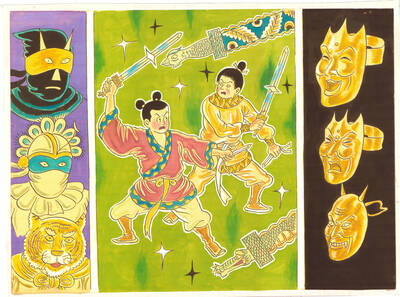
April 22 to April 28 The true identity of the mastermind behind the Demon Gang (魔鬼黨) was undoubtedly on the minds of countless schoolchildren in late 1958. In the days leading up to the big reveal, more than 10,000 guesses were sent to Ta Hwa Publishing Co (大華文化社) for a chance to win prizes. The smash success of the comic series Great Battle Against the Demon Gang (大戰魔鬼黨) came as a surprise to author Yeh Hung-chia (葉宏甲), who had long given up on his dream after being jailed for 10 months in 1947 over political cartoons. Protagonist

A fossil jawbone found by a British girl and her father on a beach in Somerset, England belongs to a gigantic marine reptile dating to 202 million years ago that appears to have been among the largest animals ever on Earth. Researchers said on Wednesday the bone, called a surangular, was from a type of ocean-going reptile called an ichthyosaur. Based on its dimensions compared to the same bone in closely related ichthyosaurs, the researchers estimated that the Triassic Period creature, which they named Ichthyotitan severnensis, was between 22-26 meters long. That would make it perhaps the largest-known marine reptile and would


 RSS
RSS