


They begin the morning at dawn clothed in white, but by mid-day the 25 Western men gathered at Thailand's largest temple wear the saffron robes of the Buddhist monk.
With their heads shaved and concentration on their faces, they kneel in front of the abbot and other senior monks of Wat Dhammakaya to recite in ancient Pali some of the 227 precepts that will guide them through the next several weeks.
The ceremony in a traditional Thai chapel is closely watched here; elderly Thai women in white robes sit on the matted floor with their backs to the temple walls, palms together in prayer, offering support to the novices about to embark on a religious journey to seek, in part, the meaning of mindfulness.
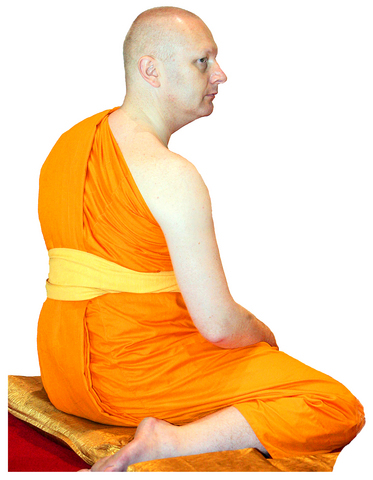
Most are undergoing a temporary, one-month ordination, but for some, the ritualistic donning of the orange robes represents a spiritual renewal that could last a lifetime.
"It is impossible to make progress without faith," an English voice tells them, translating the abbot's words moments before their ordination. "The first thing is to be able to overcome our bad habits, the character traits which we may have from the past."
The voice belongs to 40-year-old Nicholas Thanissaro, one of Thailand's best known farang (Western) monks and the temple's primary interlocutor for American and European Buddhist novices. The only visible traces of his English identity are his light skin and the soft fullness of his facial features. With his head shaved and bearing the temperament of a senior religious figure, there is little to identify him as a foreigner.
Yet Phra (monk) Nicholas is among a growing number of Westerners putting on the robes in Thailand, keen on exploring the wisdom of Buddhist doctrine but also on embracing a deeper Eastern spirituality and meditation that they see is lacking back home.
"The general image of religion is getting worse in Western eyes," Phra Nicholas says, as he expounds on the hits organized faith has taken in recent years, particularly with the emotional touchstone that the US-led war in Iraq has become. Religion, he argues, frames a clash of civilizations.
"Religion is seen as a source of conflict, a source of wars, a source of people who don't have reasons for doing things. They follow blind faith.
"But Buddhism is seen as different," he continues. "It is a religion of wisdom, which encourages people to think, encourages people to believe in cause and effect."
Here in the serene 325-hectare temple complex outside Bangkok which is home to some 1,000 monks and a rapidly expanding and controversial Buddhist movement, Westerners have been encouraged to explore the dharma, re-evaluate priorities, question their role in life.
The ceremony is the third annual ordination of foreign monks at Wat Dhammakaya. In addition to the 25 Westerners, there are another 25 Chinese and Taiwanese participating.
"In Thailand we have the tradition of temporary ordination. So people ordain, and they can draw on their purity of practice when they go back to their everyday life and use what they've learned."
Today's newest monks are the latest foreign men to be ordained in a kingdom that already has an estimated 300,000 local monks, about one for every 215 Thai citizens.
Like their Thai counterparts, most of the new recruits will join the monkhood for a month, then return to their lives as lawyers, stock analysts or engineers. Others, like Phra Nicholas, opt to stay for good.
"My aim was to ordain for life," Phra Nicholas says. "But for that you have to be fairly sure in your mind what you are doing."
Phra Nicholas was born Nicholas Woods and raised in Manchester, England, where he attended church schools as a boy. He read the Bible "cover to cover," yet it failed to make an impression.
"The whole subject of religion turned me off, even as I had a whole lot of questions about spiritual issues," he says. "I had a fairly negative view of organized religion."
As a university student he began exploring religious and psychological issues more deeply, and he was routinely drawn to an overlapping element of both: meditation. Woods studied and practiced meditation at a Buddhist society in Manchester in the 1980s, learning of Sri Lankan, Japanese, Vietnamese and Myanmar strains of Buddhism.
The Theravada school most common in Southeast Asia and Sri Lanka originated with the monastic community that first followed the Buddha. It tends towards conservative and cautious interpretation of its canon of scripture, which is considered Bhuddism's oldest surviving texts.
Phra Nicholas says: "What I liked about the Thai approach was that the teachings were very much based in daily life -- they were speaking in practice and not just in theory," he explains. But many of his instructors were Westerners. He was seeking the source itself.
"I needed to get the feel of something completely different from my own culture."
Eventually Woods made his way to Thailand in 1988 to learn more. He taught English at a local school, but after visiting Wat Dhammakaya with some friends he experienced an ephiphany. What he discovered at Wat Dhammakaya was a very active spiritual community that wasn't afraid to press its founder's guiding philosophy on outsiders, including foreigners.
Over the space of nine years he prepared for the monkhood by learning Thai and studying the precepts. He changed his last name when he became a monk eight years ago, and has worn the robes ever since.
Today Phra Nicholas splits his time between Bangkok and Manchester, where he has set up educational courses and teaches meditation. He also arranged to teach a meditation class to Thais and foreigners at a fitness center in downtown Bangkok.
Hope Weiner, a 37-year-old American who works in Bangkok for the Red Cross, emerges from the class elated.
"It reminded me of Russian dolls, with all these little yous inside!" she tells the monk. "Damn, they need this in New York."

Last week Joseph Nye, the well-known China scholar, wrote on the Australian Strategic Policy Institute’s website about how war over Taiwan might be averted. He noted that years ago he was on a team that met with then-president Chen Shui-bian (陳水扁), “whose previous ‘unofficial’ visit to the US had caused a crisis in which China fired missiles into the sea and the US deployed carriers off the coast of Taiwan.” Yes, that’s right, mighty Chen caused that crisis all by himself. Neither the US nor the People’s Republic of China (PRC) exercised any agency. Nye then nostalgically invoked the comical specter
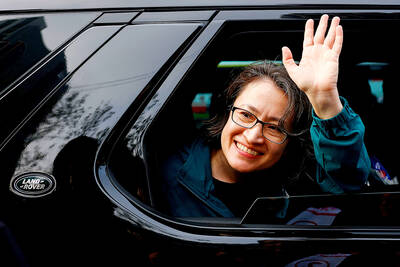
Relations between Taiwan and the Czech Republic have flourished in recent years. However, not everyone is pleased about the growing friendship between the two countries. Last month, an incident involving a Chinese diplomat tailing the car of vice president-elect Hsiao Bi-khim (蕭美琴) in Prague, drew public attention to the People’s Republic of China’s (PRC) operations to undermine Taiwan overseas. The trip was not Hsiao’s first visit to the Central European country. It was meant to be low-key, a chance to meet with local academics and politicians, until her police escort noticed a car was tailing her through the Czech capital. The
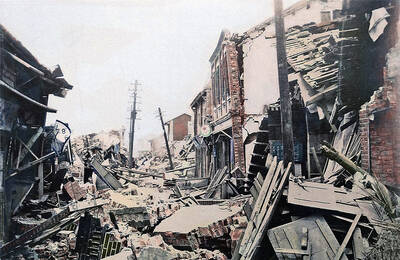
April 15 to April 21 Yang Kui (楊逵) was horrified as he drove past trucks, oxcarts and trolleys loaded with coffins on his way to Tuntzechiao (屯子腳), which he heard had been completely destroyed. The friend he came to check on was safe, but most residents were suffering in the town hit the hardest by the 7.1-magnitude Hsinchu-Taichung Earthquake on April 21, 1935. It remains the deadliest in Taiwan’s recorded history, claiming around 3,300 lives and injuring nearly 12,000. The disaster completely flattened roughly 18,000 houses and damaged countless more. The social activist and

Over the course of former President Ma Ying-jeou’s (馬英九) 11-day trip to China that included a meeting with Chinese Communist Party (CCP) leader Xi Jinping (習近平) a surprising number of people commented that the former president was now “irrelevant.” Upon reflection, it became apparent that these comments were coming from pro-Taiwan, pan-green supporters and they were expressing what they hoped was the case, rather than the reality. Ma’s ideology is so pro-China (read: deep blue) and controversial that many in his own Chinese Nationalist Party (KMT) hope he retires quickly, or at least refrains from speaking on some subjects. Regardless


 RSS
RSS