


Calm down.
That is the essential message of Harold Schechter's Savage Pastimes, which is a charming tour through the charnel house of history and popular culture, as he attempts to persuade us that we are not living in cultural endtimes, and that, in spite of the evidence of our eyes and ears, things used to be much worse.
"While American popular culture is far more technologically sophisticated than it used to be," asserts Schechter, "it is not, by any stretch, more brutal."
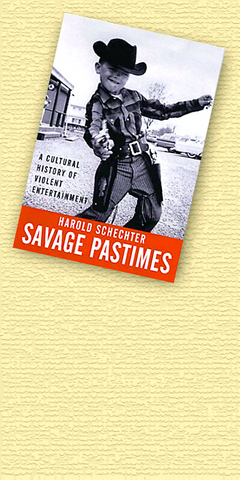
Schechter is an energetic writer who takes in everything from the great gouts of blood loosed in Grimm's Fairy Tales and Titus Andronicus, to the insane excesses of the Elizabethan playwright Thomas Kyd and the Grand Guignol of Paris, and the great comic-book scare of the 1950s.
He writes about the arsenals of toy guns that every self-respecting child brought up in the 1950s had, whether it was a Roy Rogers model or a Davy Crockett model. All this, of course (according to sociologists and professional alarmists), was going to turn America into a sociopath's haven, a country whose role models would cease to be Jefferson and Lincoln and become Dillinger and de Sade.
"Instead, we grew up to be the generation that preached (how-ever sanctimoniously) peace, love and flower power."
Schechter's point is that humans have always indulged themselves in bloody, anti-social visions because, as a species, we're hard-wired for it. (Writer William James once referred to our "Aboriginal capacity for murderous excitement.") This capacity transcends ancestry, environment and the civilizing influences of culture.
"The notion that little boys are sweet, docile creatures until taught otherwise by the media can only be seriously entertained by someone who has never witnessed or experienced a phenomenon common in certain liberal communities; the sight of, say, a three-year old boy -- raised in a household where violent toys are forbidden and the most action-packed TV program he is permit-ted to watch is Spongebob SquarePants -- spontaneously picking up a twig or Popsickle stick and wielding it as a weapon in a make-believe swordfight with a playmate."
Schechter asserts that violence is relative, i.e. one generation's bloodbath is another's nasty paper cut: "In terms of . . . pyrotechnical destruction, and sheer body count, there is in fact no comparison between a Die Hard movie and John Ford's Stagecoach. The effect of the two films on their respective audiences, however, was much the same. For little boys in 1939, "Stagecoach" was Die Hard -- a fast-paced action movie that set their hearts racing, filled their heads with violent daydreams, and inspired them to play at make-believe mayhem."
Schechter is twisting things to make a point. For one thing, Stagecoach is hardly fast-paced; even by the standards of 1939, the storytelling is quite methodical, and there isn't any action until practically the two-thirds point. I suspect kids in 1939 would have been slightly bored by most of it, probably because it wasn't made for them -- it was an adult western. Kids preferred Gene Autry or serials with ridin' and fightin.'
That said, it seems to me that Schechter is on to something -- the supposed social manifestations of a brutalizing culture are nowhere in evidence: The crime rate continues to fall, just as it has for nearly 20 years.
But Schechter is also missing something by inferring that the only negative consequences of coarse culture can be quantified by crime statistics. Doesn't creeping stupidity -- the way that public discourse has been dumbed down over the past 30 years -- count? What about the mass media's part in that?
A crowd in the 16th century that gathered to watch someone be drawn and quartered might number a few hundred or a few thousand bloodthirsty souls who were getting their jollies. Those people who lived outside the cities or who were repelled by such things didn't have to have it be part of their daily diet.
In a media-driven culture, you can't avoid it even if you want to, short of joining a Trappist monastery. Besides that, there's the spurious realism of the modern media. Someone shot in a 1939 western clutched his stomach and fell down in a neat, bloodless bundle. Someone shot today is likely to have his head explode in a shower of brains. More realistic? Presumably. (I've never actually seen anybody shot, and I hope my luck holds.) But so what? Why is realism intrinsically preferable to a more oblique artistry? It isn't, actually; it's just far more commonplace, because it doesn't require any imagination on either end of the production process. Schechter's book is entertaining but rather thinly imagined; it would make a better argument as a much shorter piece in The Atlantic Monthly than a book between hard covers.

In late October of 1873 the government of Japan decided against sending a military expedition to Korea to force that nation to open trade relations. Across the government supporters of the expedition resigned immediately. The spectacle of revolt by disaffected samurai began to loom over Japanese politics. In January of 1874 disaffected samurai attacked a senior minister in Tokyo. A month later, a group of pro-Korea expedition and anti-foreign elements from Saga prefecture in Kyushu revolted, driven in part by high food prices stemming from poor harvests. Their leader, according to Edward Drea’s classic Japan’s Imperial Army, was a samurai

Located down a sideroad in old Wanhua District (萬華區), Waley Art (水谷藝術) has an established reputation for curating some of the more provocative indie art exhibitions in Taipei. And this month is no exception. Beyond the innocuous facade of a shophouse, the full three stories of the gallery space (including the basement) have been taken over by photographs, installation videos and abstract images courtesy of two creatives who hail from the opposite ends of the earth, Taiwan’s Hsu Yi-ting (許懿婷) and Germany’s Benjamin Janzen. “In 2019, I had an art residency in Europe,” Hsu says. “I met Benjamin in the lobby

April 22 to April 28 The true identity of the mastermind behind the Demon Gang (魔鬼黨) was undoubtedly on the minds of countless schoolchildren in late 1958. In the days leading up to the big reveal, more than 10,000 guesses were sent to Ta Hwa Publishing Co (大華文化社) for a chance to win prizes. The smash success of the comic series Great Battle Against the Demon Gang (大戰魔鬼黨) came as a surprise to author Yeh Hung-chia (葉宏甲), who had long given up on his dream after being jailed for 10 months in 1947 over political cartoons. Protagonist

A fossil jawbone found by a British girl and her father on a beach in Somerset, England belongs to a gigantic marine reptile dating to 202 million years ago that appears to have been among the largest animals ever on Earth. Researchers said on Wednesday the bone, called a surangular, was from a type of ocean-going reptile called an ichthyosaur. Based on its dimensions compared to the same bone in closely related ichthyosaurs, the researchers estimated that the Triassic Period creature, which they named Ichthyotitan severnensis, was between 22-26 meters long. That would make it perhaps the largest-known marine reptile and would


 RSS
RSS