


The 60th anniversary of the dropping of the atom-bomb on Hiroshima occurs next month, on Aug. 6. This new book, a day-by-day account of the run-up to that day in laboratories, on airfields and in the corridors of power, as well as in the streets and parks of Hiroshima itself, appears to have been commissioned in order to meet that deadline.
It's not only painful but also intellectually unsettling to have to write about Hiroshima at all. The horrors themselves, with the temptation to linger over them in some sort of voyeuristic fascination, are only the worst part of it. But the old, weary argument about whether the bombing was justified -- in order to end the war quickly, or as a lesson to the Soviet Union, in the summer of 1945 poised to invade Japan from the north -- is also troublingly compromising.
One of the worst parts of the argument for and against is the tacit agreement by both sides not to include consideration of the pure Buddhist precept that to take life at all is simply wrong. In the tough world of real politics, we can forget that one, people seem to assume.

Nevertheless, it was a revulsion at the whole grim, mega-death calculations of the ensuing Cold War that led to the peace movement of the 1960s, together with the alienation from "conventional" society pioneered by the Beats in the 1950s, something that led Allen Ginsberg to tell America, in a deliberately shocking early poem, just what it could do with its atom bomb.
And nowadays, when probably nine nations possess nuclear weapons, the atomic one of 1945 can even appear of limited size and power. If you go to the Peace Park in Hiroshima and look at the twis-ted bicycle that's one of the exhibits, your reaction as a modern visitor can very easily be. "How extraordinary that it survived at all!"
Also curious, but numbing in its number-crunching, is the absolute distinction made between the two bombs of August 1945 and the massive carpet bombing that had gone before. Over 100,000 civilians had been burnt alive in Tokyo on one night alone in May 1945 from incendiary bombs, not to mention the earlier wholesale destruction of Hamburg and Dresden by the UK's Royal Air Force. Such deliberate killing of civilians, which both sides claim the other began, was a huge step in the evolution of the horror of modern war. In the 18th century, right down to the Napoleonic Wars, citizens paid to be taken to convenient hilltops to watch an important battle. By the end of World War II they were being obliterated (if they were lucky) in their beds.
Nor is it enjoyable to rehearse once again such things as what Franklin Roosevelt might have done if he hadn't died in April 1945, or consider the public relations implications of Truman's given name "Harry," with its suggestion that he was at heart an easy-going, decent fellow who couldn't possibly have been responsible for anything approaching a war-crime.
All this and more was gone over at the previous major Hiroshima anniversary, the 50th in 1995. Then the planned exhibition at Washington's Smithsonian Institute, aimed at airing both sides of a permanently vexed question, was curtailed following patriotic protests from the American Legion and the Air Force Association. In the end only the aircraft, the Enola Gay, stood as a mute and ambiguous tribute to what visitors could interpret for themselves as either the US' success or humanity's disgrace.
Stephen Walker doesn't really take sides in Shockwave either. Instead, he tabulates the countdown. You have a nuclear physicist, Philip Morrison, carrying the core of the world's first atomic bomb through New Mexico on the back seat of his car. You have what is known of the conversations on board the Enola Gay. And the author has interviewed such survivors of those crucial decision-making days as remain, though some of them died between the interviews and the publication of the book.
And for the Japanese side, Walker (a UK writer) identifies a pair of lovers who met the night before the disaster, and has the couple parting, and then the scene in the reconstituted park in 2005, as his opening and closing sections, framing, as it were, the momentous central action. He interviewed the young man concerned, in 1945 a Hiroshima engineering student, last year along in preparation for writing this book.
As for the photographs, it's hard to know which is the more thought-provoking -- the before and after pictures of the street-system of central Hiroshima as seen from the air, or the photo of grinning Enola Gay tail-gunner Bob Caron in a Brooklyn Dodgers cap holding a copy of the Oakland Tribune. Its headlines read "Atom Bomb Destroys Entire City, Say Japs", "Nip Cabinet Called in Crisis" and "Tokyo Wails Blast Illegal."
Did the crew experience remorse? Some did, after their own fashion. Caron himself, who died in 1995, once commented "When I think about the fission and fusion bombs of today, I wonder whether we're not getting into God's territory."
This is an extremely vivid piece of historical recreation, seeing events always in the concrete, never in the abstract. It's hard to put down, and reminiscent in style of, say, Truman Capote's 1964 blockbuster In Cold Blood. It's true it doesn't always blench at making events immediate in a quasi-journalistic manner, but the sources for statements made and scenes depicted are nevertheless cited throughout. It is also admirably even-handed, seeking neither to make heroes or villains of the bomb's creators, nor condemning anything or anyone out of hand. All in all, if you must read about Hiroshima yet again, this book would probably be as good a one to settle down to as any.

In late October of 1873 the government of Japan decided against sending a military expedition to Korea to force that nation to open trade relations. Across the government supporters of the expedition resigned immediately. The spectacle of revolt by disaffected samurai began to loom over Japanese politics. In January of 1874 disaffected samurai attacked a senior minister in Tokyo. A month later, a group of pro-Korea expedition and anti-foreign elements from Saga prefecture in Kyushu revolted, driven in part by high food prices stemming from poor harvests. Their leader, according to Edward Drea’s classic Japan’s Imperial Army, was a samurai

Located down a sideroad in old Wanhua District (萬華區), Waley Art (水谷藝術) has an established reputation for curating some of the more provocative indie art exhibitions in Taipei. And this month is no exception. Beyond the innocuous facade of a shophouse, the full three stories of the gallery space (including the basement) have been taken over by photographs, installation videos and abstract images courtesy of two creatives who hail from the opposite ends of the earth, Taiwan’s Hsu Yi-ting (許懿婷) and Germany’s Benjamin Janzen. “In 2019, I had an art residency in Europe,” Hsu says. “I met Benjamin in the lobby
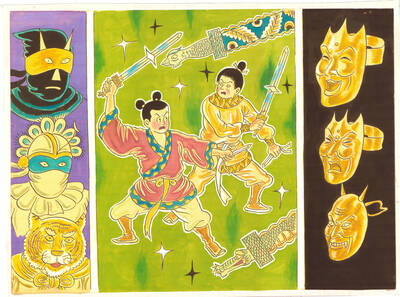
April 22 to April 28 The true identity of the mastermind behind the Demon Gang (魔鬼黨) was undoubtedly on the minds of countless schoolchildren in late 1958. In the days leading up to the big reveal, more than 10,000 guesses were sent to Ta Hwa Publishing Co (大華文化社) for a chance to win prizes. The smash success of the comic series Great Battle Against the Demon Gang (大戰魔鬼黨) came as a surprise to author Yeh Hung-chia (葉宏甲), who had long given up on his dream after being jailed for 10 months in 1947 over political cartoons. Protagonist

Peter Brighton was amazed when he found the giant jackfruit. He had been watching it grow on his farm in far north Queensland, and when it came time to pick it from the tree, it was so heavy it needed two people to do the job. “I was surprised when we cut it off and felt how heavy it was,” he says. “I grabbed it and my wife cut it — couldn’t do it by myself, it took two of us.” Weighing in at 45 kilograms, it is the heaviest jackfruit that Brighton has ever grown on his tropical fruit farm, located


 RSS
RSS