


"Start the car, I know a whoopee spot, where the gin is cold and the piano hot, and all that jazz ...."
The whoopee spot this week is the National Theater, where the killer girls of Chicago are taking center stage every night through Sunday and twice a day next weekend.
While the stagebill likes to play up the link between the 1924 murders that form the basis of the story of Chicago and today's celebrity trials and media scrums, the real reason Chicago has been such a hit since it was revived (overhauled, actually) in 1996 was the talent of the three men responsible for the original 1975 show -- John Kander and Fred Ebb, who wrote the great music and lyrics and Bob Fosse, the director and choreographer, whose highly charged and very sexual choreography stays in the audience's minds long after they have left the theater.
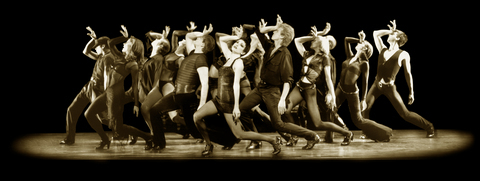
PHOTO COURTESY OF KHAM
The revival stripped the fat from the original and paid homage to Fosse's career by incorporating stylistic images from his other hits, including the musicals Sweet Charity, Pippen, Cabaret and the film All That Jazz. Fosse's long-time muse and protegee Ann Reinking did a fabulous job recreating his style in doing the choreography for the revival.
There is just something about Fosse's choreography that makes it hard for the audience to sit still -- you want to be tapping your toes, rolling your shoulders, doing that pelvic hip roll and trying to hold your arms straight out and snapping your fingers. If only you could.
But since most of us can't, we have to be content with watching others, and the dancers in the cast, clad in a variety of minimalist black costumes, do a great job.
Chicago's staging is also minimal, which makes it ideal for a touring show. There's an outsized caricature of a jury box in the center that holds the 13-piece orchestra and musical director, flanked on both sides by a row of chairs where the cast sit when not performing. But that's fine because there's not really that much of a storyline or dialogue except what is needed to string the musical numbers together -- just like a vaudville show.
But from the minute Terra MacLeod, as cabaret-singer-turned-murderess Velma Kelly, starts the opening lines of All That Jazz, she has the audience eating out of the palm of her hand. In a black chemise and slicked-back hair, she is the very image of a Fosse flapper.
Her rival for press attention is the red-headed Tracy Shayne, whose compact body appears barely big enough to contain the energy of chorine and would-be-star Roxy Hart, who is just bursting with desire to become famous.
Her opening number, Funny Honey, is performed from half-way up a ladder on stage right, and it's hard to pay attention to what's happening over on stage left, where her poor husband is attempting to take the blame for killing her lover.
These days, any company performing Chicago faces the tough challenge of competing with the film version that starred Renee Zellweger and Catherine Zeta-Jones. Not only is the tempo of several of the songs slower in the stage production, the smaller cast size and stage restrictions means the big production numbers don't have quite the same eye-popping, over-the-top flash of their film counterparts.
Nevertheless, Cell Block Tango and We Both Reached for the Gun were well-executed, and Razzle-Dazzle did just that, with multi-colored foil confettii floating down over the dancers.
Special kudos go to Kevin Carolan, who plays Roxie's hubby Amos Hart, a sad-sack figure in black cardigan and tie. Carolan makes Amos' solo Mister Cellophane his own, with nothing more than a pair of white gloves for props.
Also full of surprises was R. Bean, who plays the reporter Mary Sunshine, whose first song A Little Bit of Good was one of the songs not used in the film version.
Chicago runs through Sunday, July 17 at the Taipei National Theater at the CKS Memorial Hall. Chinese translations of the song lyrics are provided by light boxes on either side of the stage. Unfortunately, the only remaining tickets are the really expensive ones (NT$3,000 to NT$6,000), but if you have the money, you won't be disappointed. You do, however, have to provide your own gin.
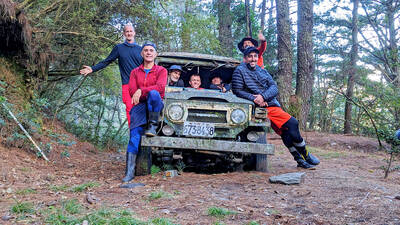
The year was 1991. A Toyota Land Cruiser set out on a 67km journey up the Junda Forest Road (郡大林道) toward an old loggers’ camp, at which point the hikers inside would get out and begin their ascent of Jade Mountain (玉山). Little did they know, they would be the last group of hikers to ever enjoy this shortcut into the mountains. An approaching typhoon soon wiped out the road behind them, trapping the vehicle on the mountain and forever changing the approach to Jade Mountain. THE CONTEMPORARY ROUTE Nowadays, the approach to Jade Mountain from the north side takes an

Last week Joseph Nye, the well-known China scholar, wrote on the Australian Strategic Policy Institute’s website about how war over Taiwan might be averted. He noted that years ago he was on a team that met with then-president Chen Shui-bian (陳水扁), “whose previous ‘unofficial’ visit to the US had caused a crisis in which China fired missiles into the sea and the US deployed carriers off the coast of Taiwan.” Yes, that’s right, mighty Chen caused that crisis all by himself. Neither the US nor the People’s Republic of China (PRC) exercised any agency. Nye then nostalgically invoked the comical specter

Relations between Taiwan and the Czech Republic have flourished in recent years. However, not everyone is pleased about the growing friendship between the two countries. Last month, an incident involving a Chinese diplomat tailing the car of vice president-elect Hsiao Bi-khim (蕭美琴) in Prague, drew public attention to the People’s Republic of China’s (PRC) operations to undermine Taiwan overseas. The trip was not Hsiao’s first visit to the Central European country. It was meant to be low-key, a chance to meet with local academics and politicians, until her police escort noticed a car was tailing her through the Czech capital. The
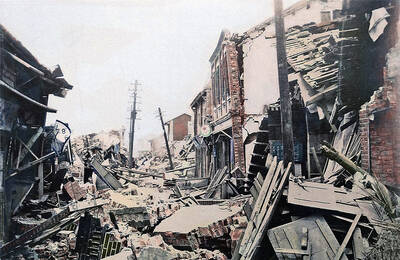
April 15 to April 21 Yang Kui (楊逵) was horrified as he drove past trucks, oxcarts and trolleys loaded with coffins on his way to Tuntzechiao (屯子腳), which he heard had been completely destroyed. The friend he came to check on was safe, but most residents were suffering in the town hit the hardest by the 7.1-magnitude Hsinchu-Taichung Earthquake on April 21, 1935. It remains the deadliest in Taiwan’s recorded history, claiming around 3,300 lives and injuring nearly 12,000. The disaster completely flattened roughly 18,000 houses and damaged countless more. The social activist and


 RSS
RSS