


The unpublished novel Get Out, You Damned One will not win any literary awards. A forgettable piece of pulp, it features a scheming traitor, an invading army of Zionist-Christian infidels and an Arab liberator. The only thing that sets the novel apart from numerous others like it in Arab bookstores is its author: Saddam Hussein.
When Raghad Saddam Hussein, Saddam's exiled daughter, announced plans to publish the 186-page novel in Amman earlier this week, she set off a fierce debate over Saddam's legacy. Jordan's press and publications department quickly banned the book. Bootleg copies then sold out.
Experts said Saddam, long held in high esteem by many Jordanians, retained his popularity even as evidence against him was being gathered for a trial in Iraq.
"A lot of people still like him, and he still commands popularity," said Suleiman al-Horani, owner of the tiny Horani Kiosk in downtown Amman. Within hours of the ban on the book, Horani says, he sold 50 bootleg copies. "His popularity is increasing because of the success the resistance is now having in Iraq."
The continued turbulence in Iraq has served to credit his grip over the country during his rule, experts here contend. American missteps, prison scandals and corruption have added to his support.
"People are comparing the old regime and the new, and the sense is that things have simply gotten much worse," said Muhammad Abu Hdeib, a member of Jordan's Parliament and chairman of its Arab and international affairs committee. "All this has made people see American propaganda as a flat-out lie."
Satan's hold
The novel, which Saddam is said to have completed on the eve of the American invasion in 2003, is seen as a picture of the occupation of Iraq.
It opens with a narrator who appears to be modeled on the story of Abraham warning his grandsons of Satan's hold over Babylon.
The story tells of Ezekiel, a greedy schemer who plots to overthrow the sheik of a tribe with the help of a powerful enemy aiming to conquer all Arabs but is ultimately defeated by the sheik's daughter with the help of an Arab warrior. This is viewed as a metaphor for a Zionist-Christian plot against Arabs and Muslims.
"Only those who refuse his nation and are faithful to God can be victorious," the narrator warns of Satan, the superpower.
Soon after its completion, the book went into circulation underground without the author's name. Last year, the pan-Arab daily Al Sharq al Awsat published the book in serial form, and numerous copies were printed in Beirut and elsewhere, selling for the equivalent of US$5 with a picture of Saddam on the cover. The first page of the manuscript, the paper reported, was signed and dated March 18, 2003, when the American invasion began.
Many see Raghad's announcement of her publishing plans as part of an orchestrated campaign timed to coincide with the one-year anniversary of the hand-over of sovereignty and the acceleration of a special tribunal that is to try Saddam for war crimes. Raghad is said to have taken an active part in designing the book's cover and editing it, and she added a note in the book in praise of her father.
"The goal was to return Saddam to the public eye," said Mousa Barhouma, executive managing editor of Al Ghad, an independent Jordanian daily, who writes about culture. "He had become a thing of the past, and this may have been an attempt at raising nationalist sentiment and bringing him back on the stage."
Strides made by the Iraqi insurgency added to the momentum, she said, and the banning of the book added to its cachet.
The government was made nervous by it.
"We found that publishing the book would hamper Jordanian-Iraqi ties that Jordan is seeking to build," said Ahmad al-Qadah, head of the press and publications department, the local censor. "Jordan rejects having the story published here, and there is no need to raise such issues."
The novel is Saddam's fourth. His first, Zabiba and the King published in 2001, concerns a heroic Saddam-like king, a woman named Zabiba who symbolizes the Iraqi people, and a tyrannical man who represents America -- and rapes Zabiba.
The second, Walled Fortress published not long after, describes a hero who defends Iraq against enemy attackers. And in 2002, he published Men and the City an autobiographical work that seeks to burnish Saddam's nationalistic credentials by describing how his grandfather supposedly fought the Ottoman Empire. One Amman book distributor noted that the books all sold well, but not on the scale of bootlegs of Saddam's latest novel.
Just say no
It has never been established whether Saddam is in fact the author of the books, or whether he secured a ghostwriter. But in the Arab world, where education and the ability to write prose are highly valued, the novels were meant to add to Saddam's image as a grand Arab leader and thinker. Now that he is in prison, the book appears to be an attempt to burnish that image.
Reaction to the book, as well as to recent images of Saddam in court and to photographs of him in his prison cell speak to the
divergent perceptions of the for-mer Iraqi leader in the West and the Arab world.
While Saddam may have been seen as tired and faded in the West, many here seized on his defiance in the face of dramatic international pressure. That an Arab leader would be caught doing his own laundry in prison, meanwhile, only spoke to his carefully crafted image as a normal man.
"They see him as a strong man who intends to return," said Barhouma, the newspaper editor. "Saddam was presented as a sacrifice at a time when no one could say no to America."
Not all Jordanians see it that way. "Some people find a cause and stick to it," said Yacoub al-Khateeb, 25, an accountant, who says Saddam's support largely emanates from older Jordanians who embraced the cause of Arab nationalism. "Go to a university, speak to some educated people, and you'll find Saddam doesn't play much of a role in their lives."
With the fall of his government, and his incarceration, Saddam lost some visibility here, even among supporters. That may be changing.

Last week Joseph Nye, the well-known China scholar, wrote on the Australian Strategic Policy Institute’s website about how war over Taiwan might be averted. He noted that years ago he was on a team that met with then-president Chen Shui-bian (陳水扁), “whose previous ‘unofficial’ visit to the US had caused a crisis in which China fired missiles into the sea and the US deployed carriers off the coast of Taiwan.” Yes, that’s right, mighty Chen caused that crisis all by himself. Neither the US nor the People’s Republic of China (PRC) exercised any agency. Nye then nostalgically invoked the comical specter
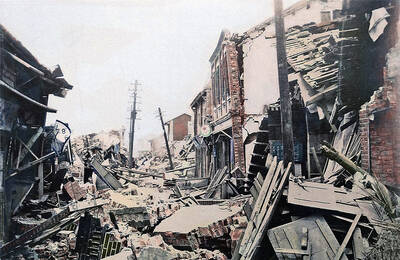
April 15 to April 21 Yang Kui (楊逵) was horrified as he drove past trucks, oxcarts and trolleys loaded with coffins on his way to Tuntzechiao (屯子腳), which he heard had been completely destroyed. The friend he came to check on was safe, but most residents were suffering in the town hit the hardest by the 7.1-magnitude Hsinchu-Taichung Earthquake on April 21, 1935. It remains the deadliest in Taiwan’s recorded history, claiming around 3,300 lives and injuring nearly 12,000. The disaster completely flattened roughly 18,000 houses and damaged countless more. The social activist and

Over the course of former President Ma Ying-jeou’s (馬英九) 11-day trip to China that included a meeting with Chinese Communist Party (CCP) leader Xi Jinping (習近平) a surprising number of people commented that the former president was now “irrelevant.” Upon reflection, it became apparent that these comments were coming from pro-Taiwan, pan-green supporters and they were expressing what they hoped was the case, rather than the reality. Ma’s ideology is so pro-China (read: deep blue) and controversial that many in his own Chinese Nationalist Party (KMT) hope he retires quickly, or at least refrains from speaking on some subjects. Regardless

Approaching her mid-30s, Xiong Yidan reckons that most of her friends are on to their second or even third babies. But Xiong has more than a dozen. There is Lucky, the street dog from Bangkok who jumped into a taxi with her and never left. There is Sophie and Ben, sibling geese, who honk from morning to night. Boop and Pan, both goats, are romantically involved. Dumpling the hedgehog enjoys a belly rub from time to time. The list goes on. Xiong nurtures her brood from her 8,000 square meter farm in Chiang Dao, a mountainous district in northern Thailand’s


 RSS
RSS