


Carlos Bousted is a laid-back recent high school graduate and a sometime DJ. Unlike most DJs, though, Bousted does not have to lug around crates of records, CDs or even an iPod. His music is strictly cellular.
Bousted, 18, is a ringtone DJ. A competitive ringtone DJ. "You put certain songs in order and play them against other people," he said, explaining his technique. "Anytime you're walking around: `Oh, what you got?' And then you pull out your phone."
Downloadable ringtones like the ones Bousted uses -- tunes from artists like the Yin Yang Twins and 50 Cent -- have been a teenage mainstay for years, a mushrooming market worth almost US$5 billion globally (the US share is US$600 million and growing).
But as people like Bousted have grown fluent in the language of ringtones, industry executives and musicians alike have realized that they need not be duplicates of already popular songs; there is room for creativity alongside the commerce.
"We definitely see a market for original content," said Andy Volanakis, president and chief officer of Zingy, a ringtone provider that has released an album by the producer Timbaland.
When combined with technology that allows them to sound like music instead of its tinny shadow, and programs that allow anyone to make, mix or otherwise devise his or her own ringtones, the seven songs on the Timbaland album -- among the first meant to be played on a phone, not a radio or CD player -- suggest that ring tones are not merely a new money-maker; they are a new art form.
"People have really started to take this stuff seriously," said Jonathan Dworkin, vice president for artists and repertory at BlingTones, a Zingy competitor that was one of the first to focus on original works. Its partners include the crunk progenitor Lil Jon, Q-Tip, and others.
With ringbacks, voice tones (Snoop Dogg says, "Pick up the phone!") and sound effects crowding the field, there are more opportunities to circumvent the cellphone's bleep or brring than ever before. Even Nokia, which in 1991 became the first company to market a cellphone with an identifiable musical ring tone (Francisco Tarrega's Gran Vals for classical guitar), has moved away from its traditional tunes. For its newest phone, the Nokia 8801, it commissioned wholly original music and sounds, composed exclusively for cellphone by the eclectic Japanese composer Ryuichi Sakamoto. Later this summer, Zingy will release a song by Free Murda, a Wu-Tang Clan acolyte, as both a single and a ringtone; it was produced by RZA, who compiled the scores for Quentin Tarantino's Kill Bill films.
Why would a serious musician bother? After all, a song can have multiple lives; a ringtone, just one, and a fruit-fly-length one at that. (Timbaland's seven original ringtones average just 20 seconds each.) Money is definitely one reason. As Lil Jon said of BlingTones, "They cut the check." But that's not the end of the story. "It's another way of reaching your audience," he added in a telephone interview. "It's exciting. Like, I was already thinking, what if I produce a song for the cellphone that ends up getting on music charts? The technology is so crazy, that could one day happen."
Actually, it already has: in Britain, the heavily advertised Crazy Frog ringtone -- based on a Swedish teenager's imitation of a revving engine -- topped artists like Coldplay and U2 on the singles charts just last month. And the remix is already out.
One BlingTones artist, Tony Kelly, has already started incorporating the old standard-issue cellphone rings into his new ringtones -- a postmodern remix in which the Nokia song morphs into a hip-hop beat, for example.
Mainstream musicians are not the only ones intrigued by the possibility of the ringing opus. In 2001, the multimedia artist Golan Levin, now a professor of electronic art at Carnegie Mellon University in Pittsburgh, was the co-creator of Dialtones, a "telesymphony" (flong.com/telesymphony), composed entirely of the rings of audience members' cellphones. In Britain (where pop-inspired ringtones already often outsell the songs they are based on), there's a wide variety of phone art, from Nick Crowe's Axis of Evil national anthems (artones.net) to Stream and Shout, which paired artists and students to create original ringtones (streamandshout.net).
"They understood it immediately," Ross Dalziel, a Liverpool, England, sound artist, said of the teenagers he worked with on the Stream and Shout project. For many people, especially the young, ringtones are as musically viable as a favorite mixtape was a generation ago. "The phone playing their favorite song is their identifier," said Geoff Mayfield, director of charts and senior analyst at Billboard magazine, which began a ringtone chart last fall. "That's part of how they brand themselves," he added.
Like so much technology before it, then, the cellphone has morphed far beyond its original function. "A phone used to ring just to get your attention," Levin said. Now, said Patrick Parodi, chairman of Mobile Entertainment Forum, a London-based trade association, "It's probably the device that identifies us most, along with our cars." For musicians, the ringtone also presents an irresistible opportunity to connect with fans. Customization is growing daily: consumers can now choose what part of Fabolous' single Baby they want as their ringtone; previously, record companies made those kinds of decisions.
"The direction we're going in is you'd actually have this artist create the ringtone when your boyfriend calls, or your best friend," said Amy Doyle, vice president for music programming at MTV, which helped release the Timbaland album. "So it becomes the artist scoring your life, almost, on your cellphone." According to Edward Bilous, a professor at the Juilliard School, "Ringtones are pointing towards a kind of new interactive media in which the user and the creator have a more democratic relationship with each other."
But as every sidewalk, cafe, or mode of public transport by now proves, there's also a performance aspect to mobile phones. (After all, nobody customizes the ringtone on a home phone.) And not everyone regards it as welcome. "I think most people would agree with me that as they exist now, ringtones are a public nuisance," Sakamoto wrote in an e-mail message. (Presumably, his composition for Nokia is an exception.)
There are certainly limitations to the form, though Levin suggests that boundaries breed creativity. But with sales on the rise, companies like Verizon, Cingular, and Sprint are creating music-playing phones and giving them the ability to tune in streaming radio. And while Bilous worries that the ubiquity of musical cellphones might ruin the listening experience (he is already pondering starting a course called "From Ring Cycle to Ringtones: A Study in Musical Attention Deficit Disorder"), others contend that they can create new fans with every sound. Even the ringtone battles described by Bousted, the cellphone DJ, foster community.
"You have a little group of people and they'll decide, like, `Oh, yours is better,"' he said. "And then you talk to each other and make friends."
Levin added, "It can be a vehicle for creative expression both on the part of the composer and the part of the person who uses it. The ringtone has a clear connection to everyday life, and, because of that, I think it's a vital form." For those who disagree, there's always vibrate.

In late October of 1873 the government of Japan decided against sending a military expedition to Korea to force that nation to open trade relations. Across the government supporters of the expedition resigned immediately. The spectacle of revolt by disaffected samurai began to loom over Japanese politics. In January of 1874 disaffected samurai attacked a senior minister in Tokyo. A month later, a group of pro-Korea expedition and anti-foreign elements from Saga prefecture in Kyushu revolted, driven in part by high food prices stemming from poor harvests. Their leader, according to Edward Drea’s classic Japan’s Imperial Army, was a samurai

The following three paragraphs are just some of what the local Chinese-language press is reporting on breathlessly and following every twist and turn with the eagerness of a soap opera fan. For many English-language readers, it probably comes across as incomprehensibly opaque, so bear with me briefly dear reader: To the surprise of many, former pop singer and Democratic Progressive Party (DPP) ex-lawmaker Yu Tien (余天) of the Taiwan Normal Country Promotion Association (TNCPA) at the last minute dropped out of the running for committee chair of the DPP’s New Taipei City chapter, paving the way for DPP legislator Su

Located down a sideroad in old Wanhua District (萬華區), Waley Art (水谷藝術) has an established reputation for curating some of the more provocative indie art exhibitions in Taipei. And this month is no exception. Beyond the innocuous facade of a shophouse, the full three stories of the gallery space (including the basement) have been taken over by photographs, installation videos and abstract images courtesy of two creatives who hail from the opposite ends of the earth, Taiwan’s Hsu Yi-ting (許懿婷) and Germany’s Benjamin Janzen. “In 2019, I had an art residency in Europe,” Hsu says. “I met Benjamin in the lobby
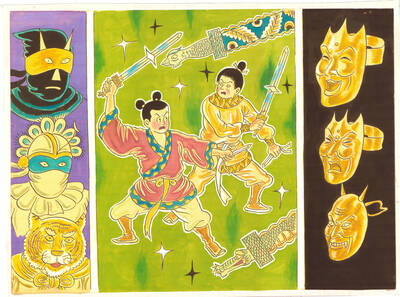
April 22 to April 28 The true identity of the mastermind behind the Demon Gang (魔鬼黨) was undoubtedly on the minds of countless schoolchildren in late 1958. In the days leading up to the big reveal, more than 10,000 guesses were sent to Ta Hwa Publishing Co (大華文化社) for a chance to win prizes. The smash success of the comic series Great Battle Against the Demon Gang (大戰魔鬼黨) came as a surprise to author Yeh Hung-chia (葉宏甲), who had long given up on his dream after being jailed for 10 months in 1947 over political cartoons. Protagonist


 RSS
RSS