


The poets who came of age in the years before, during and after World War II were faced with a giant Freudian dilemma: How were they to come to terms with the
gigantic legacy of the preceding generation -- the great Modernists such as T.S. Eliot, Ezra Pound, Wallace Stevens and Hart Crane? How were they to absorb the lessons of those masters and yet discover original voices of their own? How were they to avoid being crushed by the weight, solemnity and critical reputation of their esteemed predecessors?
In his eloquent and astute new book, the critic Adam Kirsch looks at some prominent US members of that post-modernist era -- Robert Lowell, Elizabeth Bishop, John Berryman, Randall Jarrell, Delmore Schwartz and their slightly later cousin Sylvia Plath -- and examines how, in wrestling with the anxiety of influence, they helped redefine the boundaries of contemporary verse, pioneering a new level of autobiographical exposure while giving voice to a more informal sort of writing that expanded poetry's range of diction, tone and subject matter.

Most of the poets discussed in this volume began writing under the umbrella of modernism and the then-dominant school of "New Criticism," which enshrined the modernist dogma of impersonality, symbolism and obscurity, and its dense, allusive language.
In their early years, they tended to write poems that dutifully hewed to their mentors' strictures, but in time each tried, in his or her own way, to break free from the styles and subjects that modernism had deemed suitable.
"In Jarrell's dramatic monologues and Schwartz's family epic, Bishop's tense plainspokenness and Berryman's jagged comedy, the values of Modernism are tested, resisted, and transcended," Kirsch writes. "As Schwartz wrote in 1954, `What the [old] literary methods exclude from all but the privacy of the journal or the letter is brought to the surface and exposed to direct examination by the new method."
Kirsch, the book critic for the New York Sun, does a wonderfully nimble job of conveying each poet's individual achievement and the evolution of his or her style, as apprenticeship gave way to maturity, as new techniques and language were invented to accommodate new ideas and material.
Writing in a manner that is at once erudite and accessible, Kirsch proves equally adept at dispensing the sort of close readings of individual poems championed by the New Critics and at explicating correspondences between a poet's life and art in a fashion that would have been anathema to the high modernists.
Like Martin Amis writing about novels, he writes about the poets in this volume as a fellow practitioner; his poetry collection The Thousand Wells won the 2002 New Criterion Poetry Prize. He uses his firsthand knowledge of the craft to make the hydraulics and verbal magic of a given poem thoroughly palpable to the reader.
In addition, his easy familiarity with the complete oeuvres of his subjects enables him to convey authoritatively -- and succinctly -- the arc of each writer's career, while revealing the hard-won knowledge (the underwater part of the iceberg, as it were) that lies beneath the innovations of later years.
In fact, it is one of Kirsch's central arguments that the "discipline, seriousness and technical sophistication" that these poets acquired during their modernist apprenticeships enabled them to produce poems about newly intimate subjects that possessed the rigor and shapeliness of lasting art -- poems that stand in sharp contrast to the outpourings of earnest but flabby "confessional" verse produced from the 1960s on, in the wake of Robert Lowell's epochal book Life Studies.
While that book's revelations of mental illness and familial strife opened the floodgates to poems about madness, marital grief and emotional dysfunction, he argues, Lowell's best work was not catalyzed by therapeutic or penitential motives, but by more purely aesthetic ends.
"What gives the poems of Life Studies their enduring value," Kirsch writes, "is not their honesty about Lowell's personal life, but their artistic form; the poet's experiences are not simply revealed but shaped through rhythm and symbol and tone, into works of art. Lowell could not have written poems like Waking in the Blue and Sailing Home From Rapallo without the formal mastery he acquired during his rigorous New Critical training."
Kirsch makes a similar argument about John Berryman's harrowingly intimate Dream Songs, the strongest of which did not so much transcribe his own traumatic experiences as transform and ironize them.
Because of the dramatic evolution of Lowell and Berryman's poetry (which moved from imitative Modernist formality to dramatic and vernacular self-exposure) and the comparative weight of their literary achievement, Kirsch's essays about them stand as the centerpiece of this volume.
Some of the other chapters in The Wounded Surgeon are decidedly less illuminating. The argument can be made that Elizabeth Bishop does not really belong in the group of writers Kirsch has selected: Her poetry, after all, was less explicitly autobiographical than that of the others and far more reliant on symbols. Sylvia Plath, too, seems like something of an anomaly in this literary constellation. She belongs to a younger generation, and the complex mythologizing dynamic between her life and work eludes the somewhat narrow and didactic analysis presented in these pages.
These, however, are quibbles. In The Wounded Surgeon, Kirsch has not only succeeded in communicating the achievement of six remarkable American poets, but in doing so, has also established himself as a poetry critic of the very first order.
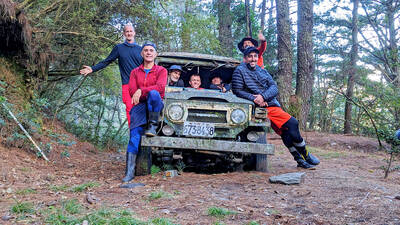
The year was 1991. A Toyota Land Cruiser set out on a 67km journey up the Junda Forest Road (郡大林道) toward an old loggers’ camp, at which point the hikers inside would get out and begin their ascent of Jade Mountain (玉山). Little did they know, they would be the last group of hikers to ever enjoy this shortcut into the mountains. An approaching typhoon soon wiped out the road behind them, trapping the vehicle on the mountain and forever changing the approach to Jade Mountain. THE CONTEMPORARY ROUTE Nowadays, the approach to Jade Mountain from the north side takes an

Last week Joseph Nye, the well-known China scholar, wrote on the Australian Strategic Policy Institute’s website about how war over Taiwan might be averted. He noted that years ago he was on a team that met with then-president Chen Shui-bian (陳水扁), “whose previous ‘unofficial’ visit to the US had caused a crisis in which China fired missiles into the sea and the US deployed carriers off the coast of Taiwan.” Yes, that’s right, mighty Chen caused that crisis all by himself. Neither the US nor the People’s Republic of China (PRC) exercised any agency. Nye then nostalgically invoked the comical specter
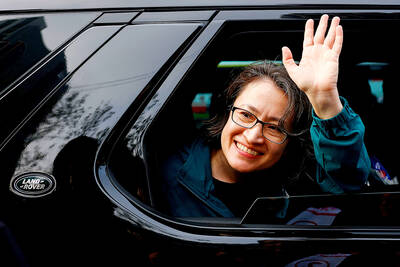
Relations between Taiwan and the Czech Republic have flourished in recent years. However, not everyone is pleased about the growing friendship between the two countries. Last month, an incident involving a Chinese diplomat tailing the car of vice president-elect Hsiao Bi-khim (蕭美琴) in Prague, drew public attention to the People’s Republic of China’s (PRC) operations to undermine Taiwan overseas. The trip was not Hsiao’s first visit to the Central European country. It was meant to be low-key, a chance to meet with local academics and politicians, until her police escort noticed a car was tailing her through the Czech capital. The
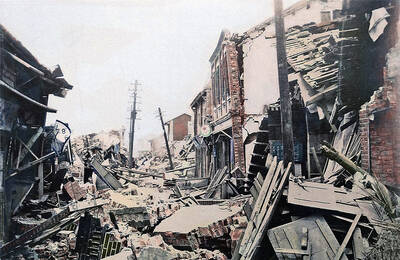
April 15 to April 21 Yang Kui (楊逵) was horrified as he drove past trucks, oxcarts and trolleys loaded with coffins on his way to Tuntzechiao (屯子腳), which he heard had been completely destroyed. The friend he came to check on was safe, but most residents were suffering in the town hit the hardest by the 7.1-magnitude Hsinchu-Taichung Earthquake on April 21, 1935. It remains the deadliest in Taiwan’s recorded history, claiming around 3,300 lives and injuring nearly 12,000. The disaster completely flattened roughly 18,000 houses and damaged countless more. The social activist and


 RSS
RSS