


Over the weekend the Formosa Singers gave audiences at the National Recital Hall a chance to enjoy choral poetry from a variety of different cultures and eras with their concert titled Flower Songs (花之歌).
On Saturday, the Singers filed into the nearly full auditorium (Sunday's concert had been sold out since Friday) and delivered three Latin songs from modern Eastern European composers. The first, Christus est Natus (1997), by Slovenian Damijan Mocnik, went from somber to disconcerting with its intense, chanted harmonies and dissonance. As the lyrics proclaimed the birth of Christ and glory to God in the highest, the music illustrated a bizarrely powerful rather than purely joyful
message.
For one line -- "Hodie in Terra Canunt Angeli" -- the music became a perfect complement to the lyrics. The basses and tenors sang in low monotones to represent the Earth, as the altos and sopranos sang a sweet melody, becoming the angels singing upon the Earth.
The second song, Diffusa est Gratia, by Lithuanian Vytautus Miskinis, was similar to the Mocnik piece but with more varied harmonies. The third song, however, Daemon Irrepit Callidus by Hungarian Gyorgy Orban, was quite different. Telling of the Devil's wiley ways and the temptation of the flesh, this was a fun, wicked-sounding piece with a fast tempo and lots of staccato.
Then came the inspiration for the concert's theme: Three Flower Songs, a set by contemporary US composer Eric Whitacre. These three songs were pure poetry. With textured harmonies and a breathtaking range of volume, the pieces were both expertly conducted by conductor Julian Su (
The choir members came out after the intermission with a spring in their step, the women having traded their black gowns for deep red ones. You could tell they were excited to perform the second half of the concert -- which was all Hakka and Hokkien folk songs -- after paying their dues to modern choral masterpieces during the first half.
They immediately launched into Zhai Cha (摘茶) a Hakka melody about picking tea, during which Atayal Aborigine Zhang Yao-qun (
Tao Hua Kai (桃花開), another Hakka folk song, provided an exuberant contrast to the mournful Zhai Cha, and its catchy melody was probably stuck in the heads of half of the audience for the rest of the night.
Tang Bo Bo, a tune written by Hakka singer Chen Yong-tao (陳永淘) and adapted for a choir by the Formosa Singers' accompanist Tsai Yu-shan (蔡昱姍), was the sweetest melody of the evening.
The remaining six songs were all Hokkien, and the conductor Su, showed off his passion for the language by reading the lyrics aloud before performing several of the pieces.
To someone who did not grow up in Taiwan, these songs were lovely but less memorable than the Hakka tunes or the earlier English and Latin pieces. However, judging from the volume of the applause, they were some of the crowd's favorites.
The best-received song of all, however, was the encore -- Shou Yu Cun (狩俁村). This hand-clapping, foot-stomping, vigorously harmonized Japanese folk song sealed the victory for Formosa Singers.
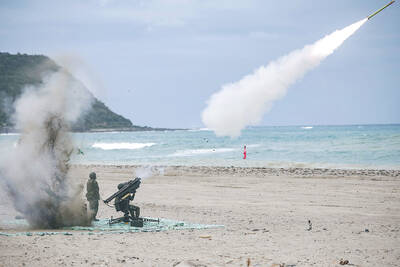
In late October of 1873 the government of Japan decided against sending a military expedition to Korea to force that nation to open trade relations. Across the government supporters of the expedition resigned immediately. The spectacle of revolt by disaffected samurai began to loom over Japanese politics. In January of 1874 disaffected samurai attacked a senior minister in Tokyo. A month later, a group of pro-Korea expedition and anti-foreign elements from Saga prefecture in Kyushu revolted, driven in part by high food prices stemming from poor harvests. Their leader, according to Edward Drea’s classic Japan’s Imperial Army, was a samurai
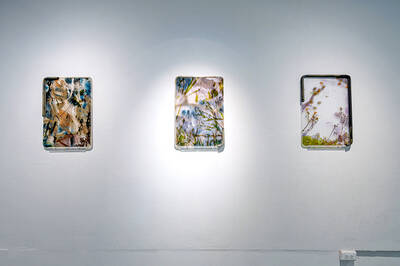
Located down a sideroad in old Wanhua District (萬華區), Waley Art (水谷藝術) has an established reputation for curating some of the more provocative indie art exhibitions in Taipei. And this month is no exception. Beyond the innocuous facade of a shophouse, the full three stories of the gallery space (including the basement) have been taken over by photographs, installation videos and abstract images courtesy of two creatives who hail from the opposite ends of the earth, Taiwan’s Hsu Yi-ting (許懿婷) and Germany’s Benjamin Janzen. “In 2019, I had an art residency in Europe,” Hsu says. “I met Benjamin in the lobby
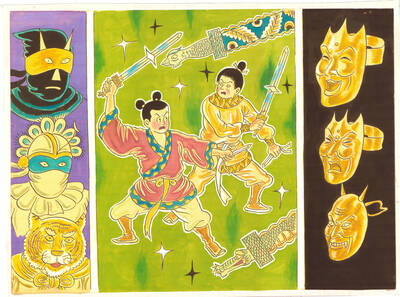
April 22 to April 28 The true identity of the mastermind behind the Demon Gang (魔鬼黨) was undoubtedly on the minds of countless schoolchildren in late 1958. In the days leading up to the big reveal, more than 10,000 guesses were sent to Ta Hwa Publishing Co (大華文化社) for a chance to win prizes. The smash success of the comic series Great Battle Against the Demon Gang (大戰魔鬼黨) came as a surprise to author Yeh Hung-chia (葉宏甲), who had long given up on his dream after being jailed for 10 months in 1947 over political cartoons. Protagonist

Peter Brighton was amazed when he found the giant jackfruit. He had been watching it grow on his farm in far north Queensland, and when it came time to pick it from the tree, it was so heavy it needed two people to do the job. “I was surprised when we cut it off and felt how heavy it was,” he says. “I grabbed it and my wife cut it — couldn’t do it by myself, it took two of us.” Weighing in at 45 kilograms, it is the heaviest jackfruit that Brighton has ever grown on his tropical fruit farm, located


 RSS
RSS