


Search a map of Los Angeles for the neighbourhood of Chavez Ravine and you will search in vain. The hillside community, just a couple of miles or so north of downtown Los Angeles is no more. What was once home to a poor Latino population is today home to the Dodgers baseball stadium, a fire service training center, a lot of dust and not much else.
Chavez Ravine and the community that once kept goats and chickens on the hills of the ravine was bulldozed at the end of the 1950s, its people long-forgotten. But now Ry Cooder, the musician and producer behind the Buena Vista Social Club, the album and film that rejuvenated an ageing generation of Cuban musicians and became the most successful world music record ever, has turned his attention to the lost Mexican community, producing a concept album that combines his own music, Latino songs from the 1940s and 1950s and appearances by some of the forgotten stars of the postwar LA music scene. Binding the music together is a narrative that sets the scene of "a place you don't know, up a road you don't go. Chavez Ravine, where the sidewalk ends."
Cooder's interest in the story was piqued by a series of photographs taken in 1949 by Don Normark, a then 19-year-old photographer who spent that year documenting the immigrant community in Chavez Ravine.

In the destruction of that community and its replacement by an impersonal, corporate piece of land, Cooder sees a precursor of the blight afflicting much of LA and contemporary America.
"The country's been taken," Cooder says. "A neighbourhood was taken in the 1950s by these maniacs who have this superhuman drive for control. It grew and grew and now we have this mall culture where people shop and that's all they do. They shop and drive and make cellphone calls. All at the same time. Is this what society is?"
The story of Chavez Ravine is quintessential LA, from the same file as Roman Polanski's semi-fictional film Chinatown. City authorities identified the area as one of the city's neediest and determined that it should be the recipient of a grandiose public housing project designed by the Austrian architect Richard Neutra.
The city bought out the home owners of Chavez Ravine -- some willingly, others through compulsory purchase -- for US$5,000 each. That the sum was insufficient to buy a home anywhere else only became apparent once the home-owners had moved on. But while they were absent, the city had a change of heart about the fate of Chavez Ravine.
"It was after the war," explains Cooder. "FDR was gone, the New Deal was crumbling and the Republicans set about dismantling all the social programs. And the first thing they wanted to do was public housing. They didn't start with social security, you wouldn't do that, that's bad politics. But it was easy to say that the federal government shouldn't be building houses for poor people. It was asked in the LA Times: why are the taxpayers supposed to subsidize housing for poor Mexicans?"
With the public housing project losing momentum, an alternative plan for the site was raised: to offer it as the home to the New York Dodgers baseball team, who were looking for a new stadium. That alternative offered LA a chance to get one over on its east coast rival, to be host to one of the major national sporting teams and to defeat the threat of public housing.
"To its opponents, public housing was communism," Cooder says. The tussle over Chavez Ravine came at the height of McCarthyism, he says, and the red scare was used as a tactic to halt the public housing plan. The final residents were removed from Chavez Ravine in May 1959; the stadium opened in 1962.
For Cooder the story is a warning, a premonition of the perils of following the mighty gods of progress and development. "Chavez Ravine was always apart because it was up on a hill and rural and poor," he says. "We don't care about poor people and we don't like where they live. They left the poor alone until they needed the property. Once you say they are bad Americans and potentially subversive you can do all you want, you can cut freeways through their communities."
From the fate of Bunker Hill, another area adjacent to downtown that is now only seen in old films, to the loss of innumerable examples of the quirky architecture that so distinguished the city, the havoc wreaked on LA by developers exasperates Cooder. "They knock down the famous coffee shops, and the restaurants that looked like pigs or barrels, which should have been precious heirlooms. The Brown Derby would have been worth a billion dollars if you had kept it but they didn't. How do I hate these people."
The only safe spot for Cooder is the airport, just a few blocks from where he grew up. "I like this airport but this is all that's left. I mean, Jesus Christ, but I'm old. I like the weather, I like the moisture, I like the light in the trees. I'm sad. California was heaven on earth but they fucking ruined it, the bastards."
He has few hopes for the new record, although he is still surprised by the success of the Buena Vista Social Club. "What will the public care about this? They liked Buena Vista, they ought to like this. Ten people should have liked Buena Vista, these old beat-up Cubans. Something clicked. It's free-standing, this album, they're not being asked to buy the Chavez Ravine natural fiber clothing line.
It stands for something that the public ought to be interested in, but I don't know the mind of the public. Do they even know their own mind? Although they're starting to play this in Starbucks and for this I have hope. It's the most focused commercial venue in the world. This is three-and-a-half years of serious work. I say, therefore, we could do business in Starbucks."
The irony of the Seattle-based coffee giant reminding the world of the plight of Chavez Ravine and of urban blight is not lost on Cooder.
His next project is already mapped out, with eight of the songs written. "I started thinking about the white people across town, the factory workers," he says, telling the story of farmers from the Midwest, lured to California by the promise of abundant agriculture, who found jobs in factories building aircraft during the World War II. But then the factories went elsewhere and the workers went jobless.
"Failure of the American dream is the story," he says. "The story of American pop music is the story of failure. The blues, country music, it's not the story of success. People don't win, they lose."
He looks up at a 1940s map of Chavez Ravine. "These songs are brimming with disappointment," he says. "It's terrific."

Last week Joseph Nye, the well-known China scholar, wrote on the Australian Strategic Policy Institute’s website about how war over Taiwan might be averted. He noted that years ago he was on a team that met with then-president Chen Shui-bian (陳水扁), “whose previous ‘unofficial’ visit to the US had caused a crisis in which China fired missiles into the sea and the US deployed carriers off the coast of Taiwan.” Yes, that’s right, mighty Chen caused that crisis all by himself. Neither the US nor the People’s Republic of China (PRC) exercised any agency. Nye then nostalgically invoked the comical specter

Relations between Taiwan and the Czech Republic have flourished in recent years. However, not everyone is pleased about the growing friendship between the two countries. Last month, an incident involving a Chinese diplomat tailing the car of vice president-elect Hsiao Bi-khim (蕭美琴) in Prague, drew public attention to the People’s Republic of China’s (PRC) operations to undermine Taiwan overseas. The trip was not Hsiao’s first visit to the Central European country. It was meant to be low-key, a chance to meet with local academics and politicians, until her police escort noticed a car was tailing her through the Czech capital. The
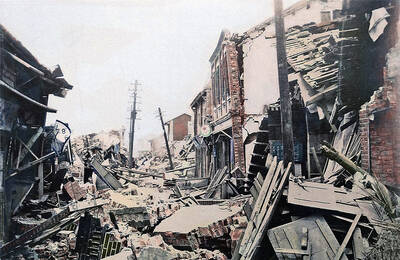
April 15 to April 21 Yang Kui (楊逵) was horrified as he drove past trucks, oxcarts and trolleys loaded with coffins on his way to Tuntzechiao (屯子腳), which he heard had been completely destroyed. The friend he came to check on was safe, but most residents were suffering in the town hit the hardest by the 7.1-magnitude Hsinchu-Taichung Earthquake on April 21, 1935. It remains the deadliest in Taiwan’s recorded history, claiming around 3,300 lives and injuring nearly 12,000. The disaster completely flattened roughly 18,000 houses and damaged countless more. The social activist and

Over the course of former President Ma Ying-jeou’s (馬英九) 11-day trip to China that included a meeting with Chinese Communist Party (CCP) leader Xi Jinping (習近平) a surprising number of people commented that the former president was now “irrelevant.” Upon reflection, it became apparent that these comments were coming from pro-Taiwan, pan-green supporters and they were expressing what they hoped was the case, rather than the reality. Ma’s ideology is so pro-China (read: deep blue) and controversial that many in his own Chinese Nationalist Party (KMT) hope he retires quickly, or at least refrains from speaking on some subjects. Regardless


 RSS
RSS