


The plum rains have come and gone and June's warmth has coaxed the last stubborn buds into full bloom. This weekend the Formosa Singers (
The Formosa Singers, a mixed choir of about 40 members, was remodeled from the Taipei Philharmonic Madrigal Choir in 1995 by conductor Julian Su (
Su, one of Taiwan's top choral conductors, has over 20 years of conducting experience under his belt. After graduating from the Cultural University in 1981 with a major in cello performance, Su's interest soon shifted to choral music. During the years from 1984 to 1991 he took turns conducting the Tamkang Chorus, Hwakang Chorus, the Taipei Philharmonic Chorus, and a group of his own, the Taipei Philharmonic Madrigal Choir (1985).
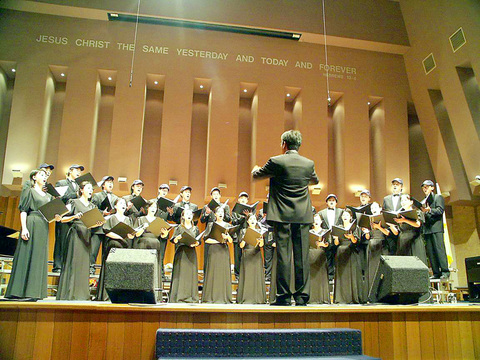
PHOTO COURTESY OF FORMOSA SINGERS
In 1992 Su traveled to New Jersey to attend Westminster Choir College at Rider University. There he studied with famous choral conductor Joseph Flummerfelt. During his final recital for his master's degree, Su conducted a choir singing Taiwanese folk songs that he arranged.
For Su, bringing the songs of Taiwan to the stage is not just about work or interest, it's about identity. He sees it as his duty to prevent the songs beloved by his generation from disappearing.
"In the past, this music was suppressed," Su said. "Perhaps in the future it could disappear." Under Martial Law, the Chinese Nationalist Party (KMT) suppressed native Taiwanese culture and language and non-Mandarin folk songs were banned from the airwaves.
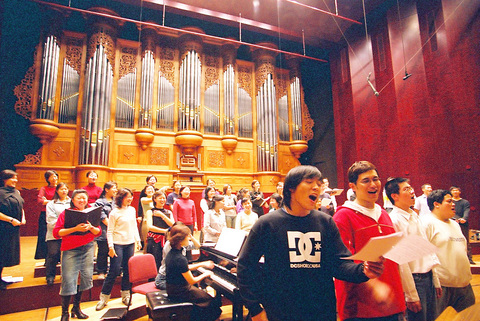
Su said that if the Formosa Singers were not promoting Taiwanese folk songs now, "it will be much more difficult to do in the future. We are the right generation to connect the past to the future."
Not everyone recognizes the importance of singing the old songs, Su said. "Many people think this work is stupid because they do not identify with it."
The most fulfilling moments for Su are when the music changes those people's minds.
In recent years Formosa Singers has toured in Japan and has made two trips to the US, where a large portion of their audience was Taiwanese immigrants.
The reaction among second-generation Taiwanese-Americans who attended the concerts was especially rewarding, Su said.
"They originally didn't identify with the songs because the arrangements they had heard were old and weren't done very well. They didn't realize the songs could sound so good, until they heard the Formosa Singers," Su said.
What made the difference was the creative and skillful arranging of the tunes by Su and by the group's accompanist Tsai Yu-shan (
The folk origins of Formosa Singers' music don't immediately pop out to the ear. The old familiar tunes have become pollished choral pieces with rich four-part harmonies and diverse melodies. Much of the group's repertoire, if it were translated into Latin, would sound much like music you would hear at a European-style Easter concert. On a closer listening, the folk elements can be identified, woven subtly into the harmonies. The most delightful thing about listening to Formosa Singers is the seamless blend of distinctly Chinese melodies with the traditional sound of a Western-style choir.
The group has been honored a number of times with nominations for Golden Melody Awards. Their album Stars Over the Sky (
Su's interest extends beyond the songs of Taiwan to include folk songs from around the world as well as well as some fresh, modern composers. This weekend's lineup will begin with three Latin pieces by Eastern European composers Damijan Mocnik, Vytautas Miskinis and Gyorgy Orban. Next is the inspiration for the concert's theme, Three Flower Songs, by US composer Eric Whitacre. Su chose Whitacre because he was impressed by the composer's ability to create a modern yet pleasing sound.
"The choral scene in America has recently become closed off and has been dominated by Northern European composers," Su said, "but Whitacre is creating music that is popular all over the world."
Whitacre is famous for his emotionally intense and electrifying choral compositions. He composed the a cappella set Three Flower Songs during his formative years at the University of Nevada and dedicated it to his teacher David Weller, who introduced Whitacre to choral music.
Most of the other songs on the lineup were chosen for dealing with the theme of flowers, so as to complement the Whitacre set. Some notable inclusions include two Japanese folk songs arranged by choral conductor Ko Matsushita, who flew to Taiwan to guest conduct the Formosa Singers for a concert in May of last year, as well as several Hokkien and Hakka folk songs arranged by Tsai.
In August, the Formosa Singers will be taking a selection from this weekend's concert to compete in the Takarazuka International Chamber Chorus Contest in Japan.
Event information :
What: Formosa Singers -- Flower Songs
Where: National Recital Hall, 21-1 Zhongshan S Rd, Taipei
(
When: Tomorrow and Sunday, 7:30pm
Tickets: NT$300 to NT$800, available through Artsticket at (02) 3393 9888 or
Formosa Singers at (02) 2746 0739

In late October of 1873 the government of Japan decided against sending a military expedition to Korea to force that nation to open trade relations. Across the government supporters of the expedition resigned immediately. The spectacle of revolt by disaffected samurai began to loom over Japanese politics. In January of 1874 disaffected samurai attacked a senior minister in Tokyo. A month later, a group of pro-Korea expedition and anti-foreign elements from Saga prefecture in Kyushu revolted, driven in part by high food prices stemming from poor harvests. Their leader, according to Edward Drea’s classic Japan’s Imperial Army, was a samurai
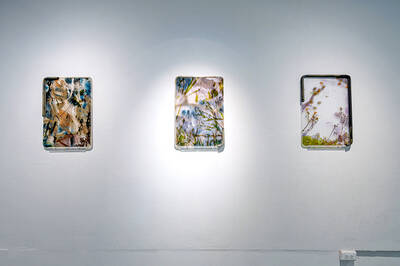
Located down a sideroad in old Wanhua District (萬華區), Waley Art (水谷藝術) has an established reputation for curating some of the more provocative indie art exhibitions in Taipei. And this month is no exception. Beyond the innocuous facade of a shophouse, the full three stories of the gallery space (including the basement) have been taken over by photographs, installation videos and abstract images courtesy of two creatives who hail from the opposite ends of the earth, Taiwan’s Hsu Yi-ting (許懿婷) and Germany’s Benjamin Janzen. “In 2019, I had an art residency in Europe,” Hsu says. “I met Benjamin in the lobby
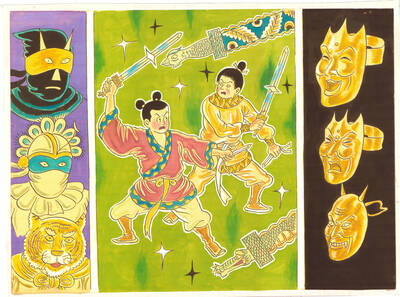
April 22 to April 28 The true identity of the mastermind behind the Demon Gang (魔鬼黨) was undoubtedly on the minds of countless schoolchildren in late 1958. In the days leading up to the big reveal, more than 10,000 guesses were sent to Ta Hwa Publishing Co (大華文化社) for a chance to win prizes. The smash success of the comic series Great Battle Against the Demon Gang (大戰魔鬼黨) came as a surprise to author Yeh Hung-chia (葉宏甲), who had long given up on his dream after being jailed for 10 months in 1947 over political cartoons. Protagonist

Peter Brighton was amazed when he found the giant jackfruit. He had been watching it grow on his farm in far north Queensland, and when it came time to pick it from the tree, it was so heavy it needed two people to do the job. “I was surprised when we cut it off and felt how heavy it was,” he says. “I grabbed it and my wife cut it — couldn’t do it by myself, it took two of us.” Weighing in at 45 kilograms, it is the heaviest jackfruit that Brighton has ever grown on his tropical fruit farm, located


 RSS
RSS