


The idea of flying cars, airmobiles, personal aircraft, skycars or Chuck Berry's New Jersey highway "Flight de Ville" is pretty much as old as powered flight. If only the Wright brothers' Flyer could have been crossed successfully with Henry Ford's Model-T, then the US might have taken collectively to the air around the time of World War I.
It never quite happened this way, and probably just as well. Imagine the number of accidents that might have occurred. Then double, treble or quadruple them. Flying is a science, an art and a skill. Aircraft need to be well-constructed and dutifully maintained.
Pilots must be level-headed when skies around them darken or spin. They must cope with engine failures, seized-up landing gear, winds that hound them off course. They must know where they are, and certainly how high or low they are flying and whether up or down and in what direction.
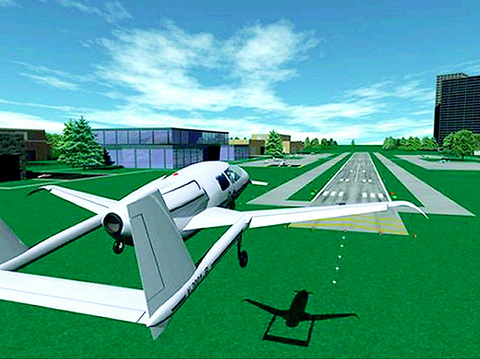
PHOTO: AFP
These things might seem obvious, yet even the most experienced pilot occasionally loses it. Vertigo can strike unexpectedly. Flying through dense banks of dirty clouds can trick the mind's eye when everything looks like nothing and down is up and up down. And what would you do if a block of ice got stuck in your Pitot tube?
Ah, but if you could stretch to a Moller International SkyCar equipped with the latest NASA-developed SATS (Small aircraft transportation system) technology, such scaredy-cat concerns would surely vanish quicker than a Saturn rocket. NASA's "highways in the sky" computer navigation system promises to turn the sci-fi dream of a popular flying car into digital-age reality. Imagine clambering aboard with the nuclear family (or not) into your Ferrari-red Moller, opening the garage door of your Mon Oncle-style home -- by remote control, of course -- pressing a button or two, heading onto the freeway and, Jiminy Cricket, vaulting into the azure blue on trips to Wal-Mart, Dairy Queen and Taco Bell, and back home in time to catch a repeat of the Jetsons without a single hair turning grey in the process.
So when the American magazine Engineer said that a SATS event scheduled earlier this month at Danville Regional Airport, Virginia, might "one day be viewed as one of the most significant milestones in aviation history," it was time to take to the air.
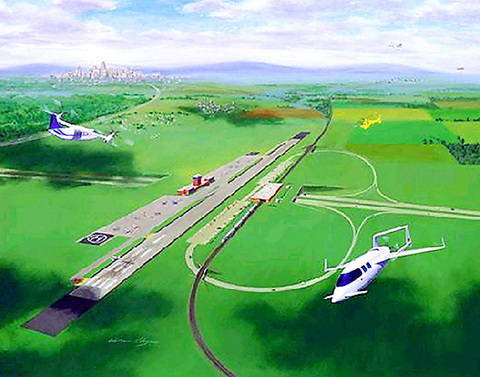
Across the Atlantic, on board a chicken-or-fish jumbo, I studied the Engineer. "SATS uses finely tuned GPS satellite technology", it read, "to allow plane-to-plane communication and provide cockpit displays showing the precise location of every aircraft in a flying zone. It will remove the need for expensive ground-based equipment, and enable large numbers of planes to operate safely around a small airport. SATS also makes it possible for one pilot to operate as safely as two by programming in pre-determined flight paths."
I dreamed happily of weird and wonderful experimental sky cars flying into and out of Danville. And, of zooming about in one aloft in the Confederate sky like some 21st-century rodeo jock. It wasn't exactly like this at Danville. As a retired real estate developer and Cessna pilot -- who had flown himself in for the occasion -- told me, "I don't think we're gonna see these things flying for another quarter-century; I can't figure out whether I think that's a good or a bad thing. Will flying ever be the same when anyone can just get in, turn the key and go anywhere they want?"
Early motorists must have thought much the same thing. Fine when the roads were the plaything of playboys and tomboys at the ship-like steering wheels of thunderous Deusenbergs, Oldsmobiles and Mercer Raceabouts, but what would the roads be like when every Tom, Hank or Sally could afford to drive?
I had to hide my disappointment that there was no Moller SkyCar flying, or waiting to be flown, at Danville. For, whatever the true stage of development of the Moller M400 SkyCar, this is a lovely looking VTOL (Vertical take-off and landing) machine designed, Mercury willing, to take four people on journeys of 750 miles at 315mph, at up to 32,000ft.
To date, though, the prototype can only take to the air when tethered from a tall crane. What if, at this early stage of development, one of the three computers, 24 microprocessors or 25,000 "lines of machine language software code" on board the M400 should fail? Down would come Moller, SkyCar and all.
NASA, meanwhile, has a number of Personal Air Vehicle (PAV) projects on its computer screens, but, to date, none has been built.
Avcen, a London-based aviation company, is developing the Jetpod, a five-seater flying taxi, that, presumably, will be programmed so as to be unable to fly "south of the river" late at night.
I pick up a Moller brochure at Danville. "No traffic, no red lights, no speeding tickets. Just quiet direct transportation from point A to point B in a fraction of the time. Three-dimensional mobility in place of two-dimensional immobility. No matter how you look at it, the automobile is only an interim step on our evolutionary path to independence from gravity. That's all it will ever be."
Yet, there is still, as the experience of Danville proved, a giant step between the reality of an ultra-reliable, faster-than-the- wind Chevy Corvette and a dream-like Moller SkyCar.
Dr Paul Moller, a Canadian-born inventor, engineer and university professor, first took to the sky in an aircraft of his own making in 1966. One meter into the air, to be precise. That was the operational ceiling of the Moller XM-2 flying saucer. The XM-3 of 1968 managed a further 5m. Things were looking up for Moller then, if slowly, yet all I could see looking up from the ground at Danville were familiar Cessnas and Pipers. Not a single SkyCar. No soft whirr of the twin-rotor engines Moller has developed from Outboard Marine Corporation's snowmobile motors, no thrum of seven-bladed, variable speed fans, no demonstration of the emergency parachute system that would see the SkyCar safely down to Earth in the event of engine failure.
Mind you, if such a demonstration had been advertised, as a laconic grandfather in a stetson suggested, personal liability lawyers would have easily outnumbered would-be SkyCar owners at Danville. "They're just waiting for things to go wrong. First accident with a SkyCar and the lawyers will be down on Moller like a pack of hyenas." He tells me that folks tell him that Moller has jetted through three wives and US$250m over the past 40 years, but has yet to get the SkyCar convincingly onto the road or into the sky.
Even if and when SkyCar does fly untethered, will SATS, the computer system it needs to make it an aircraft that anyone can fly after "just two hours' training," really work? I looked in on a number of whizzy computer screen presentations, but as an old-school, seat-of-the pants pilot, I want to look at the sky, stars, cloudscapes, contrails and the Earth dancing around me. I get easily bored with computer screens, and especially so when no one can or will satisfactorily explain how exactly SATS will connect effectively with thousands of SkyCars whizzing about over malls and trailer parks sometime in the next 25 years.
I got the feeling that SATS and personal aircraft fans are like guileless members of some perfectly innocent religious sect. They want to believe that a car can fly, that SATS will perform daily miracles for them.

In late October of 1873 the government of Japan decided against sending a military expedition to Korea to force that nation to open trade relations. Across the government supporters of the expedition resigned immediately. The spectacle of revolt by disaffected samurai began to loom over Japanese politics. In January of 1874 disaffected samurai attacked a senior minister in Tokyo. A month later, a group of pro-Korea expedition and anti-foreign elements from Saga prefecture in Kyushu revolted, driven in part by high food prices stemming from poor harvests. Their leader, according to Edward Drea’s classic Japan’s Imperial Army, was a samurai

Located down a sideroad in old Wanhua District (萬華區), Waley Art (水谷藝術) has an established reputation for curating some of the more provocative indie art exhibitions in Taipei. And this month is no exception. Beyond the innocuous facade of a shophouse, the full three stories of the gallery space (including the basement) have been taken over by photographs, installation videos and abstract images courtesy of two creatives who hail from the opposite ends of the earth, Taiwan’s Hsu Yi-ting (許懿婷) and Germany’s Benjamin Janzen. “In 2019, I had an art residency in Europe,” Hsu says. “I met Benjamin in the lobby

April 22 to April 28 The true identity of the mastermind behind the Demon Gang (魔鬼黨) was undoubtedly on the minds of countless schoolchildren in late 1958. In the days leading up to the big reveal, more than 10,000 guesses were sent to Ta Hwa Publishing Co (大華文化社) for a chance to win prizes. The smash success of the comic series Great Battle Against the Demon Gang (大戰魔鬼黨) came as a surprise to author Yeh Hung-chia (葉宏甲), who had long given up on his dream after being jailed for 10 months in 1947 over political cartoons. Protagonist

Peter Brighton was amazed when he found the giant jackfruit. He had been watching it grow on his farm in far north Queensland, and when it came time to pick it from the tree, it was so heavy it needed two people to do the job. “I was surprised when we cut it off and felt how heavy it was,” he says. “I grabbed it and my wife cut it — couldn’t do it by myself, it took two of us.” Weighing in at 45 kilograms, it is the heaviest jackfruit that Brighton has ever grown on his tropical fruit farm, located


 RSS
RSS