


Deb Ibsen's love affair with motorcycles started early. "I was a tomboy," she said. "I was always attracted to speed. So there was this natural evolution to wanting an `iron horse."'
But her father, a physician who in the emergency room had seen the results of motorcycle accidents, forbade her to ride.
Ibsen would delay pursuing her dream until she hit her 40s and came face to face with her mortality. "Two things happened several years ago," she said. "I had two friends die, and they rode motorcycles. They didn't die riding, but from cancer." Then, during an office visit in which she complained of being overly tired, her doctor tested her for lymphoma -- and she began to think about what she would regret missing in her life if the test came back positive. "I knew I'd kick myself for not doing something I'd always wanted to do," she said.
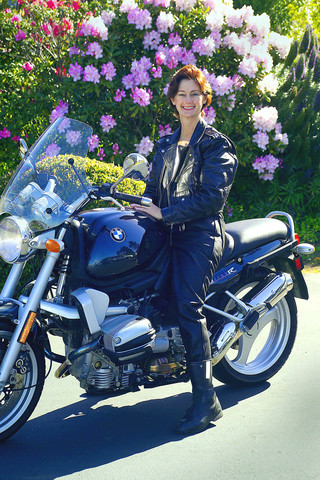
PHOTO: NY TIMES
The test came back negative, and three years later, after "a slow build of courage," she took a motorcycle safety course.
Now, at 49, she often commutes from Kensington, California, a suburb of Berkeley, to San Francisco on her big, graphite gray BMW R1100R and is pondering a cross-country trip with a map of America's back roads strapped to the gas tank. She said: "I heard this quote once that really stuck with me: `Do something every day that scares you a little."'
For a growing number of women and men in their 30s and 40s, motorcycling is continuing to break away from its anti-establishment roots.
"Certainly the image of motorcycling has evolved," said Tim Buche, president of the Motorcycle Industry Council, a trade group based in Irvine, California. "Today, it's the person down the street. It's families who get interested because their children are into off-road bikes."
In the past decade, motorcycle sales in the US have more than tripled, the council said, to 1.04 million last year from 306,000 in 1994. The pace has not been as frenetic in the last five years, but some makers are still reporting double-digit annual sales increases.
Women are behind some of the industry's sales gains. Although women's motorcycle groups like the Motor Maids have been around for many years, women accounted for only about 5 percent of motorcycle sales a decade ago. Now the figure is 10
percent.
Not just for hell's angels
The council has noticed other demographic shifts. In 1985, some 23 percent of owners were "laborers or semi-skilled," according to its statistics. In 2003, that figure was down to 7 percent. By contrast, professionals accounted for 19 percent of buyers in 1985, but 31 percent in 2003.
Some of that change is related to rising prices: A new BMW or Harley-Davidson can cost as much as a new car. But it also has to do with new thinking about motorcycling.
"Many of the stereotypes about motorcyclists have come from popular culture, but in reality doctors, lawyers and professionals have always been riders," said Tom Lindsay, a spokesman for the American Motorcyclist Association. "What helps now is that the more motorcyclists people see on the road, the more they can relate to it as something that might be for them."
Still, there is no denying that motorcycling remains a risky form of transportation. According to statistics compiled by the US National Highway Transportation Safety Administration, there were 3,244 motorcycle fatalities in 2002, up from 2,116 in 1997. On the basis of fatalities per distance traveled, it's roughly 25 times as dangerous to be on a motorcycle as is to ride in a car.
As sales grow, the image of motorcycling has undergone a makeover. Motorcycles have a strong presence in the popular culture -- whether in television shows like American Chopper or in motocross, the racing sport, on television and in video games. And popular traditional manufacturers like Harley-Davidson are also aiming to appeal to new riders.
Shaking it up
Some buyers are exploring exotic or lesser-known brands. Younger riders are being drawn to higher-horsepower sport bikes from makers like Suzuki of Japan and Aprilia of Italy. Other brands, like Moto Guzzi and Ducati, both of Italy, are drawing riders who want to set themselves apart from what has become a common sight in many towns and cities: large groups on Harleys out for an evening ride.
Amy Kraus, 41, of Lansing, Michigan, wasn't drawn to any specific bike until she saw a Moto Guzzi Breva 750 and fell in love with it. "I sat on the bike at a bike show and my husband kept saying, `Honey, it's time to go,'" Kraus said. "I was like `No, I'm OK just right here on this bike.'" A few weeks later she took a Breva for a test ride and within minutes bought a bright red one.
Kraus and her husband, 43, have turned their love of motorcycles into a business. In 2004, they opened the Alpha Training Center in Lansing and began conducting motorcycle safety courses. Kraus' husband also works as a sergeant in the Lansing police force.
The new face of motorcycling has been evident to the couple since they began teaching, Amy Kraus said, noting that 40 percent of their students, on average, are women.
"There used to be a stereotype about women who ride" -- that they were anti-establishment -- Amy Kraus said. "But the women at our classes do all the traditional things women do."
Such infusions of new riders are inspiring companies to cast a wider net for buyers.
BMW and its dealers offered open houses in April to introduce three new bikes, spending heavily on Internet advertising. "We have a real challenge in the industry to appeal to younger riders and to women riders," said Laurence Kuykendall, marketing communications manager at BMW. "We've been depending on `Chapter 2' riders, men who rode in the 1960s and return to the sport as they retire."
To reach out to new buyers, especially women, BMW has lowered seats and narrowed them near the gas tank to make straddling the bike easier. It has also made bikes lighter, and added horsepower to appeal to younger riders. "Cruising around town in groups isn't something that appeals as much to younger riders," he said.

In late October of 1873 the government of Japan decided against sending a military expedition to Korea to force that nation to open trade relations. Across the government supporters of the expedition resigned immediately. The spectacle of revolt by disaffected samurai began to loom over Japanese politics. In January of 1874 disaffected samurai attacked a senior minister in Tokyo. A month later, a group of pro-Korea expedition and anti-foreign elements from Saga prefecture in Kyushu revolted, driven in part by high food prices stemming from poor harvests. Their leader, according to Edward Drea’s classic Japan’s Imperial Army, was a samurai

The following three paragraphs are just some of what the local Chinese-language press is reporting on breathlessly and following every twist and turn with the eagerness of a soap opera fan. For many English-language readers, it probably comes across as incomprehensibly opaque, so bear with me briefly dear reader: To the surprise of many, former pop singer and Democratic Progressive Party (DPP) ex-lawmaker Yu Tien (余天) of the Taiwan Normal Country Promotion Association (TNCPA) at the last minute dropped out of the running for committee chair of the DPP’s New Taipei City chapter, paving the way for DPP legislator Su
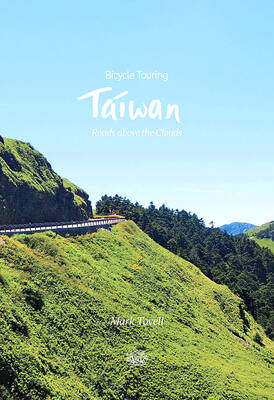
It’s hard to know where to begin with Mark Tovell’s Taiwan: Roads Above the Clouds. Having published a travelogue myself, as well as having contributed to several guidebooks, at first glance Tovell’s book appears to inhabit a middle ground — the kind of hard-to-sell nowheresville publishers detest. Leaf through the pages and you’ll find them suffuse with the purple prose best associated with travel literature: “When the sun is low on a warm, clear morning, and with the heat already rising, we stand at the riverside bike path leading south from Sanxia’s old cobble streets.” Hardly the stuff of your
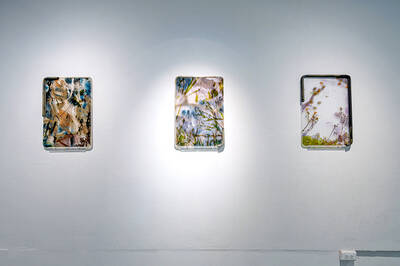
Located down a sideroad in old Wanhua District (萬華區), Waley Art (水谷藝術) has an established reputation for curating some of the more provocative indie art exhibitions in Taipei. And this month is no exception. Beyond the innocuous facade of a shophouse, the full three stories of the gallery space (including the basement) have been taken over by photographs, installation videos and abstract images courtesy of two creatives who hail from the opposite ends of the earth, Taiwan’s Hsu Yi-ting (許懿婷) and Germany’s Benjamin Janzen. “In 2019, I had an art residency in Europe,” Hsu says. “I met Benjamin in the lobby


 RSS
RSS