


Still in his early 40s, Frank Dikotter (
Dikotter grew up near the Dutch border town of Maastricht but moved to Switzerland at the age of 12. His first degree was at the University of Geneva where he majored in Russian and history, with Chinese only as a minor subject. The mid-1980s saw him in China, however, and then in 1987 he moved to the history department at the School of Oriental and African Studies (SOAS) in London University. He has remained there ever since and was made a professor in 2002.
Dikotter first came to Taiwan in 1983 as a young student visiting for a month in the summer. It was his first trip outside Europe. Taiwan was and is exciting, he thinks, because it is simultaneously so different from Europe and yet so global in its interactions. Nowadays he visits almost annually and was a resident scholar at Academia Sinica for three months in 1997.
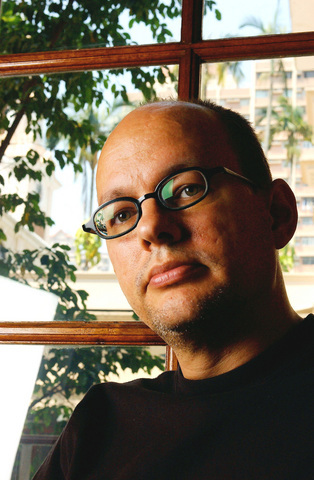
Attention to the historical archives is crucial to Dikotter's method and he is strongly critical of over-arching historical theories.
"Go to the archives and they will tell you many stories," he says. "A rigid insistence on theory will only lead to selective use of evidence. More fruitful is to look for counter-evidence, which can challenge your theory and improve your approach. Once you part company with what the archives have to offer, simplistic theories quickly take over and lead you to misunderstand the past."
This approach has led Dikotter to radical reappraisals of modern Chinese history. The Republican period itself, for instance, has frequently been seen as chaotic, with a weak central government, constant in-fighting and endless social problems, culminating in invasion by Japan. He sees the era very differently. There was a major movement of goods, people and ideas in the period, he says, and on a scale unprecedented in Chinese history. Millions sought work abroad and then returned with foreign perspectives. There was a large upsurge of ideas from abroad on democracy, law and prison reform, for instance, and a diverse array of religions flourished -- Buddhism, Christianity and Japanese Zen practices all grew in this period in China, and representatives of these religious communities established schools, orphanages and universities.
"The suffering of ordinary people in China endured between 1911 and 1949 was minor compared with what they were to experience after 1949 when 30 to 40 million people died as a result of the Great Leap Forward alone," Dikotter says.
Much of the best scholarship on this Republican era in China, he adds, has come from Taiwan.
As for Taiwan itself, its half-century under Japanese rule was more beneficial than China's half-century under the Communist Party has been. Colonialism itself, Dikotter believes, has to be judged on its achievements and failings on the ground in specific cases, and should not be simply damned root-and-branch. Language is a good example. Confucianism in China was wiping out local languages long before the days of Communism. Sinologists point out how the Chinese script enabled people from different regions to understand each other, but they neglect the fact that it also made for the easy obliteration of minority languages. Forcing every scholar to write in Mandarin was the equivalent of making Shakespeare or Montesquieu publish in Latin, he says.
"The one exception is Hong Kong: as residents of a colony, Hong Kong people were able to preserve their language. And Cantonese is not a dialect -- it is a language. Taiwanese, too, is a language, not a dialect," he says. "The difference between a language and a dialect is political, not linguistic: the one-party state is keen to foster the idea that China is one nation by portraying its many languages as dialects to be eliminated."
Diversity
The preservation of diversity is a prime virtue in Frank Dikotter's eyes. After 1949 the Communists, armed with modern technology, drove out linguistic, cultural and religious diversity wherever they could find it, he says.
"As for Chiang Kai-shek (
"Yet China today has still to make giant strides in order to return where it was in 1949 in terms of the rule of law, political plurality, international status, religious freedom, cultural diversity and freedom of speech."
Dikotter's next book will be on material culture, in other words the foreign goods that came into China in the first half of the 20th century. These were not neces-sarily an "imperialist imposition," as has been claimed, but were frequently beneficial, he will argue, because they expanded the choices and opportunities for ordinary people to improve their livelihood. Rubber soles, to give one example, kept feet drier than traditional cotton shoes, and they spread rapidly, becoming available even to relatively poor farmers in the countryside. More goods equaled more variety and more choice. As with languages, Dikotter is a proponent of the blessings of diversity, including those brought about by a choice of goods.
"On the other hand, objects are not always used for the purposes envisaged by their initial producers," he says. "Spectacles, for example, might be perceived as fashionable adjuncts for personal adornment, something to keep off the dust, or an object to create social distance between the wearer and others. Their advantages are no less for that. The appropriation of objects initially associated with the foreign increased cultural diversity, contrary to the popular but misguided notion that globalization leads to cultural uniformity."
As this new book will demonstrate, interiors in early 20th-century China happily mixed landscape paintings, calligraphy scrolls and door leaves with kitsch oil paintings and modern
advertisements: Old and new continuously interacted in ways which may have seemed incongruous to outsiders but seemed perfectly in tune to local people. Ordinary people, moreover, often marveled at things new, whether the camera or the bicycle, and sometimes even viewed them as magic objects: The attribution of magical qualities to material objects was part of a "social cosmology" which animated things with spiritual value. A sense of enchantment characterized the relationship between people and goods, it argues, something which can still be found when walking through popular markets in many parts of Asia today.
Dikotter's most recently published book, Narcotic Culture [reviewed in Taipei Times December 12, 2004], was about opium, arguing that the substance was relatively harmless and had been consumed over a long period in China with official approval. This view goes directly against the usual historical line, both in China and in the West, that the opium trade was a form of exploitation of the Chinese people by marauding Westerners. As so often, Frank Dikotter takes a dissenting view.
"China experts (in Europe and the US) think they're liberal when they approve of governments, such as those of Holland, Switzerland and Germany, moving against the prohibition of drugs today. So how can they simultaneously say the opium trade was harmful 200 years ago? This represents a double standard -- either you're against prohibition or you're not. Besides, there's little evidence to show that opium, consumed in moderate amounts, was in reality harmful.
"In a culture of restraint, opium was an ideal social lubricant, which could be helpful in maintaining decorum and composure, in contrast to alcohol which was believed to lead to socially disruptive modes of behavior," Dikotter argued in his inaugural lecture as professor at SOAS.
"Opium was a culturally privileged intoxicant generally smoked in moderate amounts for recreational and medicinal reasons without any `loss of control.' The medical authorities sought moral authenticity and legal power by transforming it from a folk remedy into a controlled substance which they alone were qualified to administer."
Anti-foucault
Dikotter's implicit hostility to grand theory extends to some famous modern names. He describes his book Sex, Culture, and Modernity in Modern China, for instance, as being "in effect anti-Foucault." The French theoretician Michel Foucault proposed grand moments of historical change, incorporating such things as the "construction of the homosexual" at the end of the 19th century (meaning that medics and others created an idea of homosexuality at that time where none had existed before). The reality on this and other fronts was more complex, Dikotter argues. The new often grows out of the old, he believes, and there are few sudden, melodramatic changes in history.
This approach bears significant fruit when it comes to the study of China. Dikotter argues that Confucian systems of state control were the antecedents of the all-embracing power of the Communist Party. And whereas 1949 did represent an abrupt change in certain ways, in others it reinforced, rather than weakened, the authoritarian lines already established in Chinese society centuries before.
As for contemporary China, Dikotter is deeply skeptical.
Beijing's so-called economic reforms, he believes, were a desperate attempt to sustain the power of the Communist Party. And most Chinese social achievements, so dazzling to some in the West, are mere surface glitter. Meanwhile, huge projects such as the Three Gorges Dam are being under-taken -- "massive and wasteful Stalinist schemes devised by party leaders for their own glory," he claims. Taiwan and Japan, by contrast, have undertaken developments that are more genuinely in tune with the interests of their populations.
This is a typical Dikotter approach: Things centralized and emanating from the state are frequently counterproductive, while those local, diverse and rooted in people's actual needs are usually much more beneficial.
Dikotter's presence at SOAS has attracted generous funding for historical research there via the UK's Research Assessment Exercise, an assessment by the government in which it is essential for departments to get high grades in order to attract further funding.
Frank Dikotter is both a strongly individual mind in his own right, and the representative in China studies of a new phase in the writing of history. With his enthusiasm for Taiwan, his skepticism regarding China, and his belief in the unpredictability of what the archives will reveal, he stands for an anti-dogmatic intellectual freedom that infuriates many but is manna from heaven to many more. Will he one day, then, write about Taiwan?
"I'm a purist," he replies with a smile, clearly aware of the political implications of his words. "My area is China, albeit China in the early 20th century. Seeing that this is the case, why should I write about Taiwan, since it is a different country altogether?"

Last week Joseph Nye, the well-known China scholar, wrote on the Australian Strategic Policy Institute’s website about how war over Taiwan might be averted. He noted that years ago he was on a team that met with then-president Chen Shui-bian (陳水扁), “whose previous ‘unofficial’ visit to the US had caused a crisis in which China fired missiles into the sea and the US deployed carriers off the coast of Taiwan.” Yes, that’s right, mighty Chen caused that crisis all by himself. Neither the US nor the People’s Republic of China (PRC) exercised any agency. Nye then nostalgically invoked the comical specter
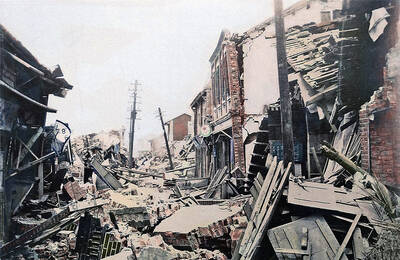
April 15 to April 21 Yang Kui (楊逵) was horrified as he drove past trucks, oxcarts and trolleys loaded with coffins on his way to Tuntzechiao (屯子腳), which he heard had been completely destroyed. The friend he came to check on was safe, but most residents were suffering in the town hit the hardest by the 7.1-magnitude Hsinchu-Taichung Earthquake on April 21, 1935. It remains the deadliest in Taiwan’s recorded history, claiming around 3,300 lives and injuring nearly 12,000. The disaster completely flattened roughly 18,000 houses and damaged countless more. The social activist and

Over the course of former President Ma Ying-jeou’s (馬英九) 11-day trip to China that included a meeting with Chinese Communist Party (CCP) leader Xi Jinping (習近平) a surprising number of people commented that the former president was now “irrelevant.” Upon reflection, it became apparent that these comments were coming from pro-Taiwan, pan-green supporters and they were expressing what they hoped was the case, rather than the reality. Ma’s ideology is so pro-China (read: deep blue) and controversial that many in his own Chinese Nationalist Party (KMT) hope he retires quickly, or at least refrains from speaking on some subjects. Regardless

Approaching her mid-30s, Xiong Yidan reckons that most of her friends are on to their second or even third babies. But Xiong has more than a dozen. There is Lucky, the street dog from Bangkok who jumped into a taxi with her and never left. There is Sophie and Ben, sibling geese, who honk from morning to night. Boop and Pan, both goats, are romantically involved. Dumpling the hedgehog enjoys a belly rub from time to time. The list goes on. Xiong nurtures her brood from her 8,000 square meter farm in Chiang Dao, a mountainous district in northern Thailand’s


 RSS
RSS