


While organically grown produce remains hard to find in many of Taiwan's numerous supermarkets, demand for it is slowly increasing. Fuelled by increased income levels, widespread concerns about health -- especially cancer and fears of other viral and bacterial diseases caused by pesticides -- the nation's consumers are, albeit gradually, beginning to devour more and more organic foodstuffs.
According to the Ministry of Economic Affairs' most recent figures, consumers purchased an estimated NT$1.5 billion of organic foodstuffs in 2003. This is an increase of 75 percent from the 1999 survey, which stated that Taiwan consumers spent only NT$800 million on organic produce.
Taiwan's transition from non-organic to macrobiotic has been slow in comparison to that of other developed nations. A 75 percent increase over four years might look good on paper, but Taiwan still lags far behind others in the production and consumption of organic eatables.
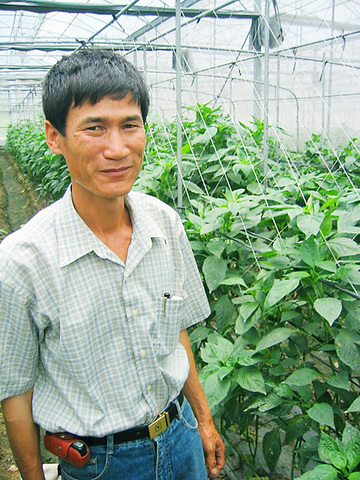
PHOTOS: GAVIN PHIPPS, TAIPEI TIMES
Consumer demand for organic foodstuffs in Japan, the US, Germany, France and the UK has grown by an estimated 20 percent per annum since the mid-1990s. And this figure is estimated to increase by between 25 percent and 35 percent over the coming five years.
It was the Taiwan Provincial Department of Agriculture and Forests -- the forerunner of the Council of Agriculture (COA, 行政院農業委員會) -- that established the nation's first certified organic-farming programs in 1995. Overseen by local District Agriculture Improvement Stations, the total land occupied by the pioneering organic farms amounted to a mere 160 hectares nationwide.
"[Farmers] were never given the incentive to change the way in which they work. Farming has traditionally been about profit. There was never any heart to it, and questions about how going organic could help the farmer, the consumers and the environment rarely arose," said organic farmer Chen Chang-hong (

Organic fruit was the leading crop in the early days. In 1996, a total of 67 hectares of land was used to cultivate organic fruits, while 26.1 hectares was put aside for the farming of vegetables and a mere 5 hectares was employed to produce tea. By 2003, the total area of land on which organic foodstuffs were being cultivated stood at 1,092 hectares and vegetables had become the leading organic cash crop.
"The total area of land used to cultivate organic produce in Taiwan has always been small. Industrial pollution, especially on the west coast, means that farmers cannot easily convert, and land with ground-water pollution means that farmers will possibly never be able to convert," said Liao Chi-i (
It is not only lack of incentives that has stymied organic farming in Taiwan. One of the major stumbling blocks to Taiwan's turning organic has been the consumers themselves. Organically produced foodstuffs, both domestically cultivated and imported, cost on average between 20 percent and 50 percent more than non-organic varieties.
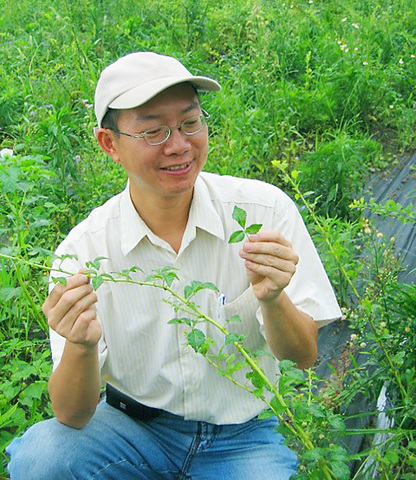
"Right now more people are looking to organic [produce], but there's still a very long way to go before its acceptance is widespread," said Canadian national Pierre Loisel, who tends and owns an organic farm in northern Taiwan. "The market is not mature enough and people are often not willing to pay the price for healthy food that does not contain cancerous pesticides."
The non-use of pesticides might be good for the consumer, but for the farmers it can spell disaster. Organic farmers are forced to produce almost a third more than the quota of non-organic produce in order to ensure that going organic is financially viable.
"The biggest problems effecting farmers are insects. Because pesticides are not used, produce has to be grown indoors else it get destroyed by insects," said Kevin Huang (

According to Huang, the loss of 30 percent of a crop of organic leaf vegetables grown outdoors is considered to be satisfactory loss for organic farmers.
When the nation's organic farmers aren't fending off insects, they are forced to deal with bureaucracy. Inadequacies in the guidelines that govern the certification of organic goods has, in recent years, also been a major stumbling block to the promotion and consumption of organic produce in Taiwan.
Between 1997 and 2000, the District Agricultural Improvement Stations were responsible for inspecting farms and issuing certificates of organic authenticity. There have been several high-profile cases of fraud, however, in which non-organic foodstuffs were mistakenly labeled and certified as "organic" in the early part of 2001.
In response to this, the government
tendered out the rights to certification to five non-government related bodies -- four locally established groups and one overseas group. Consumer trust in these groups as well has waned over the years.
Only last year the Consumers' Foundation released the results of the analysis of 17 samples of supposedly organic vegetables purchased in Taipei markets. Of the samples tested by the foundation, pesticide residue and bacteria-killing dithiocarbamates were present in over half.
Such findings come as no surprise to Loisel, however, as he's long been skeptical of the manner in which certain non-government agencies tasked with certifying organic produce work.
"One problem is that there's no central standard from which these groups work. And the other is that certain farmers simply pay the groups money in order to get the logo and certification," he said. "The
companies will keep doing this so long as the farmers pay for it."
It's not only farmers such as Loisel who are fed up with the slapdash and seemingly dishonest practices of the organic watchdogs and certifiers. As head of Hualien County Government's Agricultural Bureau, Du Li-hwa (
"I think such cases have done quite a lot of damage to the consumer's trust in what is and what isn't organic," she said. "And in so doing it has also hurt the farmers who cultivate genuine organic produce. Once one farmer has been caught cheating, then people will stop trusting all farmers. It's a no-win situation for everybody."
In response to this, the Hualien County Government began its own organic cultivation and certification program last year. As the only county government monitoring its organic farmers and with the legal right to certify their produce, Hualien County Government hopes to set a precedent and in turn cultivate organic products that consumers can trust.
Since the program began last year, the east-coast-county government has managed to persuade 100 local farmers to convert to and adopt organic farming methods. The program, although still in its infancy has already proved hugely successful. Last year's harvest of organic produce in Hualien County weighed in at upwards of 900 tonnes.
"The farmers are now confident having seen that going organic doesn't mean going bust," said Du. "Because they know that they are protected and will have any costs and overheads covered by us, they feel pretty safe."
In order to help farmers like Li Jia-fong (
"Without the backing of the county government, I probably wouldn't have changed. It would have been far too costly to do it on my own," said Li. "I had to install several greenhouses and had to install a groundwater pump. These are overheads that farmers who grow non-organic produce never have."
To ensure that all of the organic farmers in the program are able to sell their produce, the county government established a Web site where customers nationwide can order an array of produce.
Since the site went online late last year, hundreds of thousands of customers have opted to purchase their produce on the Web site. The Web site and program have proven so successful that in the week prior to the 2005 Lunar New Year, a staggering 800,000 people purchased produce cultivated by Hualien's organic farmers.
"The program has proven very popular and we hope that other county governments can learn from our success," said Du. "It would be wonderful to see other areas creating their own organic farming programs, and Taiwan could become a leader in organic farming."

In late October of 1873 the government of Japan decided against sending a military expedition to Korea to force that nation to open trade relations. Across the government supporters of the expedition resigned immediately. The spectacle of revolt by disaffected samurai began to loom over Japanese politics. In January of 1874 disaffected samurai attacked a senior minister in Tokyo. A month later, a group of pro-Korea expedition and anti-foreign elements from Saga prefecture in Kyushu revolted, driven in part by high food prices stemming from poor harvests. Their leader, according to Edward Drea’s classic Japan’s Imperial Army, was a samurai

Located down a sideroad in old Wanhua District (萬華區), Waley Art (水谷藝術) has an established reputation for curating some of the more provocative indie art exhibitions in Taipei. And this month is no exception. Beyond the innocuous facade of a shophouse, the full three stories of the gallery space (including the basement) have been taken over by photographs, installation videos and abstract images courtesy of two creatives who hail from the opposite ends of the earth, Taiwan’s Hsu Yi-ting (許懿婷) and Germany’s Benjamin Janzen. “In 2019, I had an art residency in Europe,” Hsu says. “I met Benjamin in the lobby

April 22 to April 28 The true identity of the mastermind behind the Demon Gang (魔鬼黨) was undoubtedly on the minds of countless schoolchildren in late 1958. In the days leading up to the big reveal, more than 10,000 guesses were sent to Ta Hwa Publishing Co (大華文化社) for a chance to win prizes. The smash success of the comic series Great Battle Against the Demon Gang (大戰魔鬼黨) came as a surprise to author Yeh Hung-chia (葉宏甲), who had long given up on his dream after being jailed for 10 months in 1947 over political cartoons. Protagonist

The following three paragraphs are just some of what the local Chinese-language press is reporting on breathlessly and following every twist and turn with the eagerness of a soap opera fan. For many English-language readers, it probably comes across as incomprehensibly opaque, so bear with me briefly dear reader: To the surprise of many, former pop singer and Democratic Progressive Party (DPP) ex-lawmaker Yu Tien (余天) of the Taiwan Normal Country Promotion Association (TNCPA) at the last minute dropped out of the running for committee chair of the DPP’s New Taipei City chapter, paving the way for DPP legislator Su


 RSS
RSS