


In the back corner of the local supermarket chain store, behind the tissue and toilet paper and adjacent to a rattling freezer full of ice cream, are a half dozen bottles of "grape wine" barely recognizable for the layer of dust that covered them.
That was five years ago. The bottles are still there, but beside them now stand several new bottles from France, Germany, Italy, Australia and a host of other nations -- and these aren't staying on the shelf nearly as long as the dusty originals.
"A big part of the reason wines have started selling well in Taiwan in recent years is because we now have wines that are worth drinking," said Marianni Tsai, head of wine and gourmet foods for Eslite Corporation's line of luxury goods. "If you tried drinking one of those bottles of generic red wine, of course you'd stick to rice wine or beer."
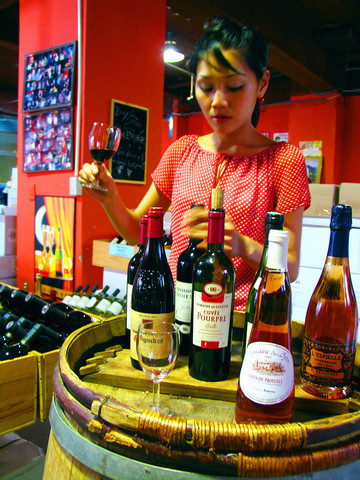
PHOTOS: DAVID MOMPHARD, TAIPEI TIMES
Another reason for wine's increased acceptance, according to her and other sommeliers, is availability. Where there were once few companies importing wine to Taiwan, now there are several. The competition, they say, has driven down prices on a product that used to demand a premium.
"The market is bigger now than Hong Kong," said Gregoire de Boisse, a French national who moved to Taiwan five years ago to open his Sommelier Wine Expert shop. "We say the industry is seven years on the back. Soon it will be much more developed."
De Boisse, who attended a wine university in his native Lyon, came to Taiwan following what he said was one of the biggest wine deals in history: "In 1998 there were 32 million bottles of wine imported here. It was far too much and there was a lot of spoilage and dumping."
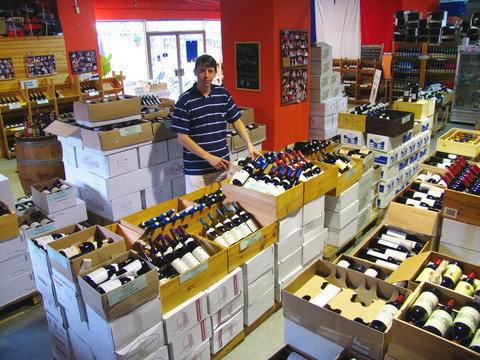
Still, he said, the deal signaled the opening of a new market for vintners and merchants alike. De Boisse now sells an estimated 60,000 bottles a year to hotels, restaurants and a growing list of individual clientele. He points to his stock of some 10,000 bottles of wine from hundreds of vineyards around the world. All of it, he says, will be gone in a few months. While most of the wines de Boisse and Tsai sell are uncorked a short time after they're purchased, both cite a increasing number of customers interested in starting collections.
"When Taiwanese first started becoming wealthy [during the "economic miracle" of the 1980s] cognac became the status-symbol drink," Tsai said. "Now we're seeing more people interested in fine wine and some who are willing to spend serious amounts of money to acquire prized wines."
To protect their investments, Tsai advises storing the bottles in climate-control boxes that protects the wine from fluctuations of temperature and keeps them out of Taiwan's often stifling humidity, which can have harmful effects.
There is also the problem of transportation. Besides temperature
fluctuations and sunlight, heat and vibration are wines' worst enemies.
"All wines are shipped here," de Boisse said. "They spend three weeks at sea in specially insulated containers and, we're told, are kept at a place on the ship where movement is minimal. But it's impossible to control this."
The exception, he said, is Beaujolais nouveau which, if it came by ship, wouldn't be Beaujolais nouveau by the time it arrived.
To celebrate the season of the wine notorious for next-day hangovers, de Boisse throws a party that in the past has been attended by several hundred people. The event is a special edition of the wine parties he throws on a monthly basis for his clients and potential customers interested in learning more about wine and finding wines they like.
"We'll have maybe 120 to 150 attend," he said, "and uncork that many different bottles of wine."
It's the type of event that wine experts and collectors alike encourage newcomers to attend before spending money on wines they may or may not like.
"A lot of people want to buy wines from a certain year because they've heard that it's an excellent vintage," Tsai said. "But it's more important to know what characteristics you enjoy. There are no great wines, only great bottles."
Avoid wine's four biggest enemies: excessive temperature fluctuations, light, heat and vibration.
Tips for tipplers:
◆ Refrigerators are horrible for long-term wine storage. The temperature fluctuates inside a refrigerator (and it's usually too cold), they often vibrate, and the low humidity can make corks dry out. Only put a wine in the refrigerator for a couple of hours before drinking.
◆ Lower-priced wines are styled to provide easy drinking early and usually don't have the concentration or structure to age. As a rule, don't expect reds that cost less than NT$800 to improve for long in the cellar.
◆ The old adage of "red wine with red meat and white wine with white meat" is out. These days, you're more likely to hear people advising to eat what you like and drink what you like. Follow the rules of pairing: Match the weight and texture of the choices, balance intensity, and try to either match flavors or counter them. Red wine with meat is nice because meat stands up to the tannins in red wine. White wine has one thing going for it that reds usually don't: acidity. This zingy, mouthwatering element will counterbalance rich foods and cut through heavy elements.
◆ Your nose knows. Remember that some 75 percent of what we "taste" is actually what we smell. Your taste buds don't understand much besides sweet, sour, bitter and salty.
◆ A particularly fragile or old wine should only be decanted 30 minutes or so before drinking. A younger, more vigorous, full-bodied wine (including whites) can be decanted an hour or more before serving.
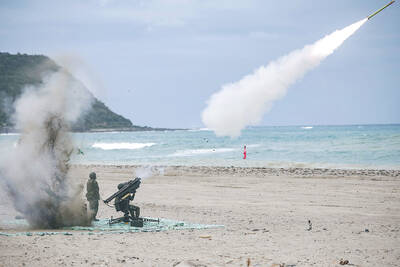
In late October of 1873 the government of Japan decided against sending a military expedition to Korea to force that nation to open trade relations. Across the government supporters of the expedition resigned immediately. The spectacle of revolt by disaffected samurai began to loom over Japanese politics. In January of 1874 disaffected samurai attacked a senior minister in Tokyo. A month later, a group of pro-Korea expedition and anti-foreign elements from Saga prefecture in Kyushu revolted, driven in part by high food prices stemming from poor harvests. Their leader, according to Edward Drea’s classic Japan’s Imperial Army, was a samurai

The following three paragraphs are just some of what the local Chinese-language press is reporting on breathlessly and following every twist and turn with the eagerness of a soap opera fan. For many English-language readers, it probably comes across as incomprehensibly opaque, so bear with me briefly dear reader: To the surprise of many, former pop singer and Democratic Progressive Party (DPP) ex-lawmaker Yu Tien (余天) of the Taiwan Normal Country Promotion Association (TNCPA) at the last minute dropped out of the running for committee chair of the DPP’s New Taipei City chapter, paving the way for DPP legislator Su
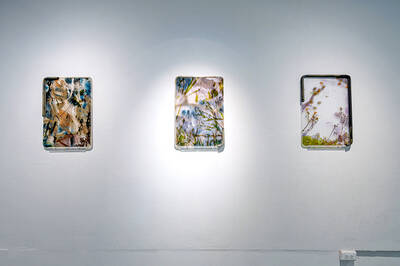
Located down a sideroad in old Wanhua District (萬華區), Waley Art (水谷藝術) has an established reputation for curating some of the more provocative indie art exhibitions in Taipei. And this month is no exception. Beyond the innocuous facade of a shophouse, the full three stories of the gallery space (including the basement) have been taken over by photographs, installation videos and abstract images courtesy of two creatives who hail from the opposite ends of the earth, Taiwan’s Hsu Yi-ting (許懿婷) and Germany’s Benjamin Janzen. “In 2019, I had an art residency in Europe,” Hsu says. “I met Benjamin in the lobby
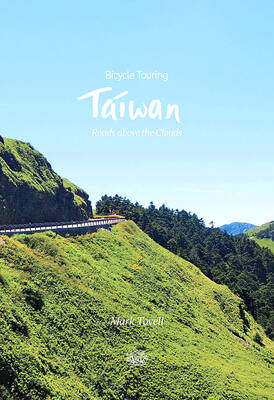
It’s hard to know where to begin with Mark Tovell’s Taiwan: Roads Above the Clouds. Having published a travelogue myself, as well as having contributed to several guidebooks, at first glance Tovell’s book appears to inhabit a middle ground — the kind of hard-to-sell nowheresville publishers detest. Leaf through the pages and you’ll find them suffuse with the purple prose best associated with travel literature: “When the sun is low on a warm, clear morning, and with the heat already rising, we stand at the riverside bike path leading south from Sanxia’s old cobble streets.” Hardly the stuff of your


 RSS
RSS