


During the first week of June 1966, pupils from a middle school in Beijing felt suddenly impelled to declare themselves part of Mao Zedong's (
To make their intentions doubly clear, they added: "We will be brutal."
Then, in a rhetorical flourish which was dangerously close to bourgeois self-regard, they signed themselves "the Red Guard."
The youthful storm troopers of what was more a madness than a movement had acquired a name.
In Mao: The Unknown Story, Jung Chang and Jon Halliday invariably, and with absolute justification, refer to the Cultural Revolution as "the Great Purge."
It so happened that the wrath of the Red Guard was directed against "intellectuals," loosely defined as anyone who had any pretensions to learning. But the method by which they were suppressed -- mass murder usually accompanied by gratuitous torture -- was the same as that which Mao employed whenever he felt it necessary to strengthen his hold over China and its people. His entire life was punctuated with slaughter of such a magnitude that it could only have been ordered by a man who was criminally insane.
Jung Chang and Jon Halliday have not, in the whole of their narrative, a good word to say about Mao. In a normal biography, such an unequivocal denunciation would be both suspect and tedious. But the clear scholarship, and careful notes, of The Unknown Story provoke another reaction. Mao's evil, undoubted and well documented, is unequalled throughout modern history.
He was candid about his megalomania. "Morality," he wrote, "does not have to be defined in relation to others. People like me want to satisfy our hearts to the full."
His heart was satisfied only by the domination of his people, a term which he defined so rigorously that, even when he was indisputable ruler of China, he still wanted to dictate the thoughts of its population to ensure that they never even thought of turning against him. He safeguarded his position by murdering millions of his innocent compatriots.
These days, it is fashionable to point out that Adolf Hitler had redeeming features. He was good with dogs and other people's children. Mao was hateful with everybody -- his women, his wives and his son and daughter.
Jung Chang and Jon Halliday deny him credit for the one episode in his blood-soaked career which, his apologists claim, at least adds an element of heroism to the savage saga: the Long March was a fraud.
After breaking with the Chinese Nationalist Party (KMT), and fearing annihilation by Chiang Kai-shek's (
Accounts of that sort appear on almost every page of The Unknown Story, often describing tens of thousands or even millions of deaths. The purge of autumn 1934 was different only in so much as it preceded Mao's attempt to take 80,000 men and women (and his personal fortune) to north Shaanxi. When he arrived, his army was only 4,000 strong.
The Long March could have been ended almost before it started, had Chiang Kai-shek not given Mao a free passage to safety.
The marchers faced the daunting prospect of four lines of blockhouses. Yet these turned out to be no obstacle at all.
Chiang hoped to win the support of the warlords by convincing them that the Red Army was a threat to their powers. If that threat disappeared, as a result of Mao's annihilation, the debating point disappeared with it. So the Red Army was allowed to pass the blockhouses and over the Xiang river, creating "one of the enduring myths of the 20th century."
The stories of continual slaughter are so horrifically compelling that they enable the reader of The Unknown Story to ignore the problems of its literary style. To be told that "by the beginning of 1948, the Reds controlled 160 million people" would normally provoke questions about who, why and where.
But the narrative moves on to explain that, according to Mao, 10 percent of the population were "kulaks or landlords" and must be eliminated.
"Hundreds of thousands, possibly as many as a million, were killed or driven to suicide." Inelegance loses its importance. The murder goes on, page after page.
Killing became an object in itself. When Mao decided to make the Great Leap Forward, which would allow China "to overtake all capitalist countries in a fairly short time and become one of the richest, most advanced countries in the world," he had no qualms about "driving peasants off the land and into factories," even if the sudden shortage of food meant that "half of China may well have to die." The famine which followed killed 38 million people in four years.
Meanwhile, Mao, with or without the support of the Soviet Union, was attempting to extend his power over neighboring territories. Tibet was first courted, then occupied and subjected to the Great Destruction, an attack on the entire Tibetan culture which resulted in the death of half the adult male population. Mao was so successful in imposing his ideas on North Korea that the country's unofficial poet laureate wrote:
"Kill, kill more. For the farm, good rice and the quick collection of taxes."
Mao died in his bed on Sept. 9, 1976, according to The Unknown Story, unconcerned about his legacy to China and its people. However, "Mao's portrait and his corpse still dominate Tiananmen Square in the heart of the Chinese capital. The communist regime declares itself to be Mao's heir and perpetuates the myth of Mao."
That sentence is the biography's epitaph and, more important, the biographers' stimulus to complete the 10 years of research on which their book is based.
Perhaps "labor of hate" is too strong a term to describe the devotion with which Mao is denounced. The Unknown Story means to inform. Its authors take it for granted that to know Mao is to loathe him.
An 800-page philippic is not an easy read, especially when it is written with such an undiscriminating devotion to detail. But anyone who wants to understand the world should struggle through The Unknown Story. Do not expect to enjoy the experience. It is terrible proof that absolute evil can sometimes triumph.
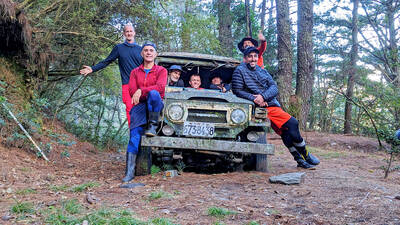
The year was 1991. A Toyota Land Cruiser set out on a 67km journey up the Junda Forest Road (郡大林道) toward an old loggers’ camp, at which point the hikers inside would get out and begin their ascent of Jade Mountain (玉山). Little did they know, they would be the last group of hikers to ever enjoy this shortcut into the mountains. An approaching typhoon soon wiped out the road behind them, trapping the vehicle on the mountain and forever changing the approach to Jade Mountain. THE CONTEMPORARY ROUTE Nowadays, the approach to Jade Mountain from the north side takes an

Last week Joseph Nye, the well-known China scholar, wrote on the Australian Strategic Policy Institute’s website about how war over Taiwan might be averted. He noted that years ago he was on a team that met with then-president Chen Shui-bian (陳水扁), “whose previous ‘unofficial’ visit to the US had caused a crisis in which China fired missiles into the sea and the US deployed carriers off the coast of Taiwan.” Yes, that’s right, mighty Chen caused that crisis all by himself. Neither the US nor the People’s Republic of China (PRC) exercised any agency. Nye then nostalgically invoked the comical specter
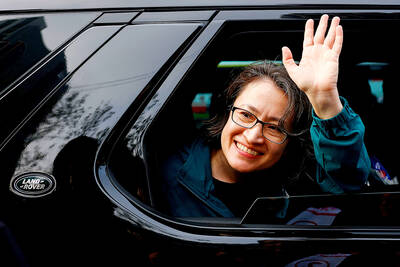
Relations between Taiwan and the Czech Republic have flourished in recent years. However, not everyone is pleased about the growing friendship between the two countries. Last month, an incident involving a Chinese diplomat tailing the car of vice president-elect Hsiao Bi-khim (蕭美琴) in Prague, drew public attention to the People’s Republic of China’s (PRC) operations to undermine Taiwan overseas. The trip was not Hsiao’s first visit to the Central European country. It was meant to be low-key, a chance to meet with local academics and politicians, until her police escort noticed a car was tailing her through the Czech capital. The
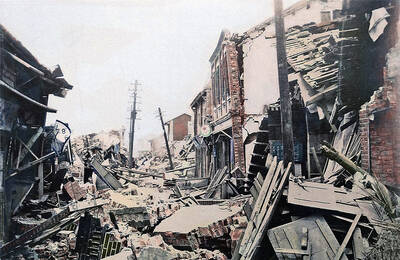
April 15 to April 21 Yang Kui (楊逵) was horrified as he drove past trucks, oxcarts and trolleys loaded with coffins on his way to Tuntzechiao (屯子腳), which he heard had been completely destroyed. The friend he came to check on was safe, but most residents were suffering in the town hit the hardest by the 7.1-magnitude Hsinchu-Taichung Earthquake on April 21, 1935. It remains the deadliest in Taiwan’s recorded history, claiming around 3,300 lives and injuring nearly 12,000. The disaster completely flattened roughly 18,000 houses and damaged countless more. The social activist and


 RSS
RSS