


It's hard to tell if Tongfang Po (
But when you talk to him, it's not hard to tell that Po is the sort of person that invests his whole life into his work.
The Canada-based Taiwanese author spent 12 years researching and writing the 1.5-million-character epic that spans a century and tells the story of three families in Taiwan.
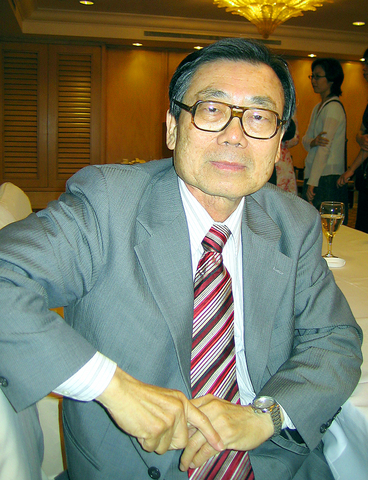
PHOTO: MEREDITH DODGE, TAIPEI TIMES
The central story is based on the life of Dr Cai A-xin (
Po was inspired to write Sand in the Waves when he read Cai's 80-page autobiography in English. A visiting Taiwanese professor at Canada's University of Edmonton, where Po still teaches, first introduced him to Cai's story.
"He wanted to know if anybody would translate [Cai's] biography into Chinese. Many people offered, but in the end they all said they didn't have time," Po said.
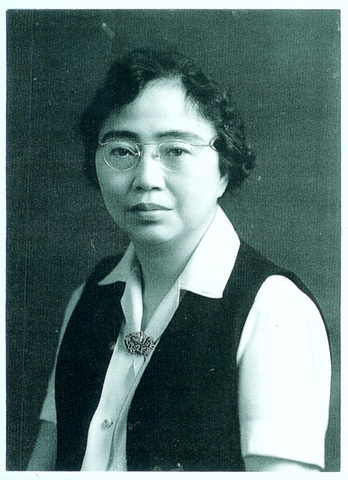
PHOTO COURTESY OF TONGFANG PO
So Po offered to translate the small book into Chinese. (Cai was a Taiwan native, but she received her education in Japanese and English and was not fluent in written Chinese). Little did Po know that this project would take up 12 years of his life.
But he has no regrets.
"The fullest years of my life were the 12 years when I was writing Sand in the Waves. A writer doesn't plan what to write, but rather stumbles upon it."

PHOTO COURTESY OF GREEN-APPLE CO
The calling of writer is also something Po stumbled upon. Like the father of modern Chinese literature, Lu Xun (
Despite his PhD in engineering, Po is the first to champion the importance of literature -- especially in the context of Taiwan. Disgusted by a political climate rife with conflict and chaos, Po sees Taiwanese fiction as a means of national salvation.
"Who is president?" he asked. "If you write well, you are
president."
His distaste for politics is a factor in his writing.
Some people make it a point to get involved in politics, but Po feels that those who find politics butting its way uninvited into their lives are the people worth writing about.
"Hers is a very colorful story, and full of irony," Po said of Cai (her name changed to Qiu Ya-xin in his book).
As if being a Taiwanese woman doctor in an era when feminism had scarcely been invented wasn't difficult enough, Cai suffered from the harsh slings and arrows that plagued Taiwan and its people before, during and after World War II.
A Japanese saying about women says, "The nail that sticks up will be hammered down." Cai, who was educated in Japan, completely ignored these words of conventional wisdom.
Born in 1895 in Taipei, Cai's father died when she was five and her mother, unable to support her, sent her to be raised by another family. That family, however, gave up on the homesick youngster after she kept running back to her mother's house.
Cai's mother remarried, and her new husband doted on the child. He paid for Cai to attend elementary school (in Japanese) and then high school (in English) at the Christian Danshui Girls School, founded by Canadian missionary George Leslie Mackay.
Cai excelled in physics, math and English, and after graduation headed for Tokyo Women's Medical University on the recommendation of her Canadian teachers (but against the wishes of her mother, who was afraid people would talk).
Upon returning to Taiwan in 1921 as a doctor, Cai felt that merely practicing medicine was not enough, so she founded Qingxin Hospital and obstetrics school (
When war broke out, Japan started sending Taiwan's doctors and nurses to Southeast Asia to administer to wounded soldiers. As a result, people stopped enrolling in Cai's school.
With the situation in Taiwan as it was, Cai went to the US and then to Canada to further her education in medicine. One day, she visited the Toronto church that had sent Mackay to Taiwan.
"The people [in the church] embraced her as a daughter and were so happy to see her."
Just then, the news of the Japanese attack Pearl Harbor came.
"Cai fainted, and when she came to, nobody was nice to her anymore."
Due to the war in the Pacific, there was no way for Cai to return to either Taiwan or Japan. She found employment as a doctor in an internment camp for ethnic Japanese in Slocan, British Columbia. Then, when it was discovered that she had no Canadian license to practice medicine, she was thrown out of the camp.
When the war ended and Cai could finally go home, she was barely able to get a visa from Taiwan because her work in the internment camp was seen as treason.
Finally, returning to Taiwan in 1946, Cai faced persecution by the KMT as a Taiwanese intellectual. A marriage of convenience to Canadian Raymond Gibson (and the UK citizenship it provided) spared Cai the fate of many intellectuals in 1947's 228 incident, but caused her to be exiled by the ROC government when Britain recognized the PRC in 1950. Cai lived out the rest of her days in Vancouver.
"This story goes to show you how hard it was for women to do business -- three times harder than for a man," said Po, who laments how undervalued women are in traditional Chinese society.
"There's a saying in Chinese that a daughter equals a thief," said Po, "because parents think that a daughter will cost them much and bring them nothing in return."
When asked if things are any better nowadays, Po replied that they are "much better, but it is still very difficult."
Po is doing his part, though. He pointed, grinning, to the picture of him and his wife inside one of newly printed second-edition volumes of Sand in the Waves: "How great is that -- the woman is in front of the man, not behind him."
The TV series of Sand in the Waves airs on Formosa TV (channel 6) every Saturday and Sunday at 10pm.
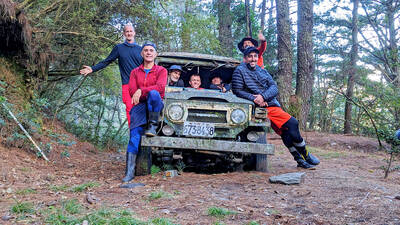
The year was 1991. A Toyota Land Cruiser set out on a 67km journey up the Junda Forest Road (郡大林道) toward an old loggers’ camp, at which point the hikers inside would get out and begin their ascent of Jade Mountain (玉山). Little did they know, they would be the last group of hikers to ever enjoy this shortcut into the mountains. An approaching typhoon soon wiped out the road behind them, trapping the vehicle on the mountain and forever changing the approach to Jade Mountain. THE CONTEMPORARY ROUTE Nowadays, the approach to Jade Mountain from the north side takes an

Last week Joseph Nye, the well-known China scholar, wrote on the Australian Strategic Policy Institute’s website about how war over Taiwan might be averted. He noted that years ago he was on a team that met with then-president Chen Shui-bian (陳水扁), “whose previous ‘unofficial’ visit to the US had caused a crisis in which China fired missiles into the sea and the US deployed carriers off the coast of Taiwan.” Yes, that’s right, mighty Chen caused that crisis all by himself. Neither the US nor the People’s Republic of China (PRC) exercised any agency. Nye then nostalgically invoked the comical specter

Relations between Taiwan and the Czech Republic have flourished in recent years. However, not everyone is pleased about the growing friendship between the two countries. Last month, an incident involving a Chinese diplomat tailing the car of vice president-elect Hsiao Bi-khim (蕭美琴) in Prague, drew public attention to the People’s Republic of China’s (PRC) operations to undermine Taiwan overseas. The trip was not Hsiao’s first visit to the Central European country. It was meant to be low-key, a chance to meet with local academics and politicians, until her police escort noticed a car was tailing her through the Czech capital. The
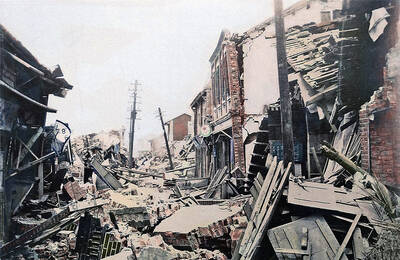
April 15 to April 21 Yang Kui (楊逵) was horrified as he drove past trucks, oxcarts and trolleys loaded with coffins on his way to Tuntzechiao (屯子腳), which he heard had been completely destroyed. The friend he came to check on was safe, but most residents were suffering in the town hit the hardest by the 7.1-magnitude Hsinchu-Taichung Earthquake on April 21, 1935. It remains the deadliest in Taiwan’s recorded history, claiming around 3,300 lives and injuring nearly 12,000. The disaster completely flattened roughly 18,000 houses and damaged countless more. The social activist and


 RSS
RSS